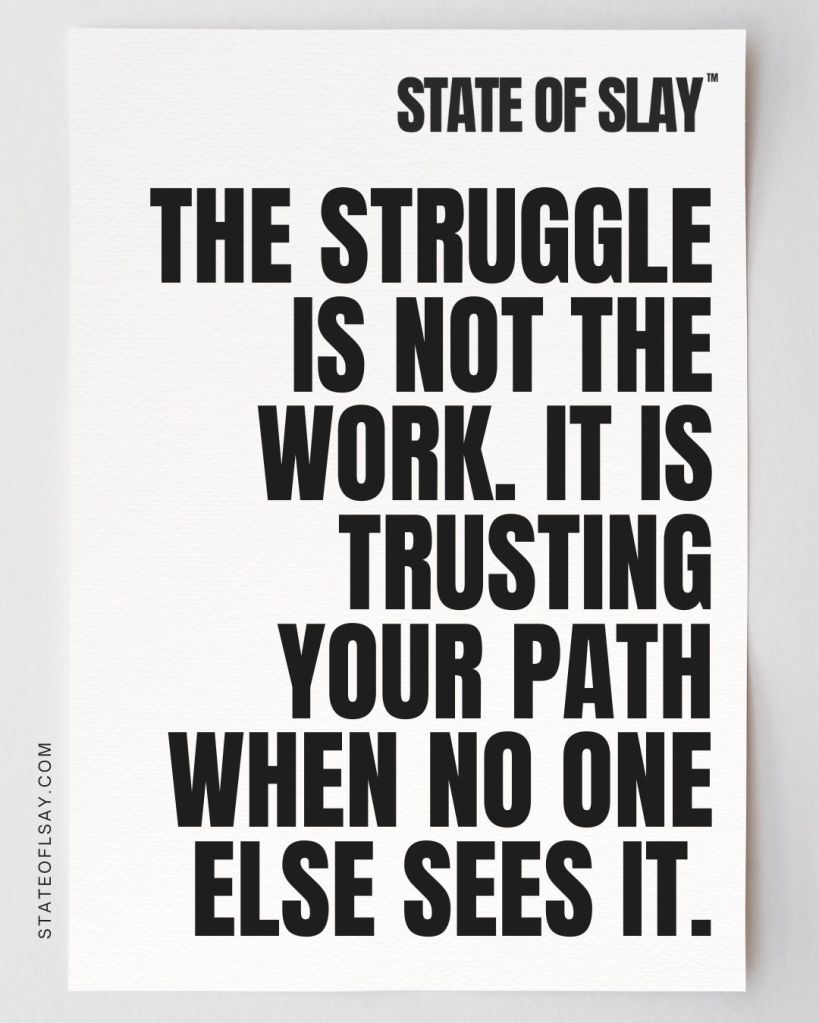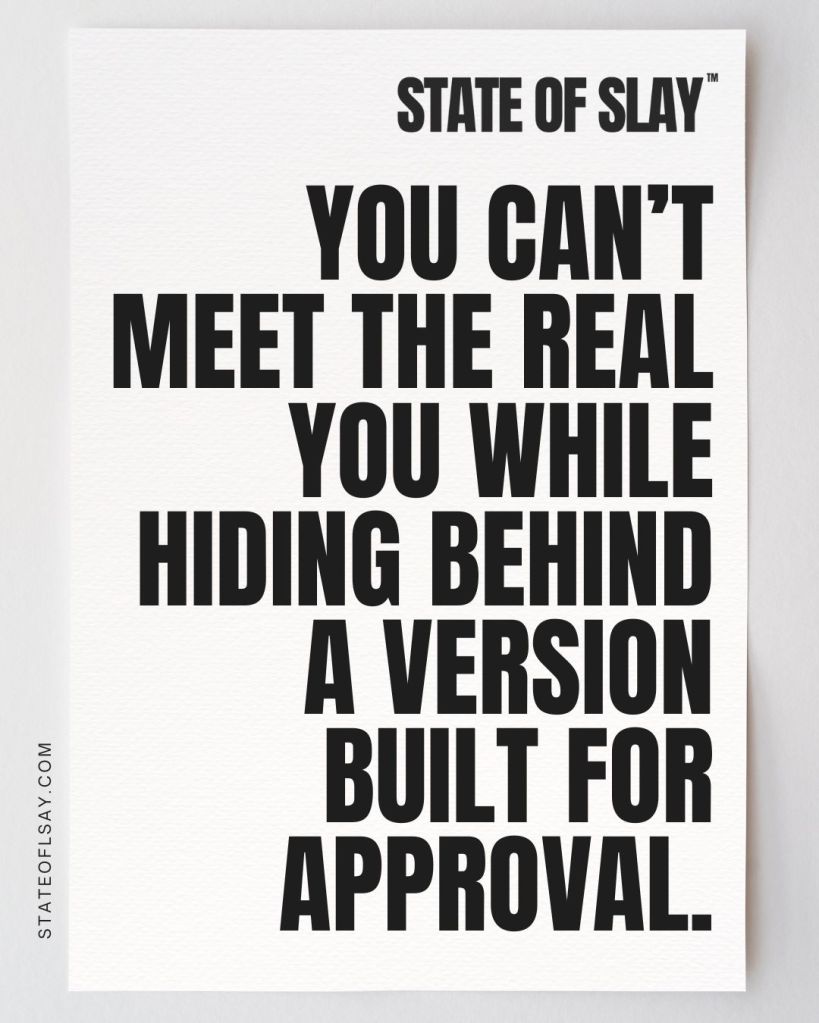
Slay Say

Unearth Your Thriving Self

There’s a version of you that doesn’t live in reaction, exhaustion, or fear.
It’s the version that breathes easier, moves with intention, and believes they deserve peace.

But to meet that version, you have to release the one that’s just getting by. The one that clings to old patterns, familiar chaos, and constant survival mode.

Thriving isn’t something you earn—it’s who you uncover when you stop settling for struggle as your normal.

This is your reminder that your next level of peace, purpose, and power is already within you—waiting to rise.

Slay On!

Your Brain Isn’t Broken, It’s Searching for Safety

There’s a moment in healing when you realize that what you’ve been calling “broken” was really protective.
Those looping thoughts, the anxious spirals, the what-ifs that replay like a broken record — they’re not your brain failing you. They’re your brain trying to keep you safe.

It’s called pattern completion, and it’s one of the ways your mind tries to make sense of the world.
When your brain experiences something painful, confusing, or traumatic, it looks for patterns — familiar situations, similar people, recognizable emotions — and tries to predict what comes next. It’s a survival mechanism, not a flaw.

But survival mode isn’t meant to be a permanent address.


Your Brain Is Trying to Protect You, Not Punish You

When you’re caught in a mental loop — replaying a conversation, worrying about what might happen, or assuming the worst — it’s your brain saying, “I’ve been here before. I know what this felt like last time, so I’ll prepare for it again.”

That’s pattern completion.
It’s your nervous system scanning for danger based on old data.

But here’s the truth: you’re not living that old story anymore.

The brain doesn’t know the difference between memory and reality until you show it.
Every time you ground yourself in the present, take a deep breath, or remind yourself “I’m safe now,” you’re re-educating your mind. You’re teaching it that not every silence means rejection, not every argument means abandonment, not every change means chaos.

You’re not broken — you’re healing an overworked safety system.


Familiar Isn’t Always Safe

One of the hardest truths to accept is that your brain equates familiar with safe, even when familiar hurt you.

That’s why we sometimes repeat relationships that feel eerily similar to the ones that wounded us.
Why we overwork ourselves the way we saw others do.
Why we shrink in moments that ask us to rise.

Your brain is chasing comfort, not happiness.
It’s doing what it knows.
But healing begins when you start showing it something new — when you remind it that safety can look like calm, silence, boundaries, and peace.

At first, that newness will feel uncomfortable. Your brain may resist. It’s not because you’re doing something wrong — it’s because you’re doing something different. And different can feel like danger when you’ve lived in survival mode for too long.


Teach Your Brain a New Way to Be Safe

Rewiring those patterns takes intention, but it’s possible.

Here’s how to start:

  • Notice the loop. When your thoughts start spiraling, pause. Label it. “This is my brain trying to complete an old pattern.”
  • Ground yourself in the present. Look around. Name five things you see, four you can touch, three you can hear. Tell yourself, “This is now, not then.”
  • Reassure your nervous system. Speak gently to yourself. “I’m safe. I don’t need to fight, flee, or freeze right now.”
  • Replace fear with truth. Ask, “What is real in this moment?” That question alone can shift everything.

Over time, your brain learns.
It starts to trust that you’re no longer in danger — that you’re the safe place now.

And that’s when healing becomes your new pattern.


You’re the Safety You’ve Been Searching For

The next time your mind replays an old fear, remember this:
You’re not back there. You’re right here.
You’ve survived everything that tried to break you — and now, you get to teach your brain what safety truly feels like.

Because your brain isn’t broken. It’s learning a new language — one called peace.


SLAY Reflection

  1. What thought patterns or worries tend to repeat for you?
  2. When you feel triggered, can you pause and remind yourself, “I’m safe now”?
  3. How can you show your brain a new version of safety today?
  4. What familiar behaviors are you ready to release, even if they once made you feel “safe”?
  5. How can you speak to yourself with compassion when old fears resurface?

S – Stop labeling your survival instincts as flaws
L – Learn to identify when your mind is replaying old fears
A – Align your thoughts with the truth of the present moment
Y – Yield to peace; you’re safe now


Call to Action: Join the Conversation

I’d love to hear from you.
What’s one pattern your brain keeps replaying — and how are you learning to rewrite it?
Share your story in the comments. Let’s cheer each other on.

And if you know someone who’s been hard on themselves for how they think or feel, send this to them.
Sometimes, all we need is a reminder: we’re not broken — we’re healing.

Slay Say

Rewrite Your Power

Healing isn’t about pretending the pain never happened. It’s about refusing to let it be the only story you tell.

When we stop replaying the moments that broke us and start focusing on the strength that carried us through, we shift from surviving to rising.

Each time you choose peace over the past, you rewrite your power.

This is your reminder that your story isn’t over—it’s evolving.
Let the next chapter be the one where you heal out loud.

Slay on!

Pressure Is a Privilege

There’s a saying I’ve always loved: pressure is a privilege.

At first, it can sound like something only the ultra-successful would say—like a line meant for athletes, CEOs, or overachievers. But the truth is, pressure exists wherever there’s potential.

Pressure means someone believes in you.
Pressure means you’ve earned responsibility.
Pressure means you’ve shown you can handle something worth doing.

It’s not punishment—it’s purpose in disguise.


The Weight of Expectation

When life starts demanding more of us, our instinct is often to push back. We say things like:

  • “Why is this so hard?”
  • “Why does everyone expect me to have it all together?”
  • “Can’t I just have one easy day?”

But those expectations—those moments that make us sweat and doubt and question—are actually markers of growth.

If no one expected anything of you, it would mean no one believed in your ability to rise. Pressure is often the shadow side of opportunity.

We tend to see only the strain, but pressure exists because something inside you is ready to expand.

The next chapter of your life is pressing on the walls of your comfort zone, asking to be born.


From Fear to Fuel

Pressure can crush you if you let it. But it can also create diamonds.

It all depends on how you see it.

When you frame pressure as a burden, it feels heavy, suffocating, endless. But when you frame it as privilege—as proof that something meaningful is unfolding—you stop resisting and start responding.

Think of it this way:

  • Pressure is proof that you’re trusted.
  • Pressure is proof that you’re capable.
  • Pressure is proof that you’re in the game.

When the moment feels too big, remember: you wouldn’t be under this much pressure if you weren’t meant to handle it.

You’ve already proven something powerful just by being here.


Perfection vs. Purpose

Many of us crumble under pressure not because we’re incapable—but because we confuse pressure with perfection.

We think pressure means we can’t fail. That we must perform flawlessly. That we’re being watched and judged.

But pressure isn’t about being perfect—it’s about being present.

The people who thrive under pressure aren’t superhuman. They’ve just learned how to focus on progress over perfection.

When you stop chasing flawless and start chasing faithful, something shifts. You stop trying to prove and start showing up.

That’s where true resilience is built—not in trying to please everyone, but in doing your best with what’s in front of you, even when it’s hard.


Pressure Builds Strength

The first time you lift a weight, it feels impossible. Your muscles shake. Your body resists. But over time, that same pressure builds strength.

Emotional pressure works the same way.

Every time you stand in discomfort—face the meeting, have the hard conversation, take the next step when you’re terrified—you grow.

Each moment of pressure becomes a training ground for your next level.

So instead of asking “Why is this happening to me?”, start asking “What is this building in me?”

Because if you let it, pressure will make you powerful.


Reframing the Privilege

Think about this: if no one ever challenged you, you’d never know how capable you are.

Pressure doesn’t show up when you’re weak—it arrives when you’re strong enough to handle it.

That’s why it’s a privilege.

Pressure says, “You’ve proven you can do hard things.”
It says, “You’ve earned the right to grow.”
It says, “You matter enough for this to matter.”

And when you start to see pressure that way, something beautiful happens—you stop fearing it. You start welcoming it. You realize that pressure isn’t trying to destroy you; it’s trying to develop you.

That’s the difference between breaking down and breaking through.


How to Handle Pressure with Grace

Here are a few ways to turn pressure into power:

  1. Pause Before You React
    When pressure hits, don’t spiral. Breathe. Re-center. Respond from clarity, not panic.
  2. Shift Your Perspective
    Ask: “What is this moment trying to teach me?” Instead of resisting, get curious.
  3. Release Perfection
    You don’t need to ace every test. You just need to show up—consistently, courageously, honestly.
  4. Find Gratitude in Growth
    Pressure means you’re trusted with something meaningful. That’s worth being grateful for.
  5. Remember: You’ve Done Hard Things Before
    You’ve survived every pressure moment that came before this one. This, too, will become proof of your strength.

When Pressure Feels Like Too Much

There will be days when you’ll want to quit—when pressure doesn’t feel like privilege at all.

On those days, it’s okay to step back. Rest. Breathe. Ask for help. Privilege doesn’t mean perfection; it means participation. You’re allowed to pause without giving up.

Just don’t confuse taking a break with backing down. Even resting is part of rising.

You’re building endurance, not just achievement. You’re learning to carry the weight without losing yourself underneath it.


SLAY Reflection

  1. How do you usually react when you feel pressure?
  2. What opportunities in your life right now are disguised as pressure?
  3. What story do you tell yourself when expectations rise?
  4. How might seeing pressure as privilege change how you show up?
  5. What’s one way you can turn current pressure into personal power?

S – Stop seeing pressure as punishment
L – Let it teach you instead of crush you
A – Align your energy with purpose, not perfection
Y – Yield to growth—pressure is proof you’re evolving


Call to Action: Join the Conversation

I’d love to hear from you.
How has pressure shaped you into who you are today?
Share your story in the comments. Let’s cheer each other on.

And if you know someone feeling overwhelmed by the weight of expectations, send this to them.
Sometimes, all we need is a reminder that the pressure we feel is the privilege of becoming more.

Slay Say

Own Your Part Without Passing the Pain

True growth isn’t about being perfect—it’s about being accountable. It’s recognizing when you’ve hurt someone and taking ownership of it without turning the spotlight or the blame back on them.

Maturity is the ability to sit with discomfort long enough to say, “I was wrong,” without needing to defend, deflect, or explain it away.

This is your reminder that healing doesn’t come from shifting the blame—it comes from standing in your truth with grace.

Slay On!

Forgive Yourself Every Night Before You Go to Sleep

Every night before your head hits the pillow, there’s one thing that can change the way you wake up tomorrow: forgiveness—not for others, but for yourself.

We talk a lot about self-care, gratitude, and mindfulness, but one of the most overlooked forms of healing is this quiet ritual of release. When you forgive yourself every night, you unclench the weight of the day, you clear the emotional noise, and you give your heart permission to rest.

Because here’s the truth: you can’t rest when you’re still at war with yourself.


The Weight We Carry Into the Night

How often do you crawl into bed replaying every word you said, every mistake you made, every little thing you should have done differently?

Your mind spins on an endless loop:
Why did I say that?
Why didn’t I do more?
Why can’t I just get it right?

Those thoughts are heavy. They pull you out of the present and anchor you in regret. And when you carry that energy into your dreams, it lingers into the next morning—starting the new day with yesterday’s shame.

That’s how cycles of guilt are built. Not because we did something terrible, but because we refused to put it down.

But the day is over. You did your best with what you knew, what you had, and who you were in that moment. You can’t go back, but you can choose peace before you go to sleep.


Forgiveness Is a Form of Self-Respect

Forgiving yourself doesn’t mean excusing bad behavior or ignoring accountability. It means acknowledging your humanity and allowing growth to take the place of punishment.

We often confuse self-forgiveness with self-indulgence. We think, If I let myself off the hook, I’ll never change. But that’s not true.

Guilt keeps you stuck. Forgiveness moves you forward.

Every night when you lie down, ask yourself:

  • Did I show up the best I could today?
  • What did I learn?
  • What do I want to do differently tomorrow?

Then, forgive yourself for the rest.

You’re not weak for forgiving yourself. You’re wise for not wasting time punishing someone who’s already trying to do better.


Release Before Rest

Sleep is meant to restore you, not punish you. It’s where your body repairs, your mind resets, and your spirit reconnects. But it can’t do that if you go to bed clenched in self-criticism.

Imagine physically setting down the baggage of the day at the edge of your bed.
The argument you had? Set it down.
The missed opportunity? Set it down.
The thing you said you wish you hadn’t? Set it down.

You can pick up the lessons tomorrow—but tonight, give yourself rest.

Peace is not found by overanalyzing the past. It’s found by releasing it.


How to Forgive Yourself Every Night

  1. Reflect, don’t ruminate.
    Take a few moments before bed to think through your day. Reflection asks, What did I learn? Rumination asks, What’s wrong with me? Choose the first.
  2. Speak gently to yourself.
    Replace self-criticism with compassion. Try saying:
    “I did my best today. Tomorrow, I’ll do better.”
  3. Write it out.
    Journaling before bed helps move thoughts out of your head and onto paper. Once they’re out, they lose their power.
  4. Breathe it out.
    Take a deep breath in for forgiveness. Exhale guilt. Repeat until your body starts to relax.
  5. End with gratitude.
    Thank yourself for showing up, for trying, for learning, for still being here. Gratitude and guilt can’t coexist—choose gratitude.

The Morning After Forgiveness

When you forgive yourself before you sleep, you wake lighter.
Your morning thoughts aren’t filled with shame; they’re filled with clarity.

You’re able to meet the new day without dragging the weight of the old one. You think more clearly, speak more kindly, and move more confidently.

Forgiving yourself isn’t just a nighttime ritual—it’s an act of emotional hygiene. You’re clearing out what no longer serves you so your soul can breathe again.


The Truth About Growth

You will make mistakes. You will say the wrong thing, choose the wrong person, take the wrong path. That’s part of being human.

But every day, you’re also learning, evolving, and becoming.

The goal isn’t to be flawless—it’s to be free.

Free from the grip of guilt.
Free from the noise of self-judgment.
Free from believing you’re not worthy of forgiveness.

Because you are. Always have been.


SLAY Reflection

  1. What do you still carry from your day that deserves to be released?
  2. How do you usually talk to yourself before bed—are you kind or critical?
  3. What would it feel like to go to sleep at peace with yourself?
  4. Can you name one thing you’re proud of today?
  5. How can you forgive yourself tonight for simply being human?

S – Stop punishing yourself for being imperfect
L – Let go of the day before you close your eyes
A – Accept your mistakes as part of your becoming
Y – Yield to peace instead of guilt before you rest


Call to Action: Join the Conversation

I’d love to hear from you.
What changes when you forgive yourself before you go to sleep?
Share your story in the comments. Let’s cheer each other on.

And if you know someone who lies awake replaying their day, send this to them.
Sometimes, all we need is a reminder that peace begins with forgiveness.

Slay Say

Let Failure Guide You, Not Define You

Failure is inevitable—but how we interpret it determines what it becomes. When we see failure as proof that we’re not enough, it defeats us. But when we see it as guidance, it strengthens us.

Every misstep offers direction. Every setback points toward growth. The path may not look how you imagined, but it’s still leading you somewhere valuable.

This is your reminder that the detour is not the end of the road. It’s the map showing you another way forward.

SLAY on!

Tell Your Brain the Kind of Day You’re Going to Have

Have you ever noticed how your mornings set the tone for everything that follows? The moment you wake up, before your feet even hit the floor, your brain is already scanning for cues about what kind of day it’s going to be. And here’s the truth: what you tell your brain, your brain will look for.

That means if you wake up thinking, Ugh, this is going to be a hard day, your brain will search for every piece of evidence to confirm it. If you start the day with, I’m choosing peace today, your brain will find moments to validate that choice.

Your mindset is like a compass—point it in one direction, and your day will naturally start aligning with it. The question is, are you pointing it toward chaos or calm? Toward frustration or gratitude? Toward fear or courage?


Your Brain Believes What You Feed It

Here’s what’s fascinating: our brains are designed with something called the reticular activating system (RAS). It acts like a filter, deciding what gets your attention. When you tell your brain to focus on something—whether consciously or unconsciously—it scans your environment to find it.

Think of it like when you buy a new car, and suddenly you start seeing that same make and model everywhere. It’s not that the cars weren’t there before—it’s that your brain is now wired to notice them.

Your thoughts work the same way.

If you tell yourself, This meeting is going to be a disaster, your brain will notice every sigh, every side-eye, and every awkward silence. If you tell yourself, I can handle this with grace, your brain will pick up on the support, the nods, the opportunities to speak with confidence.

This is why starting your day with intentional thoughts is so powerful. Your brain is always listening.


The Power of Morning Scripts

The way you script your morning can shift everything. Here are some examples:

  • Instead of: Today’s going to be so stressful.
    Try: Today I’m choosing peace, no matter what comes my way.
  • Instead of: I’m so tired, this day is going to drag.
    Try: I have enough energy to handle what matters most today.
  • Instead of: Nobody respects me at work.
    Try: I respect myself, and I show up in a way that earns respect.

These aren’t empty affirmations. They are instructions for your brain. And when your brain has instructions, it follows them.


Frustration, Stress, and the Choice We Overlook

Life is going to throw things at you—that’s not optional. Someone cuts you off in traffic, a coworker sends a passive-aggressive email, your plans get derailed.

But here’s the key: those external things don’t decide the quality of your day. You do.

The outside world can invite you to be upset, but you are the one who accepts or declines that invitation.

When you catch yourself spiraling into negativity, pause and ask:
What did I just tell my brain about this moment? Did I tell it to look for the worst, or did I give it something else to notice?

It’s in those pauses that power lives.


Rewiring Takes Practice

If you’ve spent years waking up dreading the day or rehearsing worst-case scenarios, it’s going to take practice to redirect that thought pattern. And that’s okay.

Every time you catch yourself choosing the old script—This is going to be awful—and instead replace it with a new one—I’ve handled worse, and I will handle this too—you are literally rewiring your brain.

The more you do it, the easier it gets. Eventually, your default setting changes. Instead of your brain scanning for stress, it starts scanning for strength. Instead of looking for failure, it starts looking for possibility.


Tell Your Brain Where to Go

Think of your brain like a GPS. If you program it with the wrong address, you’ll end up somewhere you don’t want to be. But when you give it the right directions, it will get you closer to where you want to go.

So before you argue with someone, before you step into that meeting, before you check your email—set the address.

Tell your brain:

  • I’m going to stay calm.
  • I’m going to choose compassion.
  • I’m going to focus on solutions, not problems.

And watch how your day reroutes to align with it.


SLAY Reflection

  1. What’s the first thought you usually have when you wake up? Does it serve you or sabotage you?
  2. How often do you give your brain negative instructions without realizing it?
  3. What would it feel like to intentionally start your day with a thought that empowers you?
  4. When was the last time you caught yourself spiraling, and what did you do to redirect it?
  5. What’s one phrase you can start telling yourself tomorrow morning to shift your entire day?

S – Script your mornings with intentional thoughts
L – Let your brain look for evidence that supports your peace
A – Align your mindset with the day you want to create
Y – Yield to positivity and refuse to accept the invitation to chaos


Call to Action: Join the Conversation

I’d love to hear from you.
What’s the phrase you tell yourself that shifts the entire direction of your day?
Share your story in the comments. Let’s cheer each other on.

And if you know someone who’s stuck in negative loops, send this to them.
Sometimes, all we need is a reminder that our brains believe what we tell them.

Slay Say

Speak Even If Not Everyone Listens

Not everyone will understand your truth. Some may dismiss it, ignore it, or even resist it. But that doesn’t mean your voice has no value.

Your words will find their way to the ones who are ready to hear them, the ones who need the reminder, the encouragement, or the strength your voice carries.

This is your reminder that silence serves no one. Keep speaking. Keep sharing. Your voice will reach the hearts it was meant for.

Slay on!

Frustration Is an Invitation You Don’t Have to Accept

We all know the feeling—traffic that doesn’t move, a conversation that goes sideways, a plan that unravels in real time. Frustration builds, and before you know it, you’re simmering in anger, irritation, or resentment.

But here’s the truth that changed everything for me: frustration is always self-induced.

The outside world can invite us to be upset, yes—but we are the ones who accept the invitation.

When I first heard this idea, I bristled. Surely the rude driver, the unfair boss, the inattentive friend—they were the source of my frustration. But as I dug deeper, I realized the common denominator in every moment of anger was me. I was the one choosing to hold onto the irritation, the one letting it hijack my energy, the one letting the external world dictate my internal peace.

And that was the moment I understood: I can’t always control what happens, but I can always control whether or not I RSVP to frustration’s invitation.


The Hidden Cost of Accepting the Invitation

Frustration feels powerful in the moment. It gives us something to cling to, a sense of being “right,” or even righteous. But that power is fleeting, and the cost is high.

Every time we accept frustration’s invitation, we:

  • Drain our energy on things that don’t serve us.
  • Poison our mood, often for hours or days after the fact.
  • Damage relationships by reacting instead of responding.
  • Distract ourselves from solutions by obsessing over problems.

When I look back at my own life, I see how many days I lost this way—days spent stewing instead of living, days consumed by anger that did nothing but make me miserable. And all of it was preventable.

The truth? Frustration doesn’t come from what happened. It comes from the story we tell ourselves about what happened.


Pause Before You RSVP

The good news is that frustration is optional. Just because you’re invited doesn’t mean you have to attend.

Here’s what I practice today:

  1. Notice the rise. That heat in my chest, that quickening of my thoughts—I know frustration is knocking.
  2. Ask: Is this worth my peace? Nine times out of ten, the answer is no.
  3. Choose my response. Instead of spiraling, I take a breath. Sometimes I literally step away. Sometimes I laugh at how small the trigger really is. Sometimes I pray.
  4. Reframe. Instead of “Why is this happening to me?” I ask, “What is this showing me?” That shift turns frustration into information.

When I don’t RSVP to the invitation, I keep my power. I keep my peace. And I remember: the world doesn’t get to run my emotions—I do.


Frustration Reveals What We Value

Here’s the part most people miss: frustration isn’t all bad. It’s actually a teacher, if we’re willing to listen.

Frustration shows us what matters to us, what we expect, what boundaries may need adjusting. For example:

  • If traffic frustrates me, maybe it’s not about the cars—it’s about my lack of preparation or my need for control.
  • If someone interrupts me and I feel rage, maybe it’s pointing me to a wound around not feeling heard.
  • If I’m furious that a plan changed, maybe it’s about my deeper need for certainty and security.

When I stop blaming the outside world and start looking inward, frustration becomes less of a punishment and more of a flashlight.

It shines a light on the gap between my expectations and reality—and that’s where my work begins.


Choosing Peace Over Frustration

It’s not about denying your feelings. It’s about remembering that frustration is optional. You always have another choice:

  • You can let go. Not everything deserves a reaction.
  • You can laugh. Humor disarms frustration in a heartbeat.
  • You can learn. Ask what this moment is teaching you.
  • You can move on. Protect your energy by refusing to give it away.

When I practice this, I notice how much lighter my days feel. I have more energy for the things that actually matter. And maybe most importantly, I stop letting other people’s behavior write the story of my day.

Because at the end of the day, frustration is a story. And you get to decide whether or not you keep telling it.


Frustration Will Knock Again—Be Ready

Don’t get me wrong—I still get frustrated. I’m human. But now, instead of automatically reacting, I pause and ask myself:

Am I about to accept an invitation to frustration? Or am I going to choose peace instead?

That moment of awareness has changed my life. It’s not always easy, but it’s always worth it.

Frustration may knock, but peace is the one I let in.


SLAY Reflection

  1. What situations frustrate you most often?
  2. What expectations lie beneath that frustration?
  3. Can you trace your frustration back to an old story, wound, or belief?
  4. How does your day feel different when you choose not to engage with frustration?
  5. What’s one way you can practice pausing before accepting frustration’s “invitation” this week?

S – Stop and notice when frustration rises
L – Let go of the need to control what you can’t
A – Align your response with peace, not anger
Y – Yield to wisdom, not to the story frustration tells


Call to Action: Join the Conversation

I’d love to hear from you.
What’s one frustration you’ve learned to stop accepting—and how did it free you?
Share your story in the comments. Let’s cheer each other on.

And if you know someone who feels constantly hijacked by frustration, send this to them.
Sometimes, all we need is a reminder that peace is always a choice.