Forgive Yourself Every Night Before You Go to Sleep

Every night before your head hits the pillow, there’s one thing that can change the way you wake up tomorrow: forgiveness—not for others, but for yourself.

We talk a lot about self-care, gratitude, and mindfulness, but one of the most overlooked forms of healing is this quiet ritual of release. When you forgive yourself every night, you unclench the weight of the day, you clear the emotional noise, and you give your heart permission to rest.

Because here’s the truth: you can’t rest when you’re still at war with yourself.


The Weight We Carry Into the Night

How often do you crawl into bed replaying every word you said, every mistake you made, every little thing you should have done differently?

Your mind spins on an endless loop:
Why did I say that?
Why didn’t I do more?
Why can’t I just get it right?

Those thoughts are heavy. They pull you out of the present and anchor you in regret. And when you carry that energy into your dreams, it lingers into the next morning—starting the new day with yesterday’s shame.

That’s how cycles of guilt are built. Not because we did something terrible, but because we refused to put it down.

But the day is over. You did your best with what you knew, what you had, and who you were in that moment. You can’t go back, but you can choose peace before you go to sleep.


Forgiveness Is a Form of Self-Respect

Forgiving yourself doesn’t mean excusing bad behavior or ignoring accountability. It means acknowledging your humanity and allowing growth to take the place of punishment.

We often confuse self-forgiveness with self-indulgence. We think, If I let myself off the hook, I’ll never change. But that’s not true.

Guilt keeps you stuck. Forgiveness moves you forward.

Every night when you lie down, ask yourself:

  • Did I show up the best I could today?
  • What did I learn?
  • What do I want to do differently tomorrow?

Then, forgive yourself for the rest.

You’re not weak for forgiving yourself. You’re wise for not wasting time punishing someone who’s already trying to do better.


Release Before Rest

Sleep is meant to restore you, not punish you. It’s where your body repairs, your mind resets, and your spirit reconnects. But it can’t do that if you go to bed clenched in self-criticism.

Imagine physically setting down the baggage of the day at the edge of your bed.
The argument you had? Set it down.
The missed opportunity? Set it down.
The thing you said you wish you hadn’t? Set it down.

You can pick up the lessons tomorrow—but tonight, give yourself rest.

Peace is not found by overanalyzing the past. It’s found by releasing it.


How to Forgive Yourself Every Night

  1. Reflect, don’t ruminate.
    Take a few moments before bed to think through your day. Reflection asks, What did I learn? Rumination asks, What’s wrong with me? Choose the first.
  2. Speak gently to yourself.
    Replace self-criticism with compassion. Try saying:
    “I did my best today. Tomorrow, I’ll do better.”
  3. Write it out.
    Journaling before bed helps move thoughts out of your head and onto paper. Once they’re out, they lose their power.
  4. Breathe it out.
    Take a deep breath in for forgiveness. Exhale guilt. Repeat until your body starts to relax.
  5. End with gratitude.
    Thank yourself for showing up, for trying, for learning, for still being here. Gratitude and guilt can’t coexist—choose gratitude.

The Morning After Forgiveness

When you forgive yourself before you sleep, you wake lighter.
Your morning thoughts aren’t filled with shame; they’re filled with clarity.

You’re able to meet the new day without dragging the weight of the old one. You think more clearly, speak more kindly, and move more confidently.

Forgiving yourself isn’t just a nighttime ritual—it’s an act of emotional hygiene. You’re clearing out what no longer serves you so your soul can breathe again.


The Truth About Growth

You will make mistakes. You will say the wrong thing, choose the wrong person, take the wrong path. That’s part of being human.

But every day, you’re also learning, evolving, and becoming.

The goal isn’t to be flawless—it’s to be free.

Free from the grip of guilt.
Free from the noise of self-judgment.
Free from believing you’re not worthy of forgiveness.

Because you are. Always have been.


SLAY Reflection

  1. What do you still carry from your day that deserves to be released?
  2. How do you usually talk to yourself before bed—are you kind or critical?
  3. What would it feel like to go to sleep at peace with yourself?
  4. Can you name one thing you’re proud of today?
  5. How can you forgive yourself tonight for simply being human?

S – Stop punishing yourself for being imperfect
L – Let go of the day before you close your eyes
A – Accept your mistakes as part of your becoming
Y – Yield to peace instead of guilt before you rest


Call to Action: Join the Conversation

I’d love to hear from you.
What changes when you forgive yourself before you go to sleep?
Share your story in the comments. Let’s cheer each other on.

And if you know someone who lies awake replaying their day, send this to them.
Sometimes, all we need is a reminder that peace begins with forgiveness.

Tell Your Brain the Kind of Day You’re Going to Have

Have you ever noticed how your mornings set the tone for everything that follows? The moment you wake up, before your feet even hit the floor, your brain is already scanning for cues about what kind of day it’s going to be. And here’s the truth: what you tell your brain, your brain will look for.

That means if you wake up thinking, Ugh, this is going to be a hard day, your brain will search for every piece of evidence to confirm it. If you start the day with, I’m choosing peace today, your brain will find moments to validate that choice.

Your mindset is like a compass—point it in one direction, and your day will naturally start aligning with it. The question is, are you pointing it toward chaos or calm? Toward frustration or gratitude? Toward fear or courage?


Your Brain Believes What You Feed It

Here’s what’s fascinating: our brains are designed with something called the reticular activating system (RAS). It acts like a filter, deciding what gets your attention. When you tell your brain to focus on something—whether consciously or unconsciously—it scans your environment to find it.

Think of it like when you buy a new car, and suddenly you start seeing that same make and model everywhere. It’s not that the cars weren’t there before—it’s that your brain is now wired to notice them.

Your thoughts work the same way.

If you tell yourself, This meeting is going to be a disaster, your brain will notice every sigh, every side-eye, and every awkward silence. If you tell yourself, I can handle this with grace, your brain will pick up on the support, the nods, the opportunities to speak with confidence.

This is why starting your day with intentional thoughts is so powerful. Your brain is always listening.


The Power of Morning Scripts

The way you script your morning can shift everything. Here are some examples:

  • Instead of: Today’s going to be so stressful.
    Try: Today I’m choosing peace, no matter what comes my way.
  • Instead of: I’m so tired, this day is going to drag.
    Try: I have enough energy to handle what matters most today.
  • Instead of: Nobody respects me at work.
    Try: I respect myself, and I show up in a way that earns respect.

These aren’t empty affirmations. They are instructions for your brain. And when your brain has instructions, it follows them.


Frustration, Stress, and the Choice We Overlook

Life is going to throw things at you—that’s not optional. Someone cuts you off in traffic, a coworker sends a passive-aggressive email, your plans get derailed.

But here’s the key: those external things don’t decide the quality of your day. You do.

The outside world can invite you to be upset, but you are the one who accepts or declines that invitation.

When you catch yourself spiraling into negativity, pause and ask:
What did I just tell my brain about this moment? Did I tell it to look for the worst, or did I give it something else to notice?

It’s in those pauses that power lives.


Rewiring Takes Practice

If you’ve spent years waking up dreading the day or rehearsing worst-case scenarios, it’s going to take practice to redirect that thought pattern. And that’s okay.

Every time you catch yourself choosing the old script—This is going to be awful—and instead replace it with a new one—I’ve handled worse, and I will handle this too—you are literally rewiring your brain.

The more you do it, the easier it gets. Eventually, your default setting changes. Instead of your brain scanning for stress, it starts scanning for strength. Instead of looking for failure, it starts looking for possibility.


Tell Your Brain Where to Go

Think of your brain like a GPS. If you program it with the wrong address, you’ll end up somewhere you don’t want to be. But when you give it the right directions, it will get you closer to where you want to go.

So before you argue with someone, before you step into that meeting, before you check your email—set the address.

Tell your brain:

  • I’m going to stay calm.
  • I’m going to choose compassion.
  • I’m going to focus on solutions, not problems.

And watch how your day reroutes to align with it.


SLAY Reflection

  1. What’s the first thought you usually have when you wake up? Does it serve you or sabotage you?
  2. How often do you give your brain negative instructions without realizing it?
  3. What would it feel like to intentionally start your day with a thought that empowers you?
  4. When was the last time you caught yourself spiraling, and what did you do to redirect it?
  5. What’s one phrase you can start telling yourself tomorrow morning to shift your entire day?

S – Script your mornings with intentional thoughts
L – Let your brain look for evidence that supports your peace
A – Align your mindset with the day you want to create
Y – Yield to positivity and refuse to accept the invitation to chaos


Call to Action: Join the Conversation

I’d love to hear from you.
What’s the phrase you tell yourself that shifts the entire direction of your day?
Share your story in the comments. Let’s cheer each other on.

And if you know someone who’s stuck in negative loops, send this to them.
Sometimes, all we need is a reminder that our brains believe what we tell them.

I Heal Out Loud Because I Nearly Died in Silence

Silence almost killed me.

For years, I bottled everything inside—pain, fear, shame, grief, anger—because I thought speaking it out loud would make me weak, unworthy, or too much. I believed that my feelings were a burden, that no one wanted to hear the truth, and that the safest way to exist was behind a mask.

But here’s the thing about silence: it doesn’t protect you—it suffocates you.

When we swallow our pain instead of releasing it, it eats away at us. The secrets, the shame, the unspoken words—they pile up until they feel unbearable. And for me, they almost were.

That’s why today, I heal out loud. Because staying silent nearly cost me everything.


The Danger of Silent Suffering

We live in a culture that often rewards keeping it together. Smile when you’re breaking inside. Say you’re fine when you’re anything but. Push through no matter how heavy the weight.

I wore that mask for years. I said yes when I wanted to say no. I smiled when I wanted to scream. I denied myself the very human right to feel, because I thought silence kept me safe.

But silence didn’t keep me safe—it made me sick. It fed my depression, deepened my shame, and convinced me that I was alone. And when you believe you’re alone, hopelessness creeps in. That’s a dangerous place to live.

Unspoken pain doesn’t disappear—it festers. And the more we bury it, the more it convinces us we don’t deserve light.


Why Healing Out Loud Matters

Healing out loud doesn’t mean sharing every detail of your life with the world. It doesn’t mean turning your pain into a performance.

It means refusing to carry it alone anymore. It means telling the truth—to yourself, to someone you trust, to a community that understands.

For me, healing out loud started with small steps: admitting to a friend that I wasn’t okay, reaching out for help, speaking the words I had locked away for so long. Each time I spoke, the silence lost some of its power.

When you voice your truth, you cut shame off at the knees. Shame can’t survive in the light.

And as I began to heal out loud, something unexpected happened: people leaned in. They said, “Me too.” They shared their own stories. They told me I wasn’t alone.


The Power of Vulnerability

We think silence makes us strong, but real strength comes from vulnerability.

It takes courage to say: I’m hurting. I’m scared. I need help.

And yet, that’s where transformation begins. Vulnerability is not weakness—it’s the bridge to connection, compassion, and healing.

I learned that my silence kept people out, but my vulnerability drew them close. It built trust. It created bonds rooted in honesty instead of performance. And it allowed me to step into the fullness of who I am—messy, imperfect, human, but alive.

Healing out loud is how we reclaim our power from the very things that tried to silence us.


From Surviving to Thriving

The shift from silent suffering to speaking my truth didn’t happen overnight. It was clumsy, scary, and uncomfortable. But every time I let the words out, I felt a little lighter.

And slowly, my healing turned into living.

I stopped existing just to survive the day. I started building a life rooted in truth, love, and connection. I surrounded myself with people who could hold space for my story without judgment. And I realized that sharing my voice not only saved me—it helped others too.

Because when you heal out loud, you give others permission to do the same. You become a mirror that reflects back courage, honesty, and hope.


Practical Ways to Heal Out Loud

If you’ve been living in silence, here are a few ways to begin:

  • Name it. Write down what hurts, what scares you, what you’ve been carrying. Naming it is the first step to releasing it.
  • Speak it to someone safe. Choose a trusted friend, mentor, therapist, or support group. Let your truth be heard by someone who can hold it with care.
  • Create a ritual of release. Journaling, prayer, meditation, or even saying your truth out loud in private can help shift it from inside to outside.
  • Set boundaries with silence. You don’t owe your story to everyone. Healing out loud means choosing where and when to share, with intention.
  • Celebrate your courage. Every time you speak instead of stuffing it down, acknowledge your strength. Healing is a practice, not a performance.

A New Way to Live

I heal out loud now, not because it’s easy, but because I know what silence nearly cost me. I know the danger of secrets. I know the weight of carrying pain alone.

Healing out loud doesn’t erase the scars. It transforms them into reminders of resilience, proof that you can walk through the fire and come out stronger.

Your voice matters. Your truth matters. You matter.

So, if you’ve been silenced by shame, fear, or judgment—let today be the day you begin to speak. Whisper if you have to. Write it if you can’t yet say it. Share it with one safe person.

Because silence takes life, but truth gives it back.


SLAY Reflection

  1. Where in your life have you been silencing your truth?
  2. How has that silence affected your health, relationships, or self-worth?
  3. Who is one safe person you could begin sharing your truth with?
  4. What fears come up when you imagine speaking out loud?
  5. What freedom might you find if you allowed yourself to heal out loud?

S – Speak your truth instead of burying it
L – Let others in who can hold space for your story
A – Acknowledge the courage it takes to be vulnerable
Y – Yield to healing by bringing light to your silence


Call to Action: Join the Conversation

I’d love to hear from you.
Have you ever found freedom in sharing what you once kept silent?
Share your story in the comments. Let’s cheer each other on.

And if you know someone who’s struggling in silence, send this to them.
Sometimes, hearing “me too” is what saves us.

Slay Say

WHEN PROTECTION BEGINS WITH YOU

You weren’t always guarded, seen, or nurtured when you were small. But protection isn’t just for children—it’s something you can learn to give yourself now.

When you grow into the person who would’ve shielded your younger self, you reclaim safety, dignity, and the peace you longed for.

This is your reminder: you can be your own defender.

SLAY on!

Grow Into the Person Who Would Have Protected You as a Child

There’s a tender truth many of us carry quietly: as children, we weren’t always given the protection, love, or safety we deserved. Whether it was neglect, criticism, chaos, or simply the absence of someone to stand up for us, those early experiences leave marks.

But here’s the gift that healing gives us: we can grow into the very person we needed back then.

We can become the protector, the nurturer, the advocate—the voice we longed for when we were small.

And when we do that, we not only honor the child we once were—we free the adult we are today.


The Wounds We Carry From Childhood

As children, we’re like sponges. We absorb the words, actions, and silences of the adults around us.

If you were constantly criticized, you may still struggle with perfectionism.
If you were ignored, you may still feel unworthy of attention.
If you were shamed for your feelings, you may still doubt your right to have them.

These patterns don’t just disappear when we grow up. They echo in our relationships, our choices, and the way we see ourselves. And yet—those echoes don’t define us.

What defines us is how we choose to respond now.


Becoming the Protector You Needed

So, what does it mean to grow into the person who would have protected you as a child?

It means listening to yourself without judgment.
It means setting boundaries where none existed before.
It means saying the words you once longed to hear.

For me, that looked like finally telling myself: “You’re safe now. You matter. You don’t have to earn love—you already deserve it.”

I began practicing what I never heard enough of as a child, and in doing so, I gave my inner child something powerful: safety.


Reparenting Yourself

One of the most healing practices I’ve learned is reparenting—becoming the parent I always needed.

That means:

  • Showing compassion when I make a mistake instead of berating myself.
  • Nurturing myself with rest, food, and care when I feel depleted.
  • Speaking up in situations where I once would have shrunk or stayed silent.
  • Celebrating wins—no matter how small—because joy deserves to be noticed.

When you reparent yourself, you begin to break the cycle. You no longer hand the baton of pain to the next generation—you hand them a blueprint of healing.


Protecting Your Present Self

It’s not just about healing the child within—it’s about protecting the adult you are now.

That means not letting people treat you the way others once did.
That means saying no without apology.
That means refusing to bend yourself to fit into spaces that don’t value you.

Because here’s the truth: every time you protect yourself today, you’re also protecting the child inside you.

You’re proving to them that they matter. That they are safe. That someone finally has their back.


The Power of Forgiveness—For Yourself

Growing into the protector also means letting go of the guilt and shame you may still carry.

You were just a child. You did not deserve the pain you went through.

But now, as an adult, you may need to forgive yourself for the coping mechanisms you developed—whether that was numbing, hiding, or lashing out. Those were survival tools. They were never proof that you were broken—they were proof that you wanted to live.

Forgiving yourself is part of becoming the guardian you needed. Because a good protector doesn’t punish a child for trying to survive—they honor their courage.


A Love Letter to Your Younger Self

Take a moment. Picture yourself as a child.

See the face. The innocence. The hurt. The hope.

Now say to them: “I’m here now. I won’t leave you. I will keep you safe.”

When you grow into the person who would have protected you, you’re giving that child the promise they always deserved. And you’re giving your adult self the strength to move forward with love, resilience, and freedom.


SLAY Reflection

  1. What did you most need as a child that you didn’t always receive?
  2. In what ways do you still criticize yourself the way others once criticized you?
  3. What boundaries could you set today that would have protected your younger self?
  4. How can you practice reparenting in your daily life?
  5. If you could say one thing to your younger self right now, what would it be?

S – Speak kindly to yourself, especially in moments of failure
L – Let your inner child feel seen, safe, and loved
A – Align your actions with the protector you needed
Y – Yield to healing, even when it feels uncomfortable


Call to Action: Join the Conversation

I’d love to hear from you.
What have you done to become the protector your younger self needed?
Share your story in the comments. Let’s cheer each other on.

And if you know someone who’s working to heal their inner child, send this to them.
Sometimes, all we need is a reminder that it’s never too late to give ourselves the love and protection we always deserved.

Laugh in the Places You Cried

There’s something profoundly healing about returning to the places that once broke you—and finding yourself laughing there.

It doesn’t erase what happened. It doesn’t mean the tears weren’t valid. But it does mean you’ve grown. It means that grief, loss, or hardship no longer has the same power over you that it once did.

To laugh in the places you cried is not about pretending the pain never happened—it’s about showing yourself that joy can exist there too. It’s proof of resilience. It’s a reminder that your story didn’t end in the sorrow of that moment.


Pain Leaves Marks—But So Does Joy

The truth is, we all carry places inside us that feel haunted by memory. A room you once walked out of in tears. A street where your heart shattered. A house where you fought, lost, or grieved.

For a long time, those places can feel unbearable. You avoid them, you numb yourself, or you pretend they don’t matter. But eventually, life has a way of bringing you back.

And when it does, you’re not the same person who stood there before.

When you can laugh in the same space where you once cried, you prove that your spirit is bigger than your suffering. You transform the memory. You remind yourself that you are not stuck in the story of what happened there.


Your Scars Tell the Story of Your Strength

Think of the scars you carry—not just on your body, but on your heart. They’re proof that something hurt you, but also proof that you healed.

Your tears were real, but so is your laughter.

That’s the beauty of allowing yourself to live fully in both. You don’t have to deny the moments that broke you. But you also don’t have to live there forever.

When you let joy back into the places that once felt like endings, you’re not betraying your pain. You’re honoring it by showing what came after.


Turning Memory Into Medicine

For me, there have been places I thought I could never face again—rooms where I felt humiliated, benches where I cried from heartbreak, doorways I left with shame.

At first, I avoided them. I told myself it was better to never go back. But life pulled me there anyway. And when I found myself standing in those same spaces, I realized something powerful:

I could either let the pain live there forever, or I could write a new chapter.

The first time I laughed in one of those places, it felt strange—like I was trespassing on sacred ground reserved only for grief. But the truth is, grief doesn’t own that ground. I do. And so do you.

Every time you smile, laugh, or find joy in a space where you once broke down, you reclaim a piece of yourself that once felt lost.


You’re Not Erasing the Past—You’re Expanding It

Let’s be clear: laughing in the places you cried doesn’t mean you’ve forgotten. It doesn’t mean you’ve dismissed what happened or denied your feelings.

It means you’ve grown enough to hold both truths at once.

Yes, you were hurt here.
Yes, you cried here.
Yes, you thought you might never move past it.

And yes—you are also capable of joy here now.

That’s not erasure. That’s expansion. You’ve made room for more than one emotion, more than one story, more than one version of yourself.


Healing Is Circular, Not Linear

Sometimes we think healing means “moving on” and never looking back. But often, healing looks like returning to old ground with new eyes.

You circle back—not to stay stuck in the past, but to measure how far you’ve come.

And when you can laugh where you once cried, you see the full circle of your healing. You’re no longer in survival mode. You’re no longer defined by that wound. You’ve created space for something bigger: life after pain.


Reclaim Your Spaces

What if the places that broke you could become the places that build you?

That café where you ended things with someone toxic could also be the café where you laugh with a friend years later.

That park bench where you grieved could also be the park bench where you sit and watch a sunset in peace.

That room where you cried in shame could also be the room where you stand today with pride.

Your past doesn’t get the final word. You do.


SLAY Reflection

  1. What space in your life feels tied to a painful memory?
  2. How would it feel to reclaim that space with joy?
  3. Can you think of a time when you surprised yourself by laughing in a place that once felt heavy?
  4. How did that shift your perspective on healing?
  5. What step can you take this week to create a new memory in an old space?

S – See the spaces that still carry your pain
L – Let yourself imagine joy returning there
A – Allow both tears and laughter to exist in the same place
Y – Yield to healing that expands, not erases


Call to Action: Join the Conversation

I’d love to hear from you.
Have you ever laughed in a place you once cried—and how did it change you?
Share your story in the comments. Let’s cheer each other on.

And if you know someone who’s still haunted by the places they’ve cried, send this to them.
Sometimes, all we need is a reminder that healing makes room for joy too.

Is There a Better Version of You?

There’s a quiet question that can either empower us or paralyze us: Is there a better version of me out there?

Sometimes, that question pushes us toward growth. Other times, it whispers like doubt, telling us we’ll never measure up. The truth is, the “better version” of you isn’t some unreachable ideal. It’s not a stranger waiting at the finish line. It’s you—already here—waiting to be uncovered, nurtured, and expressed.


The Trap of Perfection

For years, I lived in the shadow of “not enough.” No matter what I accomplished, there was always that voice in my head saying: You should be further along. You should be doing more. You should be better.

Maybe you know that voice too. It’s the one that thrives on comparison, that scrolls through social media and whispers that everyone else has it figured out. It’s the one that insists your worth depends on productivity, appearance, approval, or someone else’s validation.

But here’s the thing: chasing perfection keeps us running in circles. We’ll never outrun the feeling of not enoughness if we keep feeding it.

The better version of you isn’t about being flawless—it’s about being free. Free from the lies that keep you small. Free from the fear of being misunderstood. Free from the chains of perfectionism that whisper you can’t begin until you’ve “arrived.”


Better Doesn’t Mean Different

One of the biggest misconceptions is that becoming a “better you” means transforming into someone else entirely. That’s not true.

The better version of you doesn’t erase the current you—it includes you. It’s your lessons, your scars, your wins, and your setbacks, refined into wisdom. It’s not a makeover. It’s an unfolding.

Think of it this way: a diamond isn’t created by swapping out the rock for something else. It’s created by pressure, time, and patience. The diamond was always there.

The better version of you isn’t an invention. It’s a revelation.


Stop Asking If You’re Enough—Start Asking If You’re Aligned

When I was stuck in cycles of self-sabotage, I constantly asked: Am I enough? That question never brought peace. It only invited judgment.

But when I shifted the question to: Am I aligned? everything changed.

Alignment asks:

  • Am I living according to my values?
  • Am I showing up with integrity?
  • Am I honoring my energy instead of over-giving it away?

When we’re aligned, we stop obsessing over “better” and start focusing on truer. Because when you live in truth, growth is inevitable.


Growth Is Messy, Not Linear

I used to think self-improvement meant climbing a straight staircase, each step higher than the last. But growth? It’s more like a spiral. You circle back to old lessons, but each time you’re stronger, wiser, and better equipped.

Sometimes, the “better version” of you looks like setting boundaries. Sometimes it looks like falling apart and finally asking for help. Sometimes it looks like saying “no” without explanation.

Better doesn’t always look shiny. Sometimes it looks like survival. And that’s okay.


How to Step Into the Better Version of You

If you’re ready to shift from chasing perfection to uncovering your truth, here are some practices that helped me:

  1. Get Honest About Your Patterns
    Where do you keep tripping up? Are you people-pleasing? Overworking? Seeking approval? Honesty is the doorway to change.
  2. Redefine Success
    Instead of measuring success by how others see you, measure it by peace of mind, self-respect, and alignment with your values.
  3. Let Go of Comparisons
    Your journey is not supposed to look like anyone else’s. A flower doesn’t envy another flower—it blooms where it’s planted.
  4. Celebrate Small Wins
    Don’t wait until you’ve “arrived” to feel proud. Every step forward—no matter how small—is evidence of growth.
  5. Forgive the Old You
    The person you were made choices with the tools they had at the time. Forgive them. They carried you here.

The Better Version of You Already Exists

Here’s the truth: there is a better version of you. But it’s not waiting in some distant future. It’s already inside you, asking to be let out.

It’s the version that knows her worth without needing validation. The version that sets boundaries without guilt. The version that chooses peace over chaos, truth over performance, and alignment over approval.

The better version of you isn’t about becoming someone else—it’s about finally becoming yourself.

So the next time you catch yourself wondering if there’s a better you, remind yourself: Yes. And she’s already here.


SLAY Reflection

  1. What does the “better version” of you look like—not in appearance, but in energy, choices, and peace of mind?
  2. Where in your life are you still trying to chase perfection instead of alignment?
  3. What old patterns keep pulling you back—and what lessons are they asking you to learn?
  4. How can you forgive the past versions of yourself for what they didn’t know?
  5. What’s one small step you can take today to align with the truest version of you?

S – Stop comparing your growth to others
L – Let go of perfectionism and people-pleasing
A – Align your choices with your truth
Y – Yield to the better version of you already inside


Call to Action: Join the Conversation

I’d love to hear from you.
When did you realize there was a better version of you waiting inside—and what changed when you began to live it?
Share your story in the comments. Let’s cheer each other on.

And if you know someone who’s still chasing perfection, send this to them.
Sometimes, all we need is a reminder that better isn’t somewhere out there—it’s already inside.

Invisible to What Isn’t Love

There’s a quiet kind of power that comes from living in love, in truth, and in alignment with who you are. It doesn’t scream for attention. It doesn’t need to prove itself. It simply is. And when you settle into that place—your authentic place—you’ll notice something miraculous: the noise, the chaos, the lies, the drama, the things that used to pull you under, can’t even touch you anymore.

It’s like you become invisible to everything that doesn’t match your frequency.

That’s not magic. That’s alignment.


Love Is the Foundation

When I talk about love here, I don’t mean the hearts-and-flowers version of love that gets wrapped up in greeting cards or romanticized movies. I mean the kind of love that starts inside you—the radical, unconditional love that says:

  • I am worthy.
  • I am enough.
  • I don’t need to perform, please, or prove my value.

When you stand in that kind of love, you stop chasing after scraps of validation. You stop bending yourself into pieces just to keep others comfortable. You recognize that your energy, your time, your spirit are sacred.

And that love becomes your shield. Not a shield that hardens you, but one that keeps out anything that doesn’t reflect back respect, kindness, or reciprocity.


Truth Sets You Free

Living in truth can be terrifying at first. Many of us were taught to hide pieces of ourselves to stay safe, to keep the peace, or to earn approval. For years, I wore masks—smiling when I wasn’t okay, saying “yes” when everything inside me screamed “no,” bending my truth so others wouldn’t have to face theirs.

But here’s the thing: bending your truth breaks you.

When I finally began to speak honestly—about what I needed, what I felt, and what I believed—I was terrified people would leave. And you know what? Some did. But the ones who stayed? They were the ones who truly saw me.

Truth is a filter. It doesn’t cost you real love. It only costs you illusions.


Alignment Makes You Untouchable

Alignment is what happens when your actions, your words, and your values finally match. It’s when your “yes” means yes, your “no” means no, and your energy flows in the direction of your highest good instead of being drained by people-pleasing, perfectionism, or fear.

When you’re aligned, you don’t need to force anything. You don’t need to beg, explain, or overcompensate. You simply are, and that “being” is enough.

And here’s where the magic happens: the things that are not love, not truth, not aligned—they literally can’t find you anymore. They bounce off. The drama you used to get pulled into suddenly looks exhausting. The games people play feel irrelevant. The old triggers don’t stick because you’ve outgrown the version of yourself that needed to engage with them.

You become invisible to what’s beneath you, because you’re no longer on that frequency.


The Power of Choosing What You Align With

Here’s what I know for sure:

  • If you align with fear, fear will find you.
  • If you align with shame, shame will chase you.
  • If you align with love, truth, and integrity, only those things can stay.

It doesn’t mean life will be free of challenges. But it does mean you’ll have the strength, clarity, and resilience to meet them without losing yourself.

And it’s in that space that you realize: peace isn’t about controlling your surroundings—it’s about controlling your alignment within them.


How to Stay in Love, Truth, and Alignment

It sounds simple, but it’s a daily practice. Here are some ways I stay anchored when the world tries to pull me out of myself:

  1. Pause before reacting. Ask: Am I about to respond from fear, or from love?
  2. Check your motives. Are you acting to be seen, validated, or liked—or because it’s aligned with your values?
  3. Revisit your boundaries. If something drains you, it’s not aligned with your truth.
  4. Speak honestly. Even if your voice shakes. Even if it costs you approval.
  5. Choose peace over proving. You don’t need to convince anyone of your worth.

The Gift of Invisibility

Being invisible to what isn’t love, truth, or alignment isn’t about ignoring reality. It’s about being so rooted in your truth that lies can’t hook you. It’s about being so anchored in love that hate has nowhere to land.

It’s about being so aligned that drama looks for someone else to feed on—because you’ve stopped giving it energy.

And that, SLAYER, is freedom.


SLAY Reflection

  1. Where in your life are you still bending your truth to keep the peace?
  2. What practices help you return to self-love when you feel unworthy?
  3. Who or what drains your energy because it’s not aligned with your values?
  4. How does it feel when you fully act from alignment?
  5. What’s one area of your life where you can choose love, truth, and alignment this week?

S – Stand firm in your truth, even when it’s uncomfortable
L – Let love, not fear, be your guide
A – Align your actions with your values, daily
Y – Yield to your highest self and let the rest fall away


Call to Action: Join the Conversation

I’d love to hear from you.
What shifted when you chose to stay in love, stay in truth, and stay aligned?
Share your story in the comments. Let’s cheer each other on.

And if you know someone who’s struggling with people-pleasing, fear, or chaos—send this to them.
Sometimes, all we need is a reminder that alignment makes us untouchable.

Slay Say

YOUR LIGHT REFLECTED

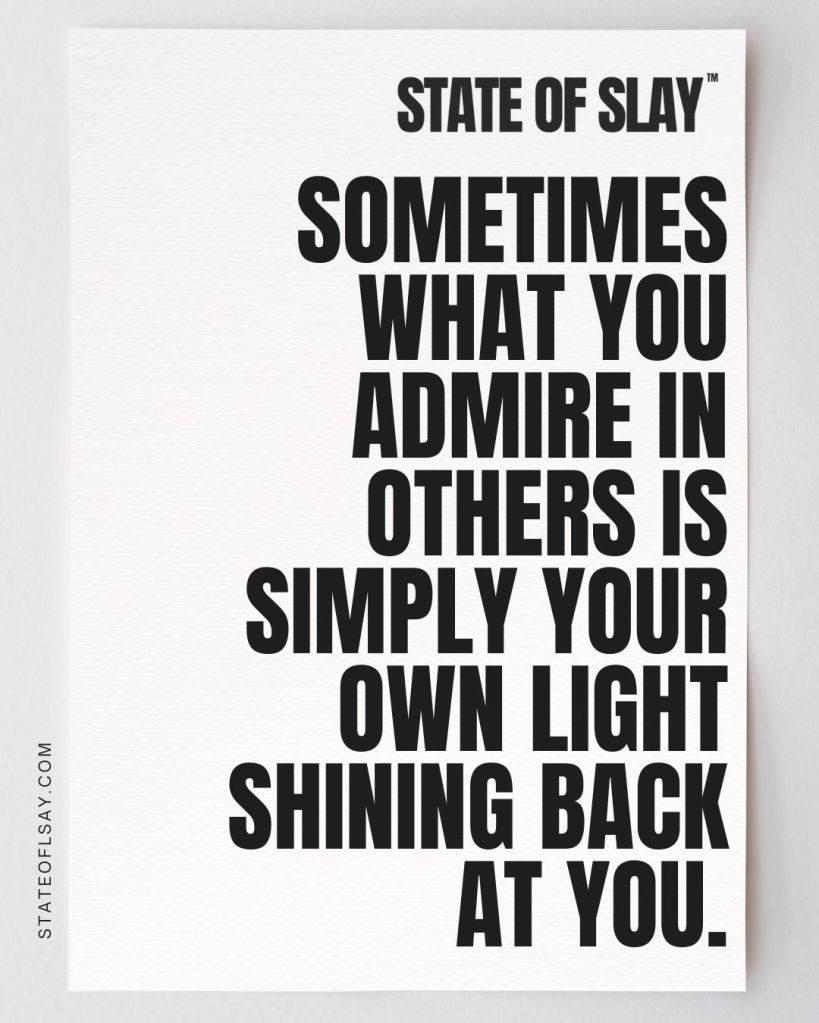
What we admire in others is often a mirror of what already lives within us. The kindness, courage, or strength you notice in someone else doesn’t just exist outside of you—it resonates because it’s also part of you.

Too often, we downplay our own gifts while lifting others up. But the truth is, the qualities you celebrate in them are not foreign—they are familiar. They’re reminders of your own capacity, your own light, your own power shining back at you.

Instead of seeing yourself as “less than,” see the reflection for what it is: proof that you, too, carry that same brilliance.

This is your reminder that what you see in others is also alive in you.

SLAY on!

The Boogeyman Only Lives in the Dark

Fear has a way of creeping in when the lights are out—both literally and metaphorically. When we’re uncertain, overwhelmed, or vulnerable, our minds can convince us that the shadows hold monsters. And when we avoid shining a light on those fears—when we stuff them down, pretend they don’t exist, or try to outrun them—they only grow bigger, louder, and harder to face.

The truth? Fear feeds on silence and secrecy. When we leave it unchecked, it multiplies in the darkness of our minds. But when we turn on the light—through awareness, honesty, and courage—fear begins to shrink.

So if you think there’s a boogeyman around, it’s time to stop hiding under the covers. Flip the switch. Call it out. See it for what it is.


Darkness Is the Breeding Ground for Fear

Think about the last time you were afraid of something—really afraid. Chances are, it wasn’t the thing itself that scared you most. It was not knowing.

Not knowing what someone thought of you.
Not knowing how a situation would turn out.
Not knowing if you could survive the pain you were in.

The unknown is where fear lives. And the more we let our imagination run wild in that dark space, the more terrifying the “boogeyman” becomes.

But here’s the thing: most fears, when brought into the light, lose their power. Naming your fear is the first step in shrinking it. It’s not the monster under the bed—it’s your anxiety about failing, being rejected, or not being enough. Once you see it clearly, you can deal with it.


Shine the Light of Truth

When we start to shine a light on fear, it doesn’t mean the fear disappears overnight. But it does mean we stop letting it run the show.

For me, facing my fears meant getting rigorously honest with myself. I had to admit where I was scared and why. Sometimes it was rooted in old wounds or trauma. Sometimes it was tied to lies I had told myself for years. And sometimes, it was just the unknown of stepping into a new chapter.

The more light I brought in—the more I talked about my fears, wrote about them, or even prayed about them—the less they controlled me.

Fear thrives in the dark. Truth thrives in the light.


The Boogeyman Is Rarely What You Think

Most of the time, the “boogeyman” isn’t nearly as scary as we’ve built it up to be.

Maybe the conversation you’ve been avoiding brings clarity instead of rejection.
Maybe the risk you’ve been afraid to take opens a door you never thought possible.
Maybe the pain you’re carrying becomes lighter when you finally share it.

Fear wants you to stay in the dark. But your healing requires the light.


Flip the Switch

So how do you “turn on the light” when fear is looming?

  • Name it. Write down exactly what you’re afraid of. No filters.
  • Share it. Talk to someone you trust. Speaking fear out loud weakens it.
  • Challenge it. Ask yourself: is this fear based in fact, or in old stories?
  • Take one small action. Even the smallest step forward shines light into the dark.

The boogeyman can’t survive in the light.

So next time you feel fear creeping in, don’t stay stuck in the dark. Reach for the switch. Bring it into the open. Remind yourself: you are braver than the shadows.


SLAY Reflection

  1. What fear have you been keeping in the dark?
  2. How does avoiding it give it more power?
  3. What would shining a light on it look like for you?
  4. Can you trace your fear back to old wounds or beliefs?
  5. What’s one small action you can take today to face it?

S – Stop letting fear grow in silence
L – Let the light of truth guide you
A – Acknowledge your fears instead of hiding them
Y – Yield to courage, not the shadows


Call to Action: Join the Conversation

I’d love to hear from you.
What fear did you finally bring into the light—and how did it change things for you?
Share your story in the comments. Let’s cheer each other on.

And if you know someone who’s hiding from their “boogeyman,” send this to them.
Sometimes, all we need is a light to remind us we’re not alone.