Slay Say

The journey no one clapped for created the moment they celebrate

It’s easy to admire someone’s success without ever seeing the struggles that built it. People will clap for the glow, but they rarely acknowledge the fire it came from.

Behind every highlight is a hard-fought story—quiet battles, sleepless nights, doubts you had to silence, and resilience you had to grow. The truth is, the spotlight only shows the ending; it doesn’t reveal the shadows you walked through to get there.

Your journey matters, even if no one sees it. Every step, every scar, every setback you’ve overcome is part of the strength that makes your light shine.

This is your reminder to honor the path as much as the outcome.

SLAY on!

Temporary People Teach Us Permanent Lessons

We don’t always get to choose who comes into our lives—or how long they stay. Some people walk with us for a lifetime, others for only a season. And while temporary people may leave as quickly as they came, their impact often lingers.

Sometimes it’s beautiful. Sometimes it’s heartbreaking. But always—it’s instructive.

Because even the ones who don’t stay teach us something we carry forward. Temporary people leave permanent lessons.


The Pain of Goodbyes and the Gift They Leave Behind

When someone exits your life, it can feel like rejection, abandonment, or loss. You may replay every moment, wondering what you could have done differently to make them stay. But here’s the truth: their leaving isn’t always about you.

Temporary people teach us boundaries. They teach us what we will and will not accept.
They teach us value. Sometimes by showing us what we deserve—and sometimes by showing us what we don’t.

Not all lessons are gentle. But every lesson has purpose.


What Temporary People Reflect Back to Us

Every person who crosses our path acts as a mirror. Some reflect our best qualities back at us—reminding us of the love, kindness, or courage we already hold. Others reflect the wounds we still carry, highlighting the work that’s left undone.

If you’ve ever noticed how one relationship reveals your need for boundaries, while another pushes you toward forgiveness, that’s no accident. Temporary people show us where we’re growing, and where we’re still stuck.

Even the ones who hurt us—sometimes especially the ones who hurt us—end up guiding us toward our truth.


Not Everyone Is Meant to Stay

We live in a culture that glorifies “forever.” Forever friends. Forever love. Forever loyalty. But life doesn’t always work that way.

The truth is, some people are only meant to walk us part of the way. They show up for a chapter, not the whole book. And that’s okay.

Because their role is not to stay—it’s to move us forward. To give us the lesson, the shift, the wake-up call we couldn’t have gotten any other way.

When we cling to people who were only meant to be temporary, we rob ourselves of the lesson. When we let them go with gratitude, we keep the gift they came to bring.


Choosing Growth Over Grief

It’s natural to grieve when someone leaves. But we don’t have to get stuck in the story of what “could have been.”

Instead, we can ask:
What did I learn from this connection?
How did this person shift me?
What strength did I discover because of them?

Sometimes the hardest people to release leave behind the clearest lessons. They teach us self-respect. They teach us resilience. They teach us that we can survive the leaving—and even thrive after it.

You may not have chosen their exit, but you can choose what you carry forward.


SLAY Reflection

  1. Who in your past was only meant to be temporary, but taught you something lasting?
  2. What lesson are you still carrying from a relationship that didn’t last?
  3. Do you find yourself holding on to people who were never meant to stay? Why?
  4. How does it feel to shift from grief to gratitude when you think of temporary people?
  5. What permanent strength or wisdom do you have today because someone left?

S – See the role they played in your growth
L – Let go of what wasn’t meant to last
A – Acknowledge the lessons they gave you
Y – Yield to gratitude instead of grief


Call to Action: Join the Conversation

I’d love to hear from you.
Who was a “temporary person” in your life, and what permanent lesson did they leave behind?
Share your story in the comments. Let’s cheer each other on.

And if you know someone struggling to let go of someone who was never meant to stay, send this to them.
Sometimes, all we need is a reminder that even endings carry gifts.

Slay Say

The Weight Was Never Yours

We often clutch what was never meant for us—regrets, expectations, the heavy burdens of things we can’t control. Our minds replay them, our hearts ache with them, and we end up carrying weight that was never ours to hold. True strength is not in forcing yourself to bear it but in recognizing when to set it down. Release is not weakness—it’s freedom.

This is your reminder to…
Choose peace over pressure. Your heart deserves rest, not heaviness.

SLAY on!

Just Because Someone Gave Up on You, Don’t Give Up on Yourself

There’s a particular kind of pain that comes when someone you believed in—someone you trusted—decides you’re no longer worth the effort. It might be a partner, a friend, a family member, or even an employer.

Sometimes they drift away quietly. Sometimes they slam the door. And sometimes, they make sure you hear exactly why you didn’t make the cut.

It’s human to internalize those moments. To question what’s wrong with you. To wonder if they saw something you didn’t. But here’s the truth—their decision to give up on you is about them, not you.


Their Choice Is Not Your Worth

When someone gives up on you, it’s easy to translate that into, “I’m not enough.” But what they’re really saying is, “I’m not willing, able, or ready to invest in this anymore.”

That’s not the same thing as saying you have no value.

We often assume that other people’s actions are direct reflections of who we are. But in reality, they’re reflections of their capacity, their priorities, their fears, and their choices. Someone’s inability or unwillingness to see your worth does not erase your worth.

When we take someone else’s abandonment as proof that we should abandon ourselves, we hand over our power. And once that happens, their absence gets to dictate the rest of our story.

You don’t owe them that power.


Self-Trust Is Your Lifeline

When the dust settles, what you’re left with is you. And that’s where the real work begins.

Self-trust isn’t built in grand declarations—it’s built in small, consistent acts of showing up for yourself. It’s saying, “I still choose me, even when they didn’t.”

Here’s the thing: if you keep believing in yourself, you always have another chapter to write.

Yes, it hurts when someone walks away. But you’re still standing. You still have dreams, talents, and the ability to create a life you love. You still have the capacity to love yourself fiercely, even if others failed to.

The most powerful way to respond when someone gives up on you is to prove—to yourself—that you never will.


Let Their Exit Teach You, Not Break You

People leaving can be clarifying. Painful? Absolutely. But clarifying.

When someone exits your life, you get the chance to ask:

  • Was I shrinking myself to keep them close?
  • Did I rely on their validation more than my own?
  • Was I ignoring red flags because I didn’t want to lose them?

The end of a relationship, friendship, or opportunity can feel like a collapse—but it can also be a clearing. A chance to rebuild in a way that’s more aligned with who you are now.

Sometimes someone’s departure forces you to look at your own patterns, boundaries, and needs in a way you never would have otherwise.

If you use the pain as data, it can actually serve you.


Your Story Isn’t Over Because They Left

It’s tempting to see someone’s departure as the end of something essential—as if the part of you that existed with them can’t survive without them. But your life is bigger than their role in it.

Think of the people you haven’t even met yet. The experiences you haven’t had. The opportunities that wouldn’t have been possible if you stayed where you were.

The world is full of people who will believe in you. People who will stand beside you, support you, and challenge you to grow—not shrink.

But the most important believer you’ll ever have is the one staring back at you in the mirror.


Refuse to Abandon Yourself

Here’s the bottom line:

  • Someone else’s choice to walk away does not define you.
  • You are allowed to grieve, but you are not required to quit on yourself.
  • You can acknowledge the hurt without adopting it as your identity.

The real loss would be if you decided their decision was the final say in your worth.

Keep showing up. Keep writing your story. Keep choosing you—over and over again.

Because the day you give up on yourself is the day you stop being open to the possibilities that are still ahead.

And trust me… there are so many.


SLAY Reflection

  1. Who in your life has walked away, and how did it impact your self-belief?
  2. In what ways have you relied on others for validation?
  3. How can you build more self-trust right now?
  4. What lesson did you learn from someone leaving your life?
  5. What’s one action you can take this week to invest in yourself?

S – Stand in your worth, even when others don’t
L – Let go of those who cannot meet you where you are
A – Affirm your value daily, without waiting for outside approval
Y – Yield to growth, even when it comes through loss


Call to Action: Join the Conversation

I’d love to hear from you.
When someone gave up on you, what did you do to keep believing in yourself?
Share your story in the comments. Let’s cheer each other on.

And if you know someone who’s questioning their worth because someone walked away, send this to them.
Sometimes, all we need is a nudge.

Learning to Love the Thing You Wish Hadn’t Happened

There are moments in life that split time in two.

There’s before it happened.
And there’s after it happened.

And sometimes, that “it” is something you would give anything to erase. A betrayal. A loss. A mistake. A failure. Something that shook you so deeply that, even years later, you still catch yourself saying, “If only that had never happened…”

I’ve been there. More than once.

For a long time, I believed the only way to be truly happy again was to go back—back to the way things were before the pain, before the fallout, before the day that changed everything. But the truth is, there is no going back. There’s only forward. And learning to move forward doesn’t mean pretending it didn’t hurt, or even pretending you’re glad it happened.

It means learning to love what it taught you.

It means finding peace in the fact that this unwanted thing—this thing you thought would break you—has also shaped you into the version of yourself you are now.


The Lie We Tell Ourselves About “If Only”

When something painful happens, our minds get stuck in loops. We replay conversations. We imagine different choices. We rewrite endings that never came.

It’s a way of bargaining with reality: If only it hadn’t happened, I’d be happier. If only it hadn’t happened, I’d be whole.

But here’s the truth no one wants to admit—those loops keep us chained to the very thing we want freedom from. Every time we run through the “if only” scenario, we hand over our present to a past we cannot change.

And if we’re not careful, we start defining ourselves by the wound instead of the healing.


What It Really Means to Love the Thing You Wish Hadn’t Happened

Loving what you wish hadn’t happened doesn’t mean excusing it, approving of it, or romanticizing pain. It’s not toxic positivity, and it’s not saying, “Everything happens for a reason” as a way to shut down your feelings.

It’s about recognizing that you did survive it. That it’s part of your story. And that by accepting it instead of resisting it, you can take back your power.

When you love what you wish hadn’t happened, you’re saying:

  • “I see what this taught me, even if I never wanted the lesson.”
  • “I won’t let this moment define my future in a way that keeps me small.”
  • “I can carry this with me without letting it weigh me down.”

That shift—acceptance over resistance—is where freedom begins.


Turning Pain Into Purpose

If I look back at my own life, the moments I once wished away have given me some of my greatest strengths.

The heartbreak that shattered me? It taught me how to listen to my intuition.

The loss that felt unbearable? It taught me to love harder and to cherish the present.

The mistake I swore I’d never recover from? It humbled me, made me more compassionate, and connected me to people I never would have met otherwise.

When you learn to love what you wish hadn’t happened, you’re essentially mining your pain for gold. You’re pulling the wisdom from the rubble. You’re saying, “If I have to carry this, I will make sure it makes me stronger.”


Choosing to See the Gift

This is the hardest part—seeing the gift in the thing you never wanted.

Sometimes the gift isn’t obvious. It’s not wrapped neatly with a bow. It might take years before you see how something awful set the stage for something better.

But I believe this: Every wound has the potential to be the very thing that builds your wings.

That doesn’t happen automatically. It happens when you choose to look for the lessons. When you decide that your story will not end in tragedy, but in transformation.


You Don’t Have to Like It to Learn From It

There’s a misconception that acceptance means approval. It doesn’t. You can still hate what happened. You can still grieve it, still wish it had been different.

Acceptance is simply saying, “It happened. I can’t change that. But I can choose how I live with it.”

And sometimes, “living with it” means integrating it into your story in a way that honors your growth instead of your grief.


From Scar to Strength

Your pain is not who you are.

It’s part of your story, but it’s not your identity. The thing you wish hadn’t happened might always sting a little, but with time, the sting fades, and the scar becomes proof—not of what hurt you, but of what couldn’t break you.

When you reach the point where you can love that scar, when you can look at it and think, That’s where I grew the most, you’ve taken back what was stolen from you.

That’s when the thing you once wished away becomes the thing that shaped you into the person you were always meant to be.


SLAY Reflection

  1. What’s one event in your life you still wish had never happened?
  2. How has holding onto resistance kept you tied to it?
  3. What’s one strength, lesson, or relationship you have today because of it?
  4. How would your life look if you could accept it fully?
  5. What’s one small step you can take this week toward making peace with it?

S – Stop replaying the “if only” loop
L – Look for the lessons, even if they’re small
A – Accept that it’s part of your story, not all of it
Y – Yield to the growth it’s given you


Call to Action: Join the Conversation

I’d love to hear from you.
What’s one thing you wish had never happened—and how has it unexpectedly shaped you for the better?
Share your story in the comments. Let’s cheer each other on.

And if you know someone who’s stuck wishing they could erase the past, send this to them.
Sometimes, all we need is a nudge.

Slay Say

Every Step Counts

Not every day will be a sprint—and that’s not a failure. Some days will feel like momentum, others like maintenance. And that’s still progress.

The truth is, life isn’t about hitting your peak every single day—it’s about honoring where you are and showing up in a way that’s true to that moment. Some days you’ll move mountains. Other days, you’ll simply stand your ground. Both matter.

Progress is built in moments, not just milestones. The small steps you take on your slowest days are just as valuable as the leaps you take on your strongest ones.

This is your reminder to celebrate the fact that you’re still moving forward, no matter the pace.

SLAY on!

Slay Say

TRUST THE STRENGTH YOU’RE BUILDING

Comfort is fleeting.
It’s easy to map out your life for the good days, the smooth seasons, the times when everything flows.

But those aren’t the days that test the strength of your foundation.

True growth happens when you shape your future with resilience in mind—when you build a life that can hold you steady through the storms, not just the sunshine.

This is your reminder: The stronger you become in the hard moments, the more unshakable your path forward will be.

SLAY on!

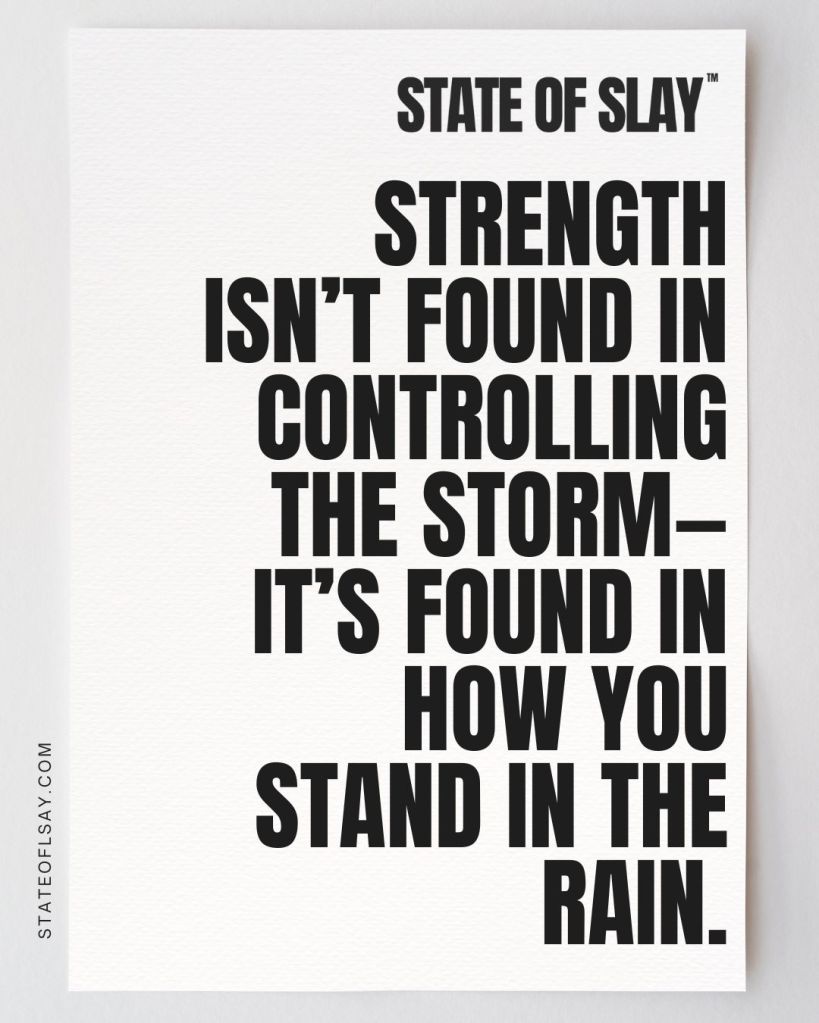
Their Storm, Not Your Forecast

There’s a strange pressure to get swept up in someone else’s chaos. To absorb their anger, defend against their projections, or even try to fix what they refuse to face. Especially if you’re a deeply empathetic person, it can be hard to remember:

Not every storm requires your umbrella.

Just because someone is bringing drama, blame, or emotional thunder into the room doesn’t mean you have to get soaked.

It might sound harsh, but not every meltdown, every mood, or every mess is yours to carry.

Let’s be real—some people thrive in the whirlwind. They create it. They stir up tension, throw lightning bolts, and wait to see who gets scorched. And if you’re not careful, you’ll mistake their storm for your reality.


You’re Not the Weather Channel

Here’s the thing: just because they’re forecasting doom doesn’t mean you have to build an ark. We can love people, support people, and still refuse to be pulled under by their emotional riptide.

Your peace isn’t up for negotiation.

One of the biggest lessons I’ve learned is this: if someone is committed to chaos, no amount of calm you bring will change them. You don’t have to match their energy, explain yourself endlessly, or prove your worth in the face of their projection.

Your job is to stay grounded in your truth.

People will accuse you of being cold, distant, or selfish when you refuse to engage in their drama. Let them. You’re not required to participate in every emotional argument you’re invited to.


Calm Isn’t Weak—It’s Wise

Some storms are loud. Others are subtle. But all of them share one trait: they pull you away from your center. When you stay calm in the face of emotional turbulence, you’re not being passive—you’re being powerful.

Calm is a boundary.

It says: “I’m not going to argue with someone who’s not listening. I’m not going to internalize someone else’s pain. I’m not going to let your storm become my identity.”

This doesn’t mean you don’t care. It means you care enough about yourself to know the difference between being present and being consumed.


Detach Without Guilt

If you’ve ever grown up in dysfunction, chaos might feel familiar—even comfortable. You may have learned to overfunction, to fix, to please, to manage the emotions of others so things wouldn’t blow up. But that’s not your role anymore.

You can walk away. You can say, “This isn’t mine.” You can let someone rage, spiral, or stew without stepping into the storm.

Because here’s the truth: the storm isn’t personal. Even if it’s aimed at you, it’s not really about you. It’s about their unhealed pain. Their fear. Their need for control.

You didn’t cause it, and you don’t have to catch it.


Protect Your Inner Weather

Boundaries aren’t walls, they’re windows. They let in light and fresh air, but they keep out the hail. When you feel that pull to jump into someone else’s chaos, pause and ask:

  • Is this really mine?
  • What happens if I don’t respond?
  • What would it look like to stay rooted in my calm?

Because that’s the goal: to be so in tune with your own emotional forecast that someone else’s storm can roll through without ever touching your peace.

Let them weather it. You’ve got sunshine to protect.


SLAY Reflection

  1. Have you ever mistaken someone else’s storm as your responsibility to fix?
  2. What patterns from your past make chaos feel familiar or expected?
  3. When was the last time you stayed calm in a moment of drama—and how did that feel?
  4. What’s one situation right now where you can say, “This isn’t mine”?
  5. How can you strengthen your boundaries to protect your inner peace?

S – Step away from unnecessary emotional storms
L – Let go of the need to fix what isn’t yours
A – Acknowledge your limits with compassion
Y – Yield to peace, not pressure


Call to Action: Join the Conversation

I’d love to hear from you.
What’s one way you’ve protected your peace by not engaging in someone else’s storm?
Share your story in the comments. Let’s cheer each other on.

And if you know someone who’s always caught in the swirl of someone else’s drama, send this to them.
Sometimes, all we need is a reminder that peace is a choice.

Invest In Yourself

When people talk about investments, they usually mean stocks, property, or retirement accounts. But there’s one investment that’s even more critical: you.

Your well-being—mental, emotional, and physical—is the foundation for everything else in your life. When you prioritize yourself, everything else gets better: your relationships, your career, your creativity, your peace of mind. Yet, so many of us wait until we’re completely burned out, overwhelmed, or spiraling to give ourselves the care we need.

It doesn’t have to be that way. It shouldn’t be that way.


Why Investing in Yourself Matters

The truth is, you can’t pour from an empty cup. If you’re constantly giving to others without replenishing yourself, you’re operating from depletion. Eventually, something gives.

Investing in yourself doesn’t mean spa days and bubble baths—though those are lovely. It means making consistent choices that nurture your well-being. It means saying no when something compromises your peace. It means taking the time to listen to your own needs, even if others don’t understand.

For me, investing in myself looked like finally saying yes to therapy. It looked like turning down invitations that drained me, and instead spending quiet time journaling, walking, or simply being. It looked like learning how to support myself the way I’d supported everyone else for years.

It was uncomfortable at first. I worried I was being selfish. But I realized: prioritizing yourself is not selfish—it’s survival. And over time, I saw how much better I could show up for others when I was also showing up for myself.


The ROI of Self-Investment

When you invest in yourself, you start to:

  • Build resilience
  • Strengthen your boundaries
  • Increase your capacity for joy
  • Reconnect with your purpose
  • Attract healthier relationships

And perhaps most importantly, you start to trust yourself more deeply. You become someone you can rely on. That’s powerful.


Start Where You Are

You don’t need to overhaul your life overnight. Start with one intentional choice a day. One small way to say, “I matter.” Maybe it’s drinking a full glass of water first thing in the morning. Maybe it’s taking five minutes to breathe. Maybe it’s setting a boundary you’ve been avoiding.

Whatever it is, let that choice be an act of self-respect.

Because when you invest in your well-being, you’re not just surviving—you’re building a life that supports you.


SLAY Reflection

  1. What does investing in yourself mean to you personally?
  2. What small act of self-care can you commit to today?
  3. Do you feel guilty prioritizing your well-being? Why?
  4. How might your relationships shift if you were more centered and grounded?
  5. What would change if you treated your mental health like a top priority?

S-L-A-Y:

  • Say yes to what nourishes you
  • Let go of guilt and shame
  • Act with intention, not obligation
  • You are worth the effort

Call to Action: Join the Conversation
I’d love to hear from you.
What’s one way you can invest in your well-being this week?
Share your story in the comments. Let’s cheer each other on.

And if you know someone who’s always giving but rarely giving to themselves, send this to them.
Sometimes, all we need is a nudge.

Sometimes Happy Is a Feeling, Sometimes Happy Is a Choice

Let’s be honest: some days happiness wraps around you like a warm blanket. Other days, it’s a threadbare flag you have to raise yourself, even when the wind isn’t blowing.

Sometimes, happy arrives uninvited. A smile you didn’t expect. A moment of peace. Laughter that catches you by surprise. These are the days when joy feels natural. Effortless. When your heart feels light and your worries take a back seat. These are the days you wish you could bottle.

But what about the other days? The days when you wake up heavy, when your body aches with exhaustion, when your mind is cluttered and your heart is a storm cloud? What then?

That’s when happy becomes a choice. And yes, sometimes, it’s the hardest choice you can make.


Feel It When It Comes

We all have seasons where happiness seems to bloom everywhere—inside us and around us. These are the easy days. The ones where gratitude feels automatic, and your smile is real. And when those moments show up?

Let them.

Don’t question the joy. Don’t wait for the other shoe to drop. Let yourself feel good without guilt. You don’t have to earn happiness for it to be valid. It’s not a reward, it’s a gift. And you are allowed to receive it, just because you exist.

Too many of us hesitate to feel joy because we’re afraid it won’t last. But here’s the truth: happiness isn’t permanent, but it is powerful. And when it comes naturally, lean in. Let it soak into your skin.


Choose It When It Feels Out of Reach

And then there are the other days.

The days when happy feels like a stranger.

That’s when you make the choice to reach for it anyway. You choose to smile. To take a walk. To text a friend. To wash your hair. To play a song that makes you sway just a little. To say thank you, even when you’re not quite feeling it.

This isn’t toxic positivity. This is resilience. This is saying, “I know I feel low, but I’m going to plant the seeds of joy anyway.” And over time, those seeds bloom.

Happiness isn’t about denying what hurts. It’s about refusing to let the hurt define the whole day.


You Are Allowed to Want More

Here’s a powerful truth: you don’t have to settle. Not for a life that keeps you stuck. Not for a mindset that keeps you small. You are allowed to chase joy. To design a life that feels good on the inside, not just one that looks good from the outside.

And when you can’t find it? You can choose it. You can create it.

Even if that looks like a slow morning with coffee and quiet.

You are not failing if you have to fight for your happiness. That’s not weakness. That’s strength.


Some Days It’s Both

Sometimes happy is a breeze. Sometimes it’s a battle.

And sometimes, it’s a little bit of both.

Either way, you have the power to feel it, create it, or reach for it. You don’t have to wait for life to feel perfect before you allow yourself to be happy. Let it show up in small ways. Invite it in. And when it comes, don’t push it away.

You are allowed to feel good. You are allowed to choose good. You are allowed to live a life that includes joy.

Even on the hard days.


SLAY Reflection

  1. When was the last time you felt joy without effort? What triggered it?
  2. Do you feel guilty when you’re happy? Why?
  3. What’s one small way you could choose joy today?
  4. How can you remind yourself that happiness isn’t a reward?
  5. What would your day look like if you let joy take up more space?

S-L-A-Y:

  • See where joy naturally shows up in your day
  • Let yourself lean into those moments
  • Acknowledge the hard feelings, but don’t stay stuck in them
  • You have the power to choose happiness, even in small ways

Call to Action: Join the Conversation
I’d love to hear from you.
What does choosing happiness look like for you right now?
Share your story in the comments. Let’s cheer each other on.

And if you know someone who’s struggling to feel joy, send this to them.
Sometimes, all we need is a reminder.