Slay Say

WHEN PROTECTION BEGINS WITH YOU

You weren’t always guarded, seen, or nurtured when you were small. But protection isn’t just for children—it’s something you can learn to give yourself now.

When you grow into the person who would’ve shielded your younger self, you reclaim safety, dignity, and the peace you longed for.

This is your reminder: you can be your own defender.

SLAY on!

Their Storm, Not Your Forecast

There’s a strange pressure to get swept up in someone else’s chaos. To absorb their anger, defend against their projections, or even try to fix what they refuse to face. Especially if you’re a deeply empathetic person, it can be hard to remember:

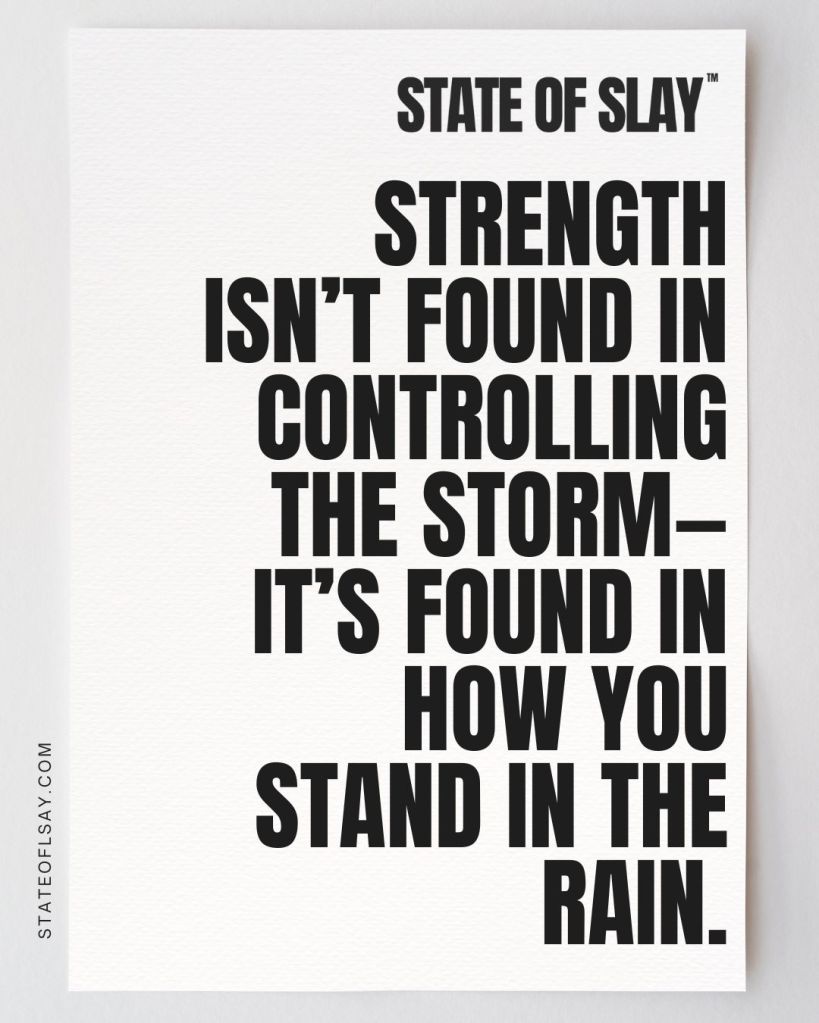
Not every storm requires your umbrella.

Just because someone is bringing drama, blame, or emotional thunder into the room doesn’t mean you have to get soaked.

It might sound harsh, but not every meltdown, every mood, or every mess is yours to carry.

Let’s be real—some people thrive in the whirlwind. They create it. They stir up tension, throw lightning bolts, and wait to see who gets scorched. And if you’re not careful, you’ll mistake their storm for your reality.


You’re Not the Weather Channel

Here’s the thing: just because they’re forecasting doom doesn’t mean you have to build an ark. We can love people, support people, and still refuse to be pulled under by their emotional riptide.

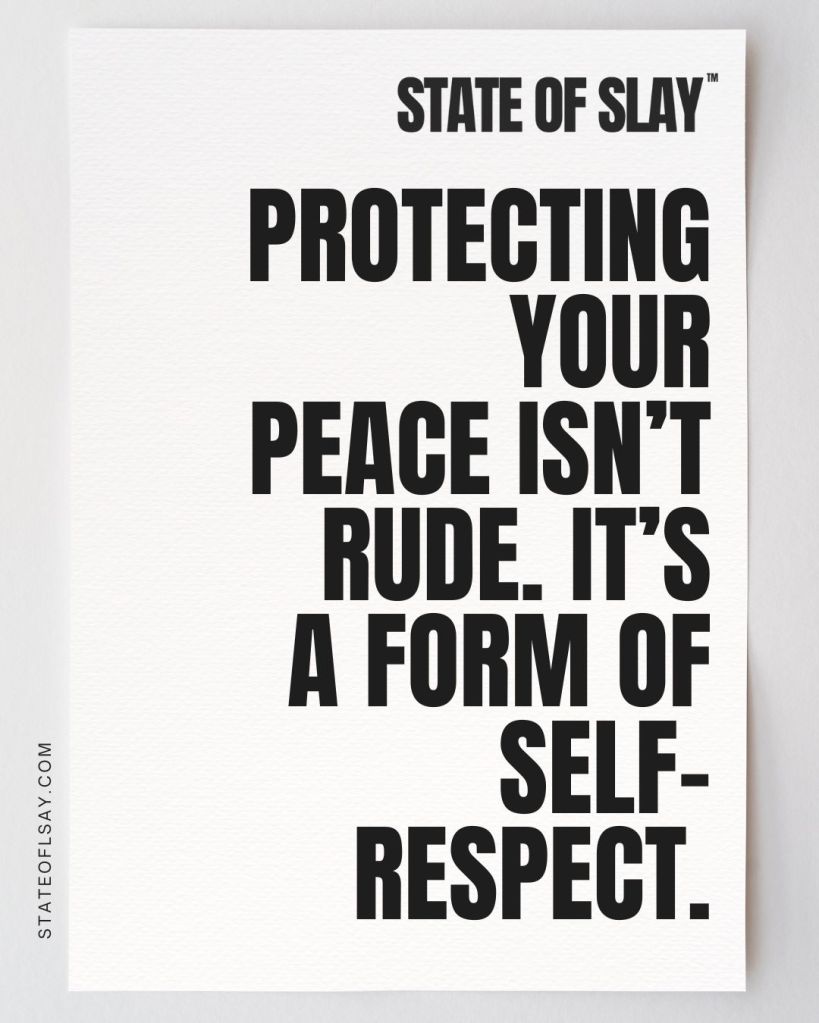
Your peace isn’t up for negotiation.

One of the biggest lessons I’ve learned is this: if someone is committed to chaos, no amount of calm you bring will change them. You don’t have to match their energy, explain yourself endlessly, or prove your worth in the face of their projection.

Your job is to stay grounded in your truth.

People will accuse you of being cold, distant, or selfish when you refuse to engage in their drama. Let them. You’re not required to participate in every emotional argument you’re invited to.


Calm Isn’t Weak—It’s Wise

Some storms are loud. Others are subtle. But all of them share one trait: they pull you away from your center. When you stay calm in the face of emotional turbulence, you’re not being passive—you’re being powerful.

Calm is a boundary.

It says: “I’m not going to argue with someone who’s not listening. I’m not going to internalize someone else’s pain. I’m not going to let your storm become my identity.”

This doesn’t mean you don’t care. It means you care enough about yourself to know the difference between being present and being consumed.


Detach Without Guilt

If you’ve ever grown up in dysfunction, chaos might feel familiar—even comfortable. You may have learned to overfunction, to fix, to please, to manage the emotions of others so things wouldn’t blow up. But that’s not your role anymore.

You can walk away. You can say, “This isn’t mine.” You can let someone rage, spiral, or stew without stepping into the storm.

Because here’s the truth: the storm isn’t personal. Even if it’s aimed at you, it’s not really about you. It’s about their unhealed pain. Their fear. Their need for control.

You didn’t cause it, and you don’t have to catch it.


Protect Your Inner Weather

Boundaries aren’t walls, they’re windows. They let in light and fresh air, but they keep out the hail. When you feel that pull to jump into someone else’s chaos, pause and ask:

  • Is this really mine?
  • What happens if I don’t respond?
  • What would it look like to stay rooted in my calm?

Because that’s the goal: to be so in tune with your own emotional forecast that someone else’s storm can roll through without ever touching your peace.

Let them weather it. You’ve got sunshine to protect.


SLAY Reflection

  1. Have you ever mistaken someone else’s storm as your responsibility to fix?
  2. What patterns from your past make chaos feel familiar or expected?
  3. When was the last time you stayed calm in a moment of drama—and how did that feel?
  4. What’s one situation right now where you can say, “This isn’t mine”?
  5. How can you strengthen your boundaries to protect your inner peace?

S – Step away from unnecessary emotional storms
L – Let go of the need to fix what isn’t yours
A – Acknowledge your limits with compassion
Y – Yield to peace, not pressure


Call to Action: Join the Conversation

I’d love to hear from you.
What’s one way you’ve protected your peace by not engaging in someone else’s storm?
Share your story in the comments. Let’s cheer each other on.

And if you know someone who’s always caught in the swirl of someone else’s drama, send this to them.
Sometimes, all we need is a reminder that peace is a choice.

Slay Say

Your time, energy, and attention are not on-demand services.

We live in a world that glorifies being constantly accessible—always replying, always saying yes, always available.
But that kind of constant output doesn’t make you kind, it makes you exhausted.
Protecting your peace means knowing when to pause, say no, or simply not respond.
Your availability doesn’t define your worth.
Your boundaries define your self-respect.

This is your reminder that you don’t need to be everywhere for everyone.
You just need to be present for yourself.

SLAY on!

Be Informed, Not Consumed

When the world feels uncertain, it’s natural to search for answers. We scroll, click, refresh—hoping that one more headline will bring us peace. But more often than not, the opposite happens. We become consumed.

In times of crisis, fear drives us to seek control. And in today’s world, control often looks like consuming as much information as possible. With news available 24/7, alerts pinging constantly, and social media spinning every story into a wildfire—it’s easy to lose ourselves in the noise.

Staying informed is important. But there’s a difference between being informed and being overwhelmed. There’s a line where knowledge becomes anxiety, and awareness turns into obsession. If we want to stay grounded, present, and well—we have to learn how to navigate that line.


When the Need to Know Becomes Too Much

Before I began this journey of healing and self-awareness, I didn’t know where that line was. When national tragedies or global emergencies happened, I’d get hooked. I’d sit in front of the news for hours, scroll endlessly, and tell myself, “I just need to stay updated.”

But the more I consumed, the more I spiraled. I wasn’t calming my fear—I was feeding it.

And here’s what I’ve learned: when I don’t check in with myself, when I don’t have balance in my day, my mind will find the darkness. If I give my energy to fear-based media or worst-case-scenario stories, that part of my brain that wants to spiral takes over—and fast.


We See What We Seek

It’s true: we find what we’re looking for.

If we’re looking for fear, we’ll find fear. If we’re looking for anger, grief, chaos—we’ll find it, and then some. But if we make the choice to seek calm, hope, and positivity, we’ll start to notice those stories too.

Our perception is shaped by what we consume and who we surround ourselves with. The news we follow, the conversations we engage in, the content we share—it all matters. It all shapes our internal world.

That’s why I’ve learned to set boundaries. I limit the content I consume. I check my sources. And then, I require balance: something that feeds my mind, something that fuels my body, and something that lifts my spirit.

When I follow that formula, I feel grounded. I feel like me.


Information Is a Tool—Not a Lifestyle

In this 24-hour news cycle, information never stops. But that doesn’t mean you have to keep consuming it nonstop.

Just because it’s available doesn’t mean it’s healthy. We don’t need to know everything in real-time. We don’t have to refresh the feed to feel in control. Sometimes, turning the news off is the healthiest decision we can make.

Information should support you—not suffocate you. It’s meant to help you make informed decisions for your life and your family. But it should never be the thing that consumes your energy, time, or peace.


Take the Break You Deserve

If you find yourself feeling overwhelmed, anxious, or hopeless—it might be time to check in.

Ask yourself:

  • How much news have I consumed today?

  • Have I moved my body?

  • Have I taken a deep breath?

  • Have I laughed, reached out to someone, or stepped outside?

The news will still be there when you get back. But your peace needs to be protected now.

Take the break. Put the phone down. Fold up the paper. Let your mind rest. Engage with your life—your real, tangible, beautiful life.


SLAY Reflection

Let’s check in together, SLAYER:

  • S: Do you find yourself consumed by news or social media during difficult times?

  • L: How does this impact your mental, emotional, and physical health?

  • A: What’s one boundary you can set today to create more balance?

  • Y: What can you add into your daily routine to feed your spirit and shift your focus back to the present?


Call to Action: Join the Conversation

I’d love to hear from you.
How are you protecting your peace while staying informed?
Share your story in the comments. Let’s cheer each other on.

And if you know someone who’s feeling overwhelmed by the noise, send this to them.
Sometimes, all we need is a nudge.
Not Everything That Weighs You Down Is Yours To Carry

This week has been heavy.
Not just in the day-to-day busyness, but emotionally, mentally, spiritually.

And as I took a step back, I asked myself a question I’ve learned to come back to again and again:
Is all of this mine to carry?

The answer?
No.
But that hasn’t stopped me from dragging it around—tight-chested, overwhelmed, and bone-tired.

Like many of us, I juggle a lot every day.
And most of the time, I believe I can handle it all.
Until I can’t.
Until I hit a wall.
And when I do, I don’t always meet myself with grace.
Sometimes, I meet myself with frustration and shame.

Even when I know better, I still find myself slipping into old habits—trying to carry it all.
No one is asking me to.
Help is there if I reach for it.
But there I go, dragging the weight of the world across some invisible finish line I made up in my head.

It’s time to pause.
To take a breath—or a few—and ask myself what I’ve picked up along the way that never belonged to me in the first place.


We Learn to Carry What We Don’t Need

Before recovery, I carried everything.
It never occurred to me that I could set anything down.

The emotional weight.
The resentment.
The guilt.
The responsibility for people and problems that were never mine to begin with.

I just kept going—until I couldn’t.

Eventually, I hit a wall.
Hard.
And that wall was the wake-up call I needed.
I couldn’t live that way anymore.
It was slowly destroying me.

So I asked for help.
Not just with what I was carrying—but with how I lived.


Learning to Let Go of What’s Not Yours

Through recovery, I discovered something profound:
A lot of what I was carrying wasn’t mine.

Some of it was inherited—passed down through family, expectations, trauma.
Some of it I volunteered to carry—because I wanted to feel helpful, needed, or in control.

And some of it… I carried on purpose to sabotage myself.
To stay small.
To stay exhausted.
To prove that I couldn’t do more, be more, live more.

That’s the hard truth.
Sometimes, we don’t just carry what’s not ours—we choose it.

But once I got honest with myself, I realized I had a choice.
To let go.
To say no.
To only carry what actually belonged to me.

And that changed everything.


What’s Yours—and What’s Not

There will always be people who would gladly let you carry their weight.
There will be moments when you try to carry someone else’s pain, fear, or responsibility—uninvited.

But that doesn’t mean you have to.

Being helpful doesn’t mean taking on someone else’s journey.
Being strong doesn’t mean carrying more than you should.
Being loving doesn’t mean sacrificing yourself.

We are responsible for ourselves.
For our peace.
For honoring what we need.

That starts with putting down what was never yours to carry in the first place.


SLAY Reflection: What Are You Carrying?

  1. Do you tend to carry more weight than you need to—physically, emotionally, or mentally?
    What does that weight feel like?

  2. What are you carrying that doesn’t actually belong to you?
    Who gave it to you—and why did you accept it?

  3. Are there responsibilities, emotions, or expectations you’ve taken on to feel valuable or in control?
    How are they serving you? How are they hurting you?

  4. What would it feel like to put that weight down—even just a little?
    What would change?

  5. What can you do today to lighten your load and honor your limits?
    Where can you say no, ask for help, or simply rest?


Call to Action: Join the Conversation

I’d love to hear from you.
What’s one burden you’ve been carrying that isn’t actually yours—and how are you learning to let it go?
Share your story in the comments. Let’s cheer each other on.

And if you know someone who’s overwhelmed by weight they were never meant to carry, send this to them.
Sometimes, all we need is a nudge.