Put Your Own Mask On First

We hear it every time we board a plane: “In the event of a loss in cabin pressure, secure your own mask before assisting others.” It’s one of those instructions that seems counterintuitive—especially for the givers, the fixers, the caretakers among us. But when you stop to really think about it, it’s not just an airline safety rule—it’s a life lesson.

For a long time, I didn’t put on my own mask first. I’d jump in to help anyone else—whether they asked or not—believing it made me strong, loving, dependable. I was the one people could count on. But quietly, I was falling apart. I was suffocating. And I didn’t even realize it until I was gasping for air.


You Can’t Pour From an Empty Cup

We’ve all heard that saying, but how many of us actually live it?

If you’ve been conditioned to believe your worth is tied to your usefulness, rest might feel selfish. Saying no might feel wrong. Asking for space might trigger guilt. But here’s the truth: constantly abandoning yourself to show up for others isn’t noble—it’s a fast track to burnout, resentment, and disconnection.

When you give from depletion, your help comes with a cost. You’re exhausted. You’re short-fused. You’re giving, but secretly hoping for a thank you, some recognition, a return on your emotional investment. And when that doesn’t come? It hurts. Because beneath all that self-sacrifice, you’re still human.

Putting your own mask on first isn’t selfish—it’s survival. It’s sustainability. It’s strength. When you’re nourished, rested, grounded—you give from overflow, not from emptiness. And everyone benefits from that version of you.


Self-Care Isn’t a Luxury—It’s a Responsibility

Somewhere along the way, we started seeing self-care as optional—as a bubble bath or a bonus. But self-care is how you keep yourself whole. It’s how you stay aligned. It’s the system check that makes sure you’re not running on fumes.

It’s not always glamorous. Sometimes, self-care is a boundary. Sometimes it’s canceling plans. Sometimes it’s letting someone else figure it out, even when you could fix it. It’s trusting that people can handle their own discomfort—and that it’s not your job to keep everything calm.

The truth is, constantly putting others first is often rooted in fear: What if they get mad? What if they leave? What if they think I’m selfish?

But ask yourself this: If you keep abandoning yourself to meet everyone else’s needs, what are you teaching them? That your needs don’t matter. That you’ll always sacrifice yourself. That love looks like martyrdom.

It doesn’t.


Show Up for You—First

Putting your own mask on first means taking inventory of your energy. It means asking: Am I okay? What do I need right now? Am I being honest about my limits?

When you start showing up for yourself, everything shifts. Your relationships become more balanced. Your boundaries become clearer. You stop saying yes when you mean no. You stop fixing what isn’t yours. And you start building a life that includes you.

This doesn’t mean you stop helping others. It just means you stop bleeding out for them. You choose to care without collapsing. You choose to support without suffocating. You choose to love from wholeness—not from empty lungs.

You’re not here to save everyone. You’re here to be you. And that’s more than enough.

So the next time you feel that urge to abandon yourself to keep the peace, to overextend just to be liked, or to put everyone ahead of you—pause. Breathe. Reach for your own mask first.

That’s not weakness. That’s wisdom.


SLAY Reflection

  1. Do you feel guilty putting your needs before others? Why?
  2. What areas of your life have suffered because you’ve neglected yourself?
  3. When was the last time you truly paused and checked in with you?
  4. How would your life change if you consistently put your needs first?
  5. What’s one small act of self-care you can commit to today?

S – Stop and assess what you really need
L – Let go of guilt tied to prioritizing yourself
A – Allow yourself to rest, recharge, and reset
Y – Yield to your own healing so you can truly thrive


Call to Action: Join the Conversation

I’d love to hear from you.
What does putting your own mask on first look like for you—and how has it changed your life?
Share your story in the comments. Let’s cheer each other on.

And if you know someone who always puts themselves last, send this to them.
Sometimes, all we need is a nudge.

Letting Go Doesn’t Mean Forgetting

There are moments in life that mark us so deeply, they carve their names into our memory. A love we lost. A chapter that closed too soon. A person who changed us forever. And when we talk about letting go, it can feel like we’re being asked to erase those parts of our story—to forget, to move on, to pretend it never meant as much as it did.

But letting go doesn’t mean forgetting. It means learning how to carry the past with you without letting it weigh you down.

There is a quiet kind of strength in remembering. In holding onto what once made your heart full, not to relive it or rewrite it—but to honor it. Letting go is not an erasure. It’s an act of transformation.


You Can Turn the Page Without Tearing It Out

I used to think that moving on meant forgetting. That in order to stop the ache, I had to pretend the past didn’t exist. But the truth is, the ache only grew louder when I tried to silence it.

Grief, loss, heartbreak—they don’t disappear just because we’re tired of feeling them. They soften when we allow them to be part of us. When we stop fighting them. When we let them shape us, instead of shame us.

The chapters that break us open are still part of our story. They don’t need to be rewritten. They need to be remembered. With tenderness. With clarity. With the understanding that they taught us something essential about who we are.

So no, you don’t need to forget. You just need to stop clutching the past so tightly that your hands aren’t free to receive what’s next.


Memory Is Not the Enemy

We’re told to move on. To get over it. To stop living in the past. And while yes, healing requires forward motion, it doesn’t require amnesia.

You can move forward and still feel. You can carry love and loss in the same breath.

Letting go is not about abandoning your memories. It’s about finding the strength to acknowledge them—even the painful ones—and still take the next step.

I had to learn how to hold space for both: the ache of what was, and the hope of what could be. And in doing that, I discovered something surprising:

The past doesn’t hold me hostage when I stop trying to run from it.

Instead, it becomes something I carry—not with regret, but with reverence.


Life Moves On, and So Can You

There’s a moment in every healing journey when you realize: you can miss what was, love who you were, and still choose to turn the page.

Letting go is not a betrayal of the past. It’s a commitment to your future.

You can bring everything you’ve learned with you. The beauty. The brokenness. The truth. All of it.

Letting go is about making peace with what no longer fits, not because it wasn’t real, but because you are growing.

So don’t rush to forget. Don’t erase what made you feel. Let the memories come. Let them stay. Just don’t let them stop you from living the life that’s waiting for you now.

Let your purpose lead. It knows the way.


SLAY Reflection

  1. Is there something in your past you’ve been trying to forget in order to move on?
  2. How might you carry it differently—with tenderness instead of pain?
  3. What have your most difficult moments taught you about yourself?
  4. Are you ready to stop running and start remembering?
  5. What would turning the page look like for you today?

S – Sit with your memories, even the hard ones
L – Let yourself feel without needing to fix
A – Accept what was, and honor how it shaped you
Y – Yield to growth—even when it hurts


Call to Action: Join the Conversation

I’d love to hear from you.
What is something from your past that you now carry with love instead of pain?
Share your story in the comments. Let’s cheer each other on.

And if you know someone who’s struggling to let go, send this to them.
Sometimes, all we need is a nudge.

Chase Purpose, Not People

There was a time in my life when I was constantly chasing people—their attention, their approval, their love.

I thought if I could earn it, maybe I’d finally feel like I was enough.

But no matter how much I gave, how much I bent, or how much of myself I lost in the process…
it never felt like enough.

Because it was never supposed to be.

I wasn’t meant to chase people.
I was meant to chase purpose.
And so were you.


When We Abandon Ourselves

When we get stuck in the cycle of proving our worth to others, we end up abandoning ourselves.

We ignore what lights us up.
We try to become what we think they want.
We twist. We shrink. We perform.

We lose the very parts of ourselves that were never meant to be hidden.

And the worst part?
The more we shape-shift to please, the more invisible we become—to others and to ourselves.


Purpose Doesn’t Need to Be Impressed

Purpose is steady.
It doesn’t need applause.
It doesn’t need permission.

It doesn’t ask you to chase it—only to follow.

When I started focusing on my purpose—my healing, my growth, my creativity, my peace—it all got clearer.

I could see what was aligned.
I could feel who was for me and who never was.
The people who truly belonged in my life didn’t need to be convinced. They didn’t need to be chased. They just showed up.

And not for what I could do for them.
But for who I was becoming.


Let Purpose Lead

The truth is:
You are never too much for the right people.
And you are never not enough for the path that was made for you.

So if you’re feeling left out, overlooked, or unseen—it might not be because something’s wrong with you.

It might be because you’re not meant to follow them.

You’re meant to follow you.

Let your purpose lead.
It knows the way.


SLAY Reflection

Do you ever find yourself chasing people instead of aligning with your purpose?
What does “chasing purpose” look like in your life right now?
Who in your life supports your growth without needing you to earn their love?
What’s one step you can take today to move closer to your purpose?
How might your life shift if you stopped proving yourself and started honoring yourself?

S — Show up for yourself
L — Let go of needing approval
A — Align with your purpose
Y — Yield to what feels right, not who feels familiar


Call to Action: Join the Conversation

I’d love to hear from you.
What’s something you’ve stopped chasing in order to start honoring your purpose?
Share your story in the comments. Let’s cheer each other on.

And if you know someone who’s trying to hold onto people instead of themselves, send this to them.
Sometimes, all we need is a nudge.
Slay Say

Growth starts where ego ends

It’s not always easy to hear what we need to hear. Sometimes, the truth pokes at our pride before it frees us. But if we want to grow, we have to stop treating feedback like failure. Growth asks for humility, curiosity, and the willingness to be wrong. The most powerful people are the ones who stay open—even when it stings.

If you treat feedback as an attack, you’ll miss every opportunity to rise.

SLAY on!

Confirmation Bias

We all want to believe we’re right. That the thoughts we have are the truth. That what we fear is valid. That what we suspect about others is accurate. And so, often without realizing it, we go looking for proof. Not for the truth—but for what we already believe.

That’s confirmation bias.

And it can quietly wreck everything from our relationships to our self-worth.


What Are You Trying to Prove?

Here’s the thing about the human brain: it’s not always looking for truth. It’s looking for evidence that confirms what it already believes.

If your brain believes you’re not good enough, it will dismiss compliments and zero in on criticism.

If your brain thinks no one can be trusted, it will interpret a delayed text or a short tone as betrayal.

If you believe someone doesn’t like you, you’ll search their face and their actions for the tiniest piece of proof—and you’ll find it, even if it isn’t real.

We all do it. It’s human.

But when we act on that bias instead of reality, we reinforce the story we already believe—and miss the opportunity for connection, growth, and healing.


When I Believed the Worst

For a long time, I believed I was unworthy. That no matter how hard I tried, it was never enough. That I would always be the one left behind.

So I looked for proof.

I clung to any sign of rejection. I dismissed care or kindness because I assumed it wouldn’t last. I assumed I was being judged, even when no one was paying attention to me.

I thought I was being self-aware. I thought I was protecting myself.

But what I was really doing was building a case against myself, collecting data that wasn’t even true. And every time I gave weight to a moment of perceived rejection, I was closing a door. I was missing a chance to see that maybe the story I was telling myself wasn’t the whole truth.

And if it wasn’t the truth? Maybe I wasn’t broken after all.


How to Break the Bias

Awareness is everything.

Next time you find yourself thinking, “See? I knew it,” pause.

Ask yourself:

What am I trying to prove right now? And is this actually true—or just familiar?

Confirmation bias feels like safety. It feels like control. But really, it’s just an old loop. One you can break.

Try asking someone you trust for a reality check. Or write down your belief and then list the evidence for and against it.

Better yet, ask yourself: Would I talk to someone I love the way I’m talking to myself right now?


SLAY Reflection

Ask yourself:

  • What beliefs do I keep trying to prove?
  • Where did those beliefs come from?
  • How is confirmation bias limiting my relationships?
  • Do I trust my thoughts more than I trust what’s real?
  • What would it feel like to look for evidence of the opposite being true?

S – L – A – Y

S: Spot the belief that keeps repeating.
L: Listen for the moment you start searching for proof.
A: Ask yourself what else could be true.
Y: Yield to possibility. It’s where healing begins.


Call to Action: Join the Conversation
I’d love to hear from you.
What’s a belief you’ve spent a long time trying to prove—and what happened when you questioned it?
Share your story in the comments. Let’s cheer each other on.

And if you know someone who’s stuck in a loop of self-doubt, send this to them.
Sometimes, all we need is a nudge.

Stop Waiting To Feel Ready

If I’m being honest, most of the time…I don’t feel ready.

Whether it’s a new opportunity, a big decision, or even sitting down to write something like this—I rarely feel 100% ready. If left to my own devices, I’d keep fine-tuning, researching, adjusting, and second-guessing. I’d wait until everything was “perfect.”

But what I’ve learned on this path is simple and powerful: ready isn’t a feeling—it’s a decision.


The Myth of “Feeling Ready”

We tell ourselves we’ll start when we feel more confident.
We’ll speak up when we feel more prepared.
We’ll leap when we feel less scared.

But the truth is, that feeling of readiness? It doesn’t always show up. And if it does, it usually comes after we’ve already taken action—not before.

The illusion of “readiness” keeps us stuck. We wait, thinking there’s some magical moment where we’ll feel different—bolder, braver, more equipped. But most opportunities don’t wait for us to feel ready.

They ask us to decide to be ready.


The Power of Deciding

In my life, there have been countless times I’ve had to make that decision.

Sometimes it was because of a deadline.
Sometimes it was because an opportunity had an expiration date.
Sometimes I just knew if I didn’t move forward, I’d stay stuck.

And every time, I’ve learned this: I didn’t need to know everything. I just needed to know enough to start.

Being ready doesn’t mean having every answer. It doesn’t mean knowing the full path. It means saying, “I’ve got what I need to take this step, and I’ll figure the next one out as I go.”


Do What’s In Front of Your Hands

One thing I’ve carried with me on my journey is this simple reminder:
Do what’s in front of your hands.

That means staying grounded in the present step—even when your mind wants to jump five steps ahead. Yes, it’s wise to have a vision. I like to look a little ahead, to prepare for what’s coming. But the real growth? It happens in the now.

When you focus on what’s right in front of you—just the next task, the next decision, the next act of courage—you start to build momentum. And that momentum leads to clarity, confidence, and more opportunity.


Progress, Not Perfection

Waiting until you feel ready often comes from a deeper fear of making mistakes. But perfection isn’t the goal—progress is.

You’re allowed to make messy starts.
You’re allowed to learn as you go.
You’re allowed to pivot, evolve, and adjust your plan.

Because the truth is, the journey is the point. It’s not about getting it “right” the first time. It’s about moving forward, learning, and becoming.

You’re not behind. You’re not unqualified. You’re simply standing at the edge of the next thing. And all that’s left is to decide to begin.


Make the Decision Today

If you’ve been waiting for the perfect moment to start, here’s your sign: stop waiting.

Make the decision. Be willing to show up before you feel completely ready. Trust that you’ll grow into each next step—and that you already have everything you need to begin.

The truth is, you won’t always feel ready.
But you can always choose to be.


SLAY Reflection

Let’s check in, SLAYER:

  • S: What are you currently putting off because you don’t feel “ready”?
  • L: What would change if you decided to start anyway?
  • A: Can you identify one small step you can take today, even if you don’t feel prepared?
  • Y: How can you reframe readiness as a mindset instead of a feeling?

Call to Action: Join the Conversation

I’d love to hear from you.
What’s something you’ve been waiting to feel ready for—and how can you choose to begin today instead?
Share your story in the comments. Let’s cheer each other on.

And if you know someone who’s stuck waiting for the “perfect moment,” send this to them.
Sometimes, all we need is a nudge.

Find Your People, Find Your Truth

For most of my life, I felt like a chameleon. I’d shift and mold myself to fit the people I was around. I convinced myself that if I acted the way they wanted—or the way I thought they wanted—I’d finally belong. But deep down, it didn’t feel right. And often, I’d leave those interactions feeling drained and wondering, “What’s wrong with me?”

I’d watch others with envy. They seemed to flow effortlessly through social situations, forming connections with ease. I couldn’t understand why it felt so hard for me. Why did it feel like everyone else had the key to belonging, while I was stuck on the outside looking in? I’d analyze every interaction, wondering what I did wrong, why I couldn’t seem to fit.

The truth is, it wasn’t about being wrong. It was about being in the wrong rooms.


The Missing Piece: Discovering Self-Truth

It wasn’t until I began my journey of self-discovery that the truth hit me: there was nothing wrong with me. I just wasn’t with the right people. I wasn’t being true to myself, and I wasn’t choosing connections that were aligned with who I really was—because, if I’m honest, I didn’t even know who I really was.

I’d spent so long being a version of myself that I thought others wanted me to be, that I lost touch with my core. The parts of me that were silly, passionate, curious, and maybe a little bit weird were buried under layers of trying to fit in. I muted my personality. I downplayed my dreams. I laughed at jokes I didn’t find funny. I agreed with opinions I didn’t fully believe in. All because I thought that was the way to be accepted.

But acceptance built on pretending is fragile. It’s conditional. It’s a house of cards ready to collapse the moment you stop performing.

Those people I admired weren’t more skilled or more likable than me—they were just authentic. They were showing up as themselves, unfiltered and unafraid. I, on the other hand, was performing a version of me I thought was acceptable. And in doing so, I was hiding the parts of myself that actually made me unique and magnetic.


Why Authenticity Feels So Hard

For so many of us, the idea of being our true selves feels risky. Maybe we’ve been hurt in the past when we showed vulnerability. Maybe we’ve faced rejection, criticism, or ridicule. Maybe we grew up in environments where it wasn’t safe to be fully seen. Over time, we learn to armor up. We put on masks. We adapt.

But here’s the thing: that armor may protect us from pain, but it also shields us from connection. When we hide our truth, we also hide our light.

The reason social situations felt so hard for me wasn’t because I was broken or unlikable. It was because I wasn’t showing up as me. I was exhausted from pretending. And deep down, I felt the ache of knowing that I wasn’t being true to myself.


The Shift: Coming Home to Yourself

Everything changed when I started to get curious about who I really was. I asked myself hard questions:

  • What do I truly value?
  • What brings me joy?
  • What kind of people energize me instead of draining me?
  • What parts of myself have I been hiding, and why?

The answers were both surprising and freeing. I realized that the right people—the ones who would become my “chosen family”—weren’t the ones I had to impress. They were the ones who loved me for me. They were the ones who felt easy to be around, where conversations flowed, laughter was real, and silence was comfortable.

I stopped chasing approval from people who didn’t value my authenticity. I started prioritizing connections that felt reciprocal, nourishing, and aligned with my values. Slowly, my circle shifted. And with it, so did my confidence.


Finding Your People

Finding your people doesn’t happen overnight. It takes patience and courage. It requires being honest with yourself about the relationships in your life:

  • Are you giving more than you’re receiving?
  • Do you feel energized or depleted after spending time with them?
  • Do you feel safe enough to be fully yourself?

If the answer to any of those questions is “no,” it might be time to reevaluate.

Here’s what I’ve learned: the right people will get you. You won’t have to explain yourself or perform. They’ll love your quirks, celebrate your wins, and hold space for your struggles. They’ll lift you up, not tear you down.

And the beautiful thing is, when you start showing up as your true self, you naturally attract those people. Authenticity is magnetic. When you let your real light shine, it draws others who resonate with that light.


The Liberation of Letting Go

One of the hardest but most liberating steps is letting go of relationships that no longer serve you. It doesn’t mean those people are bad or wrong; it just means they’re not your people.

Letting go creates space—space for new connections, space for self-growth, and space for deeper alignment. It allows you to breathe easier, to trust more, and to open your heart to those who are meant to walk this journey with you.

I promise you this: when you find your people, you’ll look back and realize that you were never broken or wrong. You were simply waiting for the right connections to show you how beautiful and worthy you’ve always been.


Your Light Is Needed

Here’s what I want you to remember, SLAYER: you don’t have to dim your light to fit in. The world doesn’t need a watered-down version of you. It needs you—fully, unapologetically, courageously you.

When you find your people, everything clicks into place. Life feels easier. Conversations feel more meaningful. Connections deepen. And you start to trust yourself in ways you never thought possible.

Because finding your people isn’t just about them—it’s about you finding yourself. It’s about coming home to your truth and realizing that you were never meant to fit in. You were meant to stand out.


SLAY Reflection

Take a moment to reflect and journal on these questions, SLAYER:

  • S: Where in your life are you still trying to fit in instead of standing out?
  • L: What relationships make you feel most like yourself? How can you nurture those?
  • A: Who or what do you need to let go of to make space for the right people?
  • Y: What’s one brave step you can take today to embrace your authenticity and attract your true community?

Call to Action: Join the Conversation

I’d love to hear from you.
Have you found your people, or are you still searching?
Share your story in the comments. Let’s cheer each other on.

And if you know someone who’s struggling to find their place, send this to them.
Sometimes, all we need is a nudge.
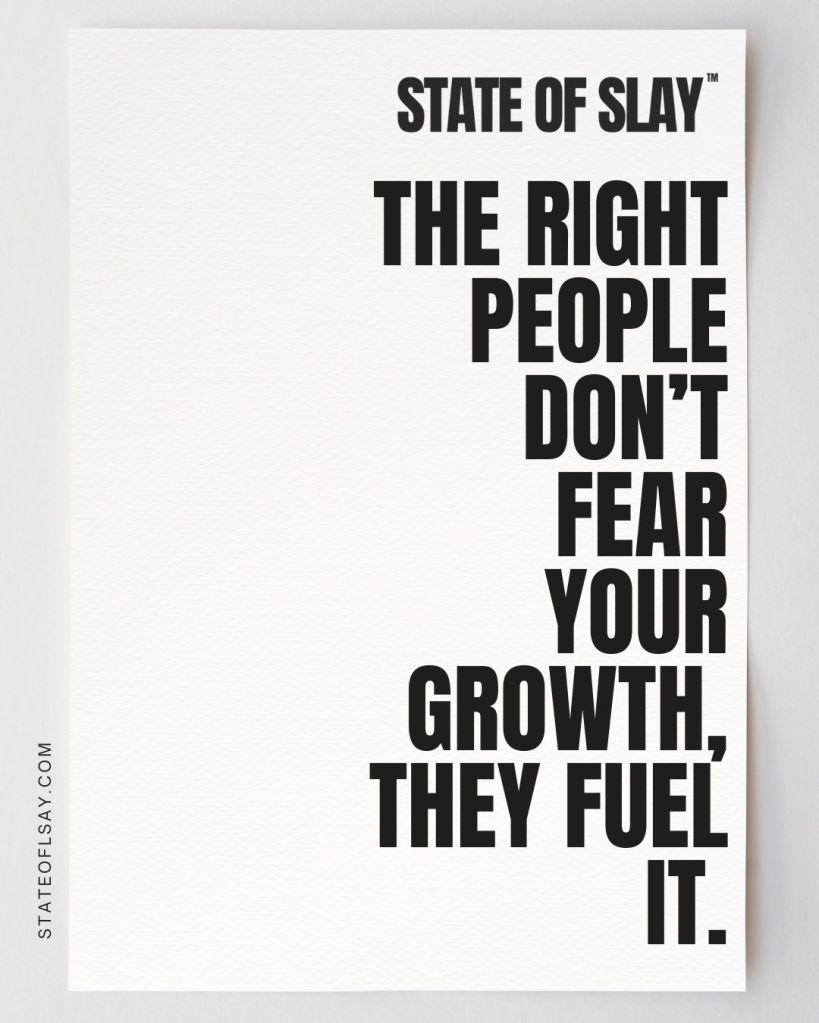
Slay Say

Follow Your Own Road

It’s tempting to look at someone else’s journey and think their path could be ours.
But the truth is, following someone else’s map won’t lead you to your destination.

Your journey is unique, filled with your own experiences, lessons, and growth.
Trust your steps, even when the road is unclear.
Embrace the detours and the unexpected turns—they’re all part of your personal map.

The path to self-discovery isn’t about following others; it’s about forging your own trail.
So, take a deep breath, trust yourself, and keep moving forward.
Your path is unfolding exactly as it should.

SLAY ON.

Your Best Yes Might Be the One That Scares You

It’s easy to say yes when you feel prepared, qualified, and ready.
But what about the yes that feels uncertain? The one that makes you pause and think, “Can I even do this?”

I’ve learned over the years that these are often the most important yeses—the ones that lead you somewhere you never expected, but exactly where you’re supposed to be.

For me, some of the best things in my life have happened because I said yes even when I wasn’t sure. Even when I doubted myself. Even when it was something I’d never done before.

Those yeses have taught me that courage often comes before confidence.


Saying Yes Before You Feel Ready (I Never Felt Ready Either)

If I had waited until I felt fully ready, I would have missed out on so many opportunities that shaped me.

There have been roles I’ve taken, projects I’ve joined, and events I’ve spoken at where my first instinct was, “Why me? I’ve never done this before.”
But then I’d hear this little voice reminding me:
“Just say yes. You’ll figure it out.”

And you know what? I always did. Maybe not perfectly. But growth never is.

Every time I said yes, I walked away with more than I expected—new skills, new friends, new perspectives.
You become ready by doing. Not by waiting.


The Unexpected Gifts of Taking a Chance

Some of my favorite experiences started with a hesitant yes.

  • Saying yes to a random opportunity led me to discover a new creative passion.
  • Saying yes to a conversation with someone I barely knew turned into a meaningful friendship.
  • Saying yes to a project that felt way out of my league ended up teaching me things I didn’t even know I was capable of.

If I had stayed in my comfort zone, I would have missed out on all of it.

What I’ve learned is that sometimes, that scary yes is simply the universe nudging you toward something bigger.


When Yes Isn’t About the Destination

One thing I’ve come to believe is this:
Not every yes is meant to be the grand finale.
Sometimes, it’s just meant to get you moving.

There have been plenty of times when saying yes didn’t lead me exactly where I thought it would.
But it got me out the door. It opened a new door. It connected me to people and places I wouldn’t have found otherwise.

Your yes doesn’t have to be perfect. It just has to be intentional.
You’re not committing to a lifetime. You’re committing to the next step.


Brave Yes vs. Reckless Yes: Here’s How I Tell the Difference

Let me be real—I’ve said yes to things for the wrong reasons too.
Guilt. People-pleasing. Fear of missing out.

Those yeses? They don’t feel good. They drain you.

But the brave yes?
That’s the one that feels a little scary but also exciting. The one that stretches you in the right way. The one your gut says “this could be good for me” even if your brain is panicking a little.

Now, I pause and ask myself:

  • Am I saying yes because I’m afraid of disappointing someone?
  • Or am I saying yes because it aligns with who I’m becoming?

That pause makes all the difference.


Growth Lives on the Other Side of Yes

Every time I’ve stepped into something new, even when it terrified me, I’ve grown.
Not just in skills or experiences, but in how I see myself.

By saying yes, I’ve learned to trust myself more.
To know that I can figure things out.
That even if I stumble, I’ll get back up stronger.

That’s what your best yes does—it helps you grow into the next version of you.


What’s Your Best Yes? Final Thoughts

Here’s what I want you to know:
You don’t have to feel fully ready to say yes.
You don’t have to know exactly how it will turn out.

Sometimes, your best yes is the one that simply gets you moving.
The one that introduces you to a new part of yourself.
The one that reminds you—you’re more capable than you think.

So, what’s the yes you’ve been hesitating on?
It might just be the beginning of something amazing.


Your Turn: Reflect & Take Action

Now it’s your turn. Take a moment and think about these questions:

  1. What opportunity have you been hesitating to say yes to because it feels outside your comfort zone?
    What’s really holding you back?
  2. Think of a time when you said yes even though you were unsure.
    What did you gain from that experience?
  3. What’s one small, brave yes you can give yourself this week?
    A chance to grow, connect, or simply show up differently.
  4. How do you personally tell the difference between a reckless yes and a brave yes?
    What does your body or intuition tell you?
  5. Who or what could benefit from you saying yes to yourself right now?
    Remember, your courage is contagious.

Call to Action: Join the Conversation

I’d love to hear from you.
What’s the yes you’re ready to say, even if it scares you?
Share your story in the comments. Let’s cheer each other on.

And if you know someone who’s standing on the edge of a yes, send this to them.
Sometimes, all we need is a nudge.

H.O.W.

Before I started this path, I wished for change daily. I hoped something—or someone—would swoop in and fix everything. But I wasn’t honest about what was really going on. I blamed others. I minimized my pain. I lived in denial.

What I didn’t realize was that my life wouldn’t get better just because I wanted it to. Wishing doesn’t work without action. And action requires honesty, openness, and willingness.

H.O.W. may sound simple, but when you’re living in darkness, it can feel impossible. Denial lies to you. It convinces you to bury the truth, avoid the mirror, and keep digging deeper into the hole.

But once I got desperate enough, I stopped digging. I looked up. I told the truth. And for the first time in a long time, I was willing to climb.


Change Starts with You

The day I got honest about the mess I’d made was the day everything started to shift.

I saw the wreckage I had caused—not just in my life, but in the lives of people who had tried to love me. I stopped blaming. I started owning. I opened myself to new ideas, new tools, new people who could guide me.

And I became willing—not just to admit my mistakes, but to fix them. That’s where real healing lives. That’s where the change I had longed for finally began to show up.

It wasn’t perfect. It wasn’t fast. But it was real.


Ask Yourself H.O.W.

When you’re ready to change but don’t know how, ask yourself:

  • Am I being honest about what’s really going on?
  • Am I open to doing things differently?
  • Am I willing to take uncomfortable—but necessary—action?

If the answer to any of those is no, you’re not stuck—you’re just not ready yet.

But if the answer is yes?

Get ready. Life is about to shift.

SLAY on.


SLAY Reflection: How Are You Showing Up for Change?

  • Do you wish for change in your life? What would it look like?
  • Are you being honest with yourself about where you are and what needs to shift?
  • How open are you to doing things in a new way?
  • What’s one thing you’re willing to try today—even if it’s uncomfortable?
  • Have you seen the power of H.O.W. in action before? What changed?

Call to Action: Join the Conversation

I’d love to hear from you.
What’s one way you can practice honesty, open-mindedness, or willingness this week?
Share your story in the comments. Let’s cheer each other on.

And if you know someone who’s ready for change but doesn’t know where to start, send this to them.
Sometimes, all we need is a roadmap—and a nudge.