Some People Come Into Your Life to Teach You How to Let Go

There are people you meet who feel like they’re meant to stay forever. People you pour into, fight for, grow with, or dream alongside. And yet, despite all of that hope and history, they don’t stay. They can’t. They weren’t meant to.

It’s painful to admit that not every person who walks into your life is meant to stay in it. But there’s a deeper truth beneath that loss — some people come into your life to teach you how to let go.

Letting go is not something we’re taught. It’s something we learn the hard way. Through heartbreak. Through disappointment. Through the quiet ache of expectations that were never met. But letting go is also one of the greatest skills you will ever learn, because it frees you to live in alignment with your truth instead of your attachments.

This is a lesson that becomes clearer the farther you get from the moment you thought would break you. With time and healing, you realize: letting go wasn’t a punishment — it was preparation.


When Holding On Hurts More Than Letting Go

We often cling to people long after their role in our lives has ended. Maybe it’s because they once made us feel seen. Maybe it’s because we fear the emptiness they’ll leave behind. Maybe it’s because we’re trying to recreate a version of ourselves we once were.

But there is a cost to holding on past the expiration of a connection. It drains your energy. It blurs your boundaries. It keeps you anchored in a past that can’t move with you into your future.

Letting go doesn’t mean the relationship was meaningless. It means the chapter has closed.

Some people aren’t meant to walk your whole path with you — they are meant to walk you to the point where you learn to walk it on your own.


Every Person Is Either a Lesson or a Mirror

When someone enters your life, they bring something with them:
A lesson.
A mirror.
A wound.
A truth.

Some people remind you what you deserve.
Others remind you what you should never accept again.
Some teach you how to love.
Others teach you when to leave.
And some teach you the most transformative lesson of all — how to release something that is no longer aligned with who you are becoming.

No lesson is wasted. Even the painful ones refine you, shape you, strengthen you. They teach you what your heart can survive and what your spirit can rise from.


Letting Go Is an Act of Self-Love

We tend to think letting go is something that happens to us. But in truth, letting go is something we choose. It is an act of self-respect. A declaration of alignment. A bold reclaiming of your peace.

Letting go says:
I deserve reciprocity.
I deserve honesty.
I deserve presence.
I deserve the kind of connection that nurtures me, not drains me.

Letting go is not the closing of your heart — it is the opening of your life to what is meant for you.

When you hold on to someone who isn’t choosing you, you abandon yourself in the process. When you let go, you return to yourself.


Sometimes Letting Go Is the Lesson You Needed Most

Think of the people you’ve released — gently or painfully, slowly or suddenly. What did you learn from their presence? And what did you learn from their absence?

Maybe you learned the difference between attachment and connection.
Maybe you learned how strong you can be by walking away.
Maybe you learned to stop begging for the bare minimum.
Or maybe you learned that losing them wasn’t losing yourself — it was finding yourself.

Some people leave because their lesson is complete.
Some people leave because you’ve outgrown the version of yourself that once needed them.
And some people leave because life has something far better waiting for you.

Letting go makes space for what your heart is truly calling in.


How to Let Go With Grace Instead of Guilt

Letting go doesn’t always come naturally — especially if you are someone who loves deeply, empathizes easily, or tries to fix what isn’t yours to fix. Here are ways to release with compassion:

1. Accept the truth instead of the potential.

You can’t love someone’s potential into reality. You can only love what is true today.

2. Stop rewriting their actions to protect your hope.

People show you who they are through their consistency. Believe what is being shown.

3. Let the goodbye be a boundary, not a punishment.

You’re not being cruel. You’re choosing peace.

4. Release the story you created about what this person was supposed to be.

The attachment often hurts more than the reality.

5. Trust that letting go won’t leave you empty — it will leave you open.

Everything you release creates space for what’s aligned.

The more you practice letting go, the more you learn that letting go is not a loss — it is liberation.


SLAY Reflection

  1. Who taught you a lesson simply by leaving your life?
  2. What relationship are you holding onto that no longer supports your growth?
  3. What fear comes up when you think about letting go?
  4. How would your life expand if you released what’s draining you?
  5. What does honoring your future self look like in this situation?

  • S – Surrender what no longer aligns with your growth
  • L – Let the lesson guide you, not the loss
  • A – Allow your future to open, unburdened
  • Y – Yield to your peace and trust the release

Call to Action: Join the Conversation

I’d love to hear from you.
Who came into your life to teach you the art of letting go — and what did that lesson reveal about you?
Share your story in the comments. Let’s cheer each other on.

And if you know someone who’s holding on to something — or someone — that’s hurting them, send this to them.
Sometimes, all we need is a reminder that letting go is not the end. It’s the beginning.

Slay Say

Stay Rooted in What Matters

Life will always offer noise—
opinions, distractions, expectations,
the pull of things that look urgent
but hold no real weight.

It’s easy to get swept up in it,
to mistake the loudest voice for the truest one,
or to drift toward what feels immediate
instead of what feels aligned.

But when you know what anchors you—
your values, your boundaries, your peace—
the noise loses its power.
You stop reacting to everything around you
and start responding from the steadiness within you.

This is your reminder:
Your grounding is your strength.
Return to what roots you
and let the rest fall away.

Slay On!

Slay Say

Honor What’s Meant to Stay

Some endings don’t come with closure.
Some people simply slip out of your life
without explanation, apology, or accountability.

And as painful as that silence can be,
it’s also information.

Not everything is meant to be revived.
Not every connection deserves resuscitation.
Sometimes the leaving tells you
everything the staying never could.

Your peace is too precious
to pour into what no longer chooses you.
Let what buried itself remain buried.
Life has a way of removing what can’t grow with you.

This is your reminder:
Your energy belongs where it’s respected,
not where you’re chasing ghosts.

Slay On!

Slay Say

Letting Go Is How You Rise

We hold on for many reasons—
habit, hope, fear, or the belief
that releasing something means we failed.

But letting go isn’t loss.
It’s liberation.
It’s choosing your peace over your patterns,
your growth over your grip,
your future over what’s familiar.

Every time you release what no longer supports you—
a belief, a memory, a relationship, a burden—
you create space for the strength
you didn’t know you were missing.

Letting go isn’t the end.
It’s who you become on the way up.

This is your reminder:
You rise every time you release.

Slay on!

What Armor Do You Reach For When You’re Afraid?

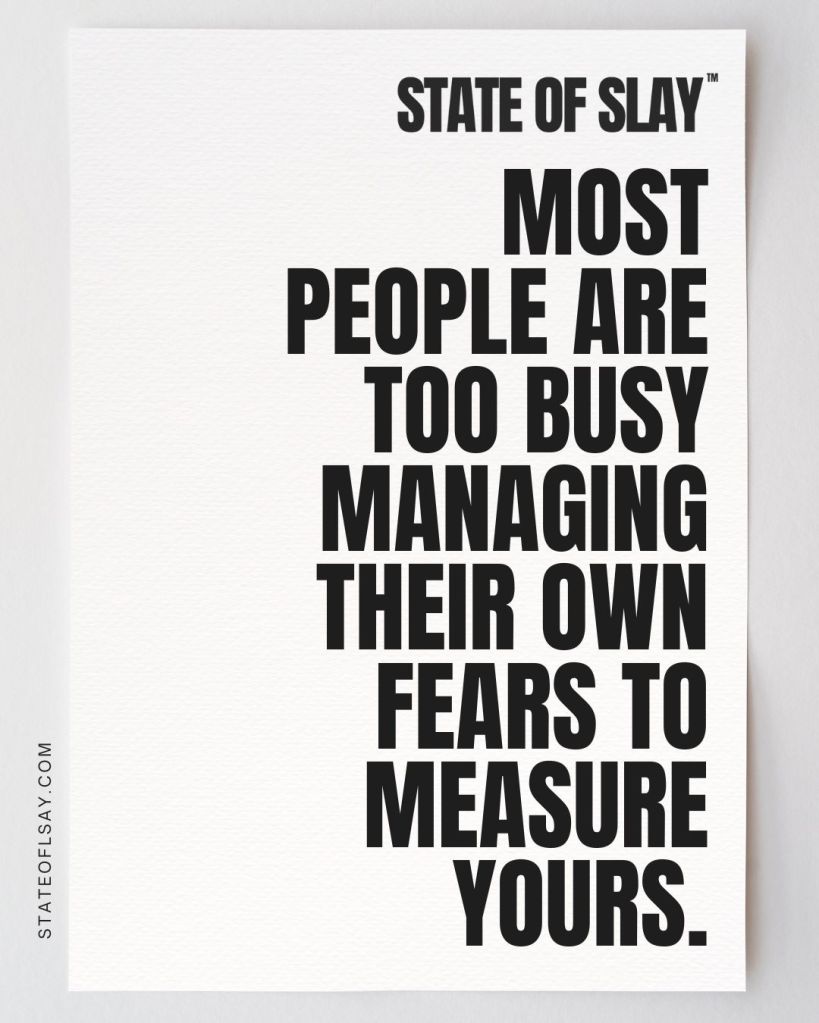
There’s a moment—sometimes so small you almost miss it—when fear slips inside you before you even realize what has happened. A tightening in the chest. A clenching of the jaw. A sudden urge to run, hide, shut down, lash out, or pretend you don’t feel what you feel.

Most of us don’t recognize these reactions as fear. We call them personality traits, or coping mechanisms, or “just how I am.” But beneath the surface, fear is often the quiet puppeteer pulling the strings. And every time fear rises, we reach for the same armor we learned long ago.

Armor that once protected us…
Now keeps us from becoming who we’re meant to be.

Understanding the armor you reach for is one of the most powerful forms of self-awareness you can develop. Because once you recognize it, you can choose differently. You can choose growth instead of protection. Truth instead of avoidance. Healing instead of hiding.


The Armor We Learn Before We Know Any Better

None of us are born armored. We learn our protection.

As children, we pick up patterns based on what made us feel safe:

  • Some of us learned to become invisible.
  • Some learned to become perfect.
  • Some learned to be pleasers.
  • Some learned to be fighters.
  • Some learned to stay busy so we’d never have to feel.
  • Some learned to make others laugh so no one would see our pain.

We didn’t choose these traits freely; they were survival. They were our shield against the painful, confusing, or overwhelming moments of our early lives.

And because they worked for a time, we carried them with us.

But armor that protects a child often imprisons an adult.


Fear Disguises Itself as Strength

Fear rarely announces itself. It cloaks itself in behaviors that appear strong or controlled:

  • Overthinking (so you never make the wrong move)
  • Perfectionism (so no one can criticize you)
  • Anger (so you never have to feel vulnerable)
  • People-pleasing (so no one can abandon you)
  • Numbing (so you never have to feel the hurt)
  • Withdrawal (so you stay safe from conflict)

These behaviors look like strength from the outside, but inside they feel like panic. We cling to them because we’re terrified of what might happen if we put the armor down.

Fear convinces us that if we stop controlling, pleasing, hiding, avoiding, or performing… we will fall apart.

But the truth is this:
The armor is what’s keeping us stuck.


What Armor Do You Reach For?

This is not a question to shame you—it’s a question to free you.

Take a moment. Get honest with yourself. When fear rises in your body, when someone triggers an old wound, when a situation feels risky or uncertain, what is your instinctive reaction?

Do you reach for anger?

Does it feel safer to bite first so no one can hurt you?

Do you reach for silence?

Do you disappear into yourself so no one sees you struggle?

Do you reach for control?

Do you plan, micromanage, over-function, or hyper-organize to avoid feeling powerless?

Do you reach for performance?

Do you become who others need you to be instead of who you really are?

Do you reach for perfection?

Do you demand so much from yourself that failure feels impossible—even if joy becomes impossible, too?

Do you reach for self-sufficiency?

Do you refuse to need anyone, even when you’re breaking, because relying on someone feels too dangerous?

Your armor once protected you.
Now it prevents you from receiving the love, connection, and ease you’ve worked so hard to create.


Armor Is a Story We Tell Ourselves

Every form of armor is built on a belief:

  • “If I show how I really feel, they’ll leave.”
  • “If I don’t get it perfect, I’ll be judged.”
  • “If I don’t stay strong, everything will fall apart.”
  • “If I ask for help, they’ll see I’m weak.”
  • “If I let someone close, I’ll get hurt again.”

These stories feel true because they protected us once. But they are outdated. They are echoes from the past masquerading as present-day truth.

And you can rewrite them.


Authentic Strength Requires Vulnerability

Putting your armor down doesn’t mean becoming defenseless. It means choosing a different kind of protection—one rooted in truth, grounded boundaries, and self-trust.

Real strength is:

  • Saying “I’m hurt” instead of lashing out
  • Saying “I need help” instead of pretending you’re fine
  • Saying “No” even when your voice shakes
  • Saying “This bothers me” instead of silently absorbing it
  • Saying “I’m afraid” instead of creating distance

Armor hides you.
Vulnerability reveals you.
Revealing yourself is how you grow.


Taking Off Your Armor, One Layer at a Time

You don’t remove armor by ripping it off overnight. You remove it the way you put it on—slowly, instinctively, intentionally.

Here’s where to begin:

1. Notice your instinct.

Fear has a physical signature. Your shoulders tense, your heartbeat shifts, your stomach tightens. Start paying attention to what happens in your body before your armor snaps into place.

2. Name the armor you’re reaching for.

Call it out: “I’m trying to control.”
Or: “I’m shutting down.”
Naming it disrupts the pattern.

3. Ask what fear is actually saying.

What is the wound underneath? Rejection? Abandonment? Shame?
The armor is the symptom. The fear is the root.

4. Choose a softer response.

Not perfect. Not polished. Just softer.
One breath. One pause. One honest sentence.

5. Celebrate your awareness.

Even catching yourself mid-pattern is growth. Removing armor is a lifelong practice, not a single breakthrough.


You Don’t Have to Live Behind Your Armor

There is a version of you who trusts your own strength.
Who doesn’t need to control everything to feel safe.
Who allows love in, even when it feels unfamiliar.
Who speaks your truth instead of burying it.
Who feels deeply, openly, fearlessly.

That version of you is not created by fear.
It is revealed when you stop hiding behind it.

Your armor is not who you are.
Your armor is who you became when you didn’t feel safe.
And now that you are healing, you can choose differently.


SLAY Reflection

  1. What form of armor do you reach for most often—anger, perfectionism, silence, control, or something else?
  2. What belief sits underneath that armor?
  3. When was the first time you remember needing that protection?
  4. Who would you be without that armor today?
  5. What is one softer, more honest response you can practice this week?

  • S – See your armor with honesty
  • L – Listen to what fear is trying to tell you
  • A – Allow vulnerability to replace old defenses
  • Y – Yield to growth, not protection

Call to Action: Join the Conversation

I’d love to hear from you.
What armor do you reach for when you’re afraid—and what does it protect you from?
Share your story in the comments. Let’s cheer each other on.

And if you know someone who’s ready to outgrow their old defenses, send them this post.
Sometimes, all we need is a reminder that we don’t have to live life behind a shield.

Slay Say

Honor the Turn

Life doesn’t always move in straight lines.
Sometimes the path you planned
stops matching the person you’re becoming.

A pivot isn’t a setback —
it’s a moment of truth.
A quiet realization that what once fit
no longer aligns with where you’re headed.

Clarity shows you the shift.
Courage is what allows you to make it.

You’re not abandoning the journey.
You’re choosing a better direction.
One that honors your growth,
your intuition,
your becoming.

This is your reminder:
You’re allowed to change course
when your soul asks you to.

Slay on!

When Someone’s Best Isn’t Enough

It’s one of the hardest truths to face: sometimes people’s best simply isn’t enough for us.

Not because they don’t care. Not because they’re bad people. But because what they’re capable of giving — emotionally, mentally, spiritually — falls short of what we need to feel seen, loved, or safe.

And that’s where the real heartbreak often lies — not in what was done to us, but in what wasn’t.


Redefining “Their Best”

When we say someone “did their best,” we often mean they tried. They gave what they had to give — based on their awareness, their upbringing, their capacity, their trauma, or their understanding of love.

But here’s the reality: trying doesn’t always meet our expectations.

Someone’s best effort might still look careless. Their version of love might still feel like neglect. Their attempt at honesty might still come across as half-truths and avoidance.

And that’s not because they didn’t try — it’s because their version of “best” comes from where they are, not where we hoped they’d be.

You can love someone deeply and still recognize that their best doesn’t align with your needs. That realization isn’t judgment — it’s clarity.


You Can Acknowledge Effort and Still Acknowledge the Pain

We often feel guilty admitting we’re hurt when someone “meant well.” But intention and impact are two very different things.

You can appreciate the effort and still acknowledge the wound.

You can say, “I know you did your best, but it still hurt me.”

Because emotional maturity isn’t about excusing behavior — it’s about accepting reality.

Sometimes, their best will never meet the version of love, care, or communication you need. And that doesn’t make you ungrateful — it makes you honest about what’s healthy for you.


Compassion Without Compromise

Here’s where the real growth happens: when you learn to hold compassion without self-betrayal.

You can have empathy for someone’s limitations and still set boundaries.

You can understand their story without living inside it.

You can see their pain and still choose to protect your peace.

Compassion says, “I see why you are the way you are.”
Boundaries say, “But I can’t let that continue to harm me.”

Both can exist together. That’s what it means to love without losing yourself.


Stop Waiting for Them to Change

So many of us stay in relationships — romantic, familial, or otherwise — waiting for people to finally give us the version of love we’ve been hoping for.

But sometimes, that version doesn’t exist for them.

If someone’s “best” is rooted in avoidance, control, or emotional unavailability, no amount of waiting will transform it. You can’t heal what someone refuses to see.

And your worth isn’t measured by how long you can endure someone’s limitations.

The truth is, you don’t need to be mad at them — you just need to stop expecting more from someone who’s shown you their limit.

Acceptance doesn’t mean you agree with their behavior. It means you finally believe it.


Letting Go of the Fantasy

Part of maturity is grieving the version of someone you hoped they’d become.

We hold onto potential because it gives us hope. But potential is not the same as partnership, love, or consistency.

When we fall in love with potential, we fall in love with who they could be, not who they are.

And that’s not fair to them — or to us.

Letting go means releasing the fantasy. It means saying, “I accept that this is your best, and I also accept that it’s not enough for me.”

That’s not cruelty. That’s self-respect.


When It’s Time to Choose You

You don’t have to hate someone to walk away.

You can love them, wish them healing, and still know that staying would mean betraying yourself.

Sometimes the most loving thing you can do — for both of you — is to stop expecting someone to meet you where they can’t.

Because every time you lower your standards to match someone’s capacity, you also lower your connection to your own worth.

Choosing yourself isn’t selfish. It’s sacred.

It’s not about giving up on people — it’s about not giving up on you.


How to Accept Someone’s Best — and Still Move Forward

1. Stop rewriting their story.
Believe what they’ve shown you, not what you’ve imagined.

2. Separate compassion from tolerance.
You can care about someone without accepting behavior that hurts you.

3. Grieve the loss of what could’ve been.
It’s okay to mourn the potential you saw — that’s part of healing.

4. Decide what “enough” means for you.
Clarity comes when you stop measuring your needs against someone else’s capacity.

5. Release with grace.
Closure doesn’t always come through a conversation. Sometimes it comes through peace.


SLAY Reflection

  1. Who in your life has given their best — and what did that reveal to you about your needs?
  2. Have you ever mistaken someone’s effort for alignment?
  3. What expectations are you holding onto that might be keeping you stuck?
  4. How can you offer compassion without losing your boundaries?
  5. What would choosing yourself look like right now?

  • S – See the difference between effort and alignment
  • L – Let go of what no longer meets your needs
  • A – Accept others without abandoning yourself
  • Y – Yield to peace, not potential

Call to Action: Join the Conversation

I’d love to hear from you.
Have you ever realized that someone’s best just wasn’t enough for you? How did you find peace with that truth?
Share your story in the comments. Let’s cheer each other on.

And if you know someone struggling to let go of unmet expectations, send this to them.
Sometimes, understanding that their best isn’t your best is the first step to freedom.

Slay Say

Bloom Where You Are

It’s easy to keep your focus on what’s next—
the next goal, the next milestone, the next version of yourself.
But when your mind is always somewhere ahead,
you miss the beauty that’s growing right here.

Healing doesn’t wait for perfect timing.
Peace doesn’t arrive once everything falls into place.
They happen in the present—
in the quiet decisions,
the small steps,
the moments you choose to stay.

The future will come soon enough,
but your roots need now.

This is your reminder:
You’re not behind.
You’re becoming.

Slay On!

Slay Say

The Quiet Kind of Strength

Real resilience doesn’t demand attention.
It doesn’t need to announce itself or prove a point.

It’s the steady breath in the middle of the storm.
The quiet decision to try again.
The choice to keep moving, even when no one is watching.

Power isn’t always loud.
Sometimes it’s the whisper that says, not today.

You’ve survived moments you thought would break you—
not because you shouted through them,
but because you stayed.

This is your reminder that quiet strength
is still strength.

Slay on!

Is There an Apology You Need to Make Today?

Sometimes, healing starts with two words: I’m sorry.

They don’t always come easily — not because we don’t mean them, but because they require vulnerability. They ask us to look at the parts of ourselves that we’d rather not see. To acknowledge the hurt we’ve caused — intentionally or not — and to face the discomfort that comes with accountability.

But here’s the truth: apologies aren’t about guilt. They’re about growth.

They aren’t about surrendering your power. They’re about reclaiming your integrity.

And when done sincerely, an apology can be one of the most powerful acts of healing — for both you and the person on the other side of it.


The Weight of What’s Left Unsaid

We all carry them — the moments that sit heavy on our hearts. The words we wish we could take back. The tone we wish we hadn’t used. The silence that lasted too long.

Maybe it’s a friend you drifted from after a misunderstanding.
Maybe it’s a parent or sibling you haven’t spoken to because pride got in the way.
Maybe it’s yourself — the hardest person of all to apologize to.

When we don’t address those moments, they don’t just disappear. They become emotional clutter — stored in our bodies, in our minds, in the quiet spaces between our thoughts.

Unmade apologies keep us stuck in old chapters, unable to fully turn the page. We replay the scenario, justify our side, or convince ourselves it’s too late to fix it. But what we’re really doing is protecting our ego instead of freeing our heart.

Sometimes the thing weighing you down isn’t what happened — it’s what’s unspoken.


What an Apology Really Means

A real apology isn’t about erasing the past. It’s about honoring the truth.

It doesn’t mean you’re weak. It doesn’t mean you’re taking all the blame. It means you’re strong enough to face your part in what happened — and brave enough to want peace more than you want to be right.

A sincere apology has three key parts:

  1. Acknowledgment.
    You name what happened and take ownership of your actions. No “if” or “but.” Just truth.
  2. Empathy.
    You acknowledge how your behavior affected the other person — without minimizing it or making excuses.
  3. Amends.
    You express what you’re doing to make it right, even if it’s simply changing your behavior moving forward.

It’s not about perfection — it’s about presence.

When you apologize with sincerity, you’re not trying to control the outcome. You’re simply clearing the energy that’s been holding you hostage.


Why It’s So Hard to Say “I’m Sorry”

Apologizing can feel like peeling off armor — especially if you’ve built a life around strength and survival.

For many of us, admitting fault triggers old wounds: shame, rejection, fear of abandonment. Maybe you grew up in a home where being wrong meant being punished. Or where vulnerability was seen as weakness.

But in truth, an apology is not a loss of power. It’s the ultimate act of strength.

It takes courage to look someone in the eye and say, “I hurt you.”
It takes integrity to say, “I wish I had handled that differently.”
It takes grace to say, “You didn’t deserve that from me.”

Every time you take responsibility for your part — without blaming, defending, or diminishing — you’re rewriting the pattern. You’re choosing growth over guilt.

And that’s how healing begins.


When an Apology Isn’t Accepted

Here’s the part that hurts — sometimes, you’ll offer a heartfelt apology, and it won’t be received.

They may still be angry. They may not be ready. They may not believe you’ve changed.

And that’s okay.

Because an apology isn’t a transaction. It’s not a guarantee of forgiveness or reconciliation. It’s a declaration of who you choose to be — regardless of how it’s received.

You don’t apologize to erase the past. You apologize to make peace with it.
You do it to honor your growth. To clear your side of the street. To free yourself from the weight of avoidance.

Whether they forgive you or not, you’ve done your part.

And that’s enough.


Sometimes the Person You Owe an Apology to Is You

We spend so much time apologizing to others, yet so little time acknowledging where we’ve betrayed ourselves.

For staying too long in situations that broke our spirit.
For silencing our needs to keep the peace.
For accepting less than we deserved because we didn’t believe we could have more.

You owe yourself an apology, too.

You owe yourself forgiveness for all the times you didn’t know better, couldn’t do better, or didn’t have the strength yet to walk away.

You don’t need to carry that guilt anymore. You’ve learned from it. You’ve grown from it.

And every time you choose to forgive yourself, you strengthen the part of you that’s still healing.


The Ripple Effect of a Sincere Apology

Apologies are energy clearings. They ripple through families, friendships, and generations.

When you take responsibility, you model accountability. When you speak truth, you give others permission to do the same.

Healing is contagious — and it often starts with one brave person choosing to break the silence.

So if there’s an apology you’ve been avoiding, ask yourself why. What are you afraid of losing — your pride or your peace?

Because one of them has to go.


SLAY Reflection

  1. Is there someone you need to apologize to — including yourself?
  2. What’s been holding you back from saying what needs to be said?
  3. How would it feel to release the guilt you’ve been carrying?
  4. What part of your pride or fear is protecting you from peace?
  5. What can you do today to clear the air and heal what’s been left unsaid?

  • S – Speak your truth with sincerity
  • L – Let go of the need to be right
  • A – Acknowledge your impact, not your intention
  • Y – Yield to humility and let healing in

Call to Action: Join the Conversation

I’d love to hear from you.
Is there an apology you need to make today — to someone else or to yourself?
Share your story in the comments. Let’s cheer each other on.

And if you know someone carrying the weight of unspoken regret, send this to them.
Sometimes, the right words at the right time can set us free.