Slay Say

Truth isn’t found in the height of a reaction, but in the clarity that comes after.

Feelings can be powerful storytellers—but not always reliable ones. They shout in moments of hurt, fear, or doubt, demanding you take action, say something, quit, or lash out. But when you give your emotions time to breathe, your wisdom steps forward. Your truth finds its voice. And your story becomes something you can stand by—without apology.

This is your reminder to pause before you print.

SLAY on!

Slay Say

Some Wounds Aren’t Loud

Just because there wasn’t malice doesn’t mean there wasn’t damage.
The ripple of someone’s behavior can still cut deep—
even when their hands never meant to cause pain.

What matters is how you felt. What you carry.
Your truth still deserves recognition.

This is your reminder to honor what happened,
even if no one else saw it.

SLAY on!

Their Storm, Not Your Forecast

There’s a strange pressure to get swept up in someone else’s chaos. To absorb their anger, defend against their projections, or even try to fix what they refuse to face. Especially if you’re a deeply empathetic person, it can be hard to remember:

Not every storm requires your umbrella.

Just because someone is bringing drama, blame, or emotional thunder into the room doesn’t mean you have to get soaked.

It might sound harsh, but not every meltdown, every mood, or every mess is yours to carry.

Let’s be real—some people thrive in the whirlwind. They create it. They stir up tension, throw lightning bolts, and wait to see who gets scorched. And if you’re not careful, you’ll mistake their storm for your reality.


You’re Not the Weather Channel

Here’s the thing: just because they’re forecasting doom doesn’t mean you have to build an ark. We can love people, support people, and still refuse to be pulled under by their emotional riptide.

Your peace isn’t up for negotiation.

One of the biggest lessons I’ve learned is this: if someone is committed to chaos, no amount of calm you bring will change them. You don’t have to match their energy, explain yourself endlessly, or prove your worth in the face of their projection.

Your job is to stay grounded in your truth.

People will accuse you of being cold, distant, or selfish when you refuse to engage in their drama. Let them. You’re not required to participate in every emotional argument you’re invited to.


Calm Isn’t Weak—It’s Wise

Some storms are loud. Others are subtle. But all of them share one trait: they pull you away from your center. When you stay calm in the face of emotional turbulence, you’re not being passive—you’re being powerful.

Calm is a boundary.

It says: “I’m not going to argue with someone who’s not listening. I’m not going to internalize someone else’s pain. I’m not going to let your storm become my identity.”

This doesn’t mean you don’t care. It means you care enough about yourself to know the difference between being present and being consumed.


Detach Without Guilt

If you’ve ever grown up in dysfunction, chaos might feel familiar—even comfortable. You may have learned to overfunction, to fix, to please, to manage the emotions of others so things wouldn’t blow up. But that’s not your role anymore.

You can walk away. You can say, “This isn’t mine.” You can let someone rage, spiral, or stew without stepping into the storm.

Because here’s the truth: the storm isn’t personal. Even if it’s aimed at you, it’s not really about you. It’s about their unhealed pain. Their fear. Their need for control.

You didn’t cause it, and you don’t have to catch it.


Protect Your Inner Weather

Boundaries aren’t walls, they’re windows. They let in light and fresh air, but they keep out the hail. When you feel that pull to jump into someone else’s chaos, pause and ask:

  • Is this really mine?
  • What happens if I don’t respond?
  • What would it look like to stay rooted in my calm?

Because that’s the goal: to be so in tune with your own emotional forecast that someone else’s storm can roll through without ever touching your peace.

Let them weather it. You’ve got sunshine to protect.


SLAY Reflection

  1. Have you ever mistaken someone else’s storm as your responsibility to fix?
  2. What patterns from your past make chaos feel familiar or expected?
  3. When was the last time you stayed calm in a moment of drama—and how did that feel?
  4. What’s one situation right now where you can say, “This isn’t mine”?
  5. How can you strengthen your boundaries to protect your inner peace?

S – Step away from unnecessary emotional storms
L – Let go of the need to fix what isn’t yours
A – Acknowledge your limits with compassion
Y – Yield to peace, not pressure


Call to Action: Join the Conversation

I’d love to hear from you.
What’s one way you’ve protected your peace by not engaging in someone else’s storm?
Share your story in the comments. Let’s cheer each other on.

And if you know someone who’s always caught in the swirl of someone else’s drama, send this to them.
Sometimes, all we need is a reminder that peace is a choice.

When a Child is Shamed for Feelings, They Don’t Stop Feeling—They Stop Trusting

There’s a heartbreaking truth many of us come to learn too late:

When a child is shamed for having feelings, they don’t stop feeling. They stop trusting.

They stop trusting their emotions. They stop trusting their voice. And eventually, they stop trusting themselves.

We often teach kids—intentionally or not—that certain feelings are too much, too messy, too inconvenient. That anger is bad. That sadness is weakness. That fear is overreacting. We hush them. We roll our eyes. We tell them to “get over it” or “calm down.” But what we’re really saying is: Your feelings don’t belong here.

And that message doesn’t just sting in the moment. It stays.


The Seeds of Self-Doubt

When we shame a child’s feelings, we’re not teaching emotional regulation—we’re teaching emotional suppression.

Instead of learning how to navigate their emotions, they learn to ignore them, question them, or feel guilt and embarrassment for even having them in the first place.

They start asking:

  • “Why am I so sensitive?”
  • “What’s wrong with me?”
  • “Why can’t I just be normal?”

These questions don’t come from nowhere. They come from a world that told them, early on, that their natural responses were somehow wrong.


Unlearning the Silence

As adults, many of us carry this conditioning into our relationships, our workplaces, and our inner dialogue. We still quiet our feelings. We second-guess our instincts. We feel shame for emotions that are perfectly human.

But here’s the thing: Our feelings don’t go away just because we learned to hide them.

They find other ways to come out—through anxiety, depression, emotional outbursts, or chronic people-pleasing. The body keeps the score. The heart remembers.

Healing begins when we give ourselves permission to feel again. To validate what was once invalidated. To trust that our emotions have something to teach us, not something to be ashamed of.


Reparenting Starts With Awareness

Maybe you were that child. Maybe you’re still carrying the weight of being told to “toughen up” or “stop crying.”

Or maybe you’ve caught yourself repeating those phrases to someone else—not out of cruelty, but because it’s what you were taught.

Here’s the good news: You can stop the cycle.

You can start by:

  • Saying “I hear you” instead of “you’re overreacting.”
  • Asking “What are you feeling?” instead of “What’s wrong with you?”
  • Letting your own emotions be seen, so others feel safe showing theirs.

You don’t need to have all the answers. You just need to be a safe place.


SLAY Reflection

Ask yourself:

  • Was I shamed for showing emotion as a child?
  • How did that shape the way I express or suppress feelings today?
  • Do I trust my emotional responses—or do I second-guess them?
  • How can I begin validating my emotions, rather than hiding or judging them?
  • What would it feel like to create space for someone else to share, without judgment?

S – L – A – Y

S: See where your emotional patterns began.
L: Listen to your inner voice with compassion.
A: Allow your feelings to surface without shame.
Y: Yield to the wisdom your emotions are offering.


Call to Action: Join the Conversation
I’d love to hear from you.
Were you taught to suppress your emotions as a child—and how has that shaped your journey?
Share your story in the comments. Let’s cheer each other on.

And if you know someone who’s learning to feel again, send this to them.
Sometimes, all we need is a nudge.

Slay Say

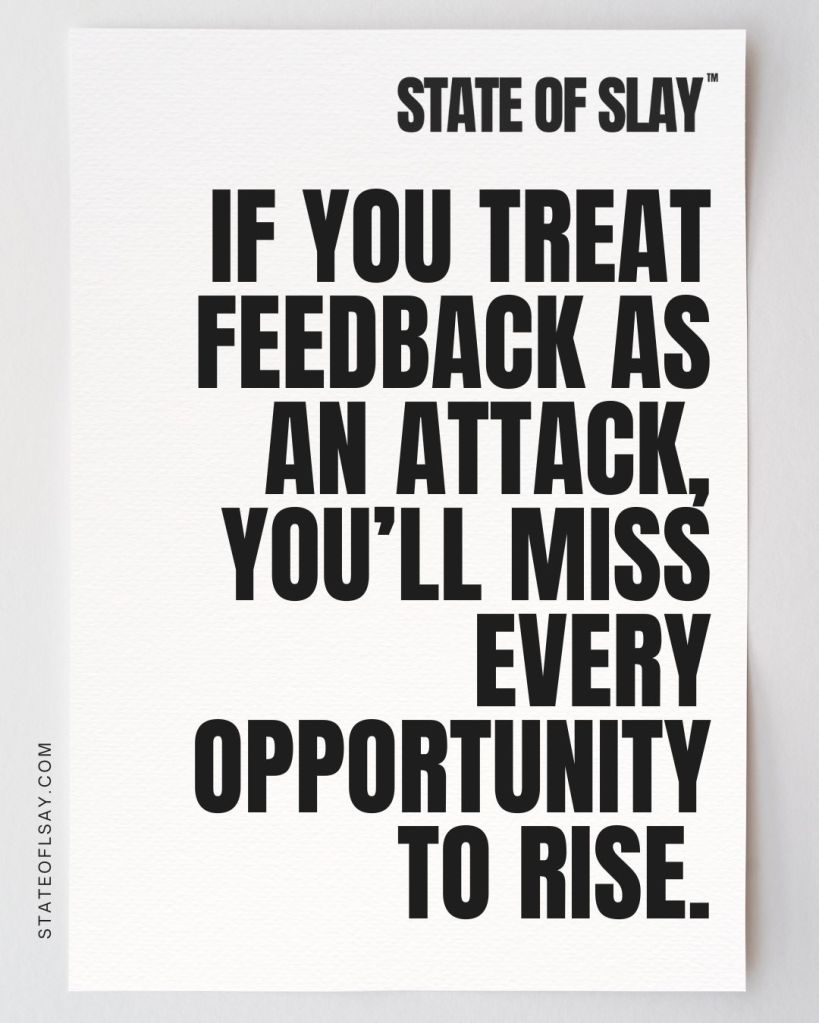
Growth starts where ego ends

It’s not always easy to hear what we need to hear. Sometimes, the truth pokes at our pride before it frees us. But if we want to grow, we have to stop treating feedback like failure. Growth asks for humility, curiosity, and the willingness to be wrong. The most powerful people are the ones who stay open—even when it stings.

If you treat feedback as an attack, you’ll miss every opportunity to rise.

SLAY on!

Your Energy Writes the Invitation

Energy isn’t invisible—it’s contagious. The way we move through the world speaks volumes, long before we say a word. That’s why it’s so important to be mindful of the energy we give off. Because whether we mean to or not, we’re always sending out an invitation—and what we invite will show up.


The Energy Exchange is Always On

You don’t have to be in someone’s presence for long to feel their energy. Some people lift a room. Others bring it down. We’ve all felt it. And whether we like it or not, we’re putting out our own energy, too.

If I’m being real, there were times in my life when I walked around spewing frustration, negativity, or fear—and then wondered why the same kept showing up in return. The truth? The energy I put out was the energy I got back. It wasn’t personal. It was physics.


What You Put Out, You Welcome In

I had to learn the hard way that if I didn’t want chaos, I couldn’t keep putting out anxious, defensive energy. If I didn’t want drama, I had to stop contributing to it. The way I spoke to myself, the way I reacted to others, the thoughts I repeated silently—all of it was casting energetic invitations out into the world.

And the guests always showed up.

It took time and effort to shift the energy I was putting out. But once I started leading with calm, openness, kindness—even when I didn’t fully feel it yet—everything around me began to change.


You Don’t Have to Be Perfect, Just Present

Let’s be clear: we all have hard days. You’re not expected to radiate sunshine 24/7. But awareness is key. Ask yourself:

  • Is this the kind of energy I would want to receive?
  • Would I want someone to speak to me the way I’m speaking to them?
  • Am I leading with intention or just reacting?

Your energy doesn’t have to be perfect—but it should be honest, compassionate, and intentional.


A New Kind of Invitation

Today, I try to think of my energy as a handwritten note I send out to the universe. What does it say? Is it welcoming, kind, curious? Or is it guarded, judgmental, defensive? Whatever I send, I know it’s going to bring something back to me.

So I try to send what I’d want to receive: peace, patience, gratitude, joy. And on the days I can’t muster those feelings genuinely? I pause. I breathe. I reflect. Because I’d rather send nothing at all than send something I’ll regret.

You’re always casting invitations. Make them count.

SLAY on.


SLAY Reflection

  1. What kind of energy are you putting into your relationships, conversations, or even your self-talk?
  2. Have you ever noticed the same energy you give off coming back to you?
  3. What would shift if you led with more kindness or curiosity?
  4. Are there moments in your day where you could pause before reacting?
  5. What kind of invitation do you want your energy to send today?

S-L-A-Y:

  • Slow down before you react.
  • Lead with intention, not impulse.
  • Ask yourself what energy you’re inviting.
  • You have the power to shift the energy in any room.

Call to Action: Join the Conversation
I’d love to hear from you.
What’s one shift you can make today in the energy you’re putting out into the world?
Share your story in the comments. Let’s cheer each other on.

And if you know someone who’s stuck in a negative loop, send this to them.
Sometimes, all we need is a nudge.

No One Can Drive You Crazy Unless You Give Them The Keys

We’ve all had those moments—when someone gets under our skin, disrupts our peace, and throws our entire day off course. Sometimes, it’s a conversation. Other times, it’s a repeated behavior. And before we know it, we’re consumed—playing it over and over in our minds, stewing in frustration, resentment, or defeat.

But here’s the truth:
They only have that power if we hand them the keys.

For a long time, I didn’t see that.
I thought I was just a victim of circumstance, or worse—other people.
But what I was really doing was giving away control.
Letting someone else take the wheel.
And then wondering why I kept crashing.


The Cost of Handing Over the Wheel

In my past, I gave away the keys to my peace all the time.

Sometimes it was people-pleasing—I didn’t want anyone to be upset with me, so I’d go along with something even when it didn’t feel right.
Other times, I hoped that if I just tolerated enough, something good would eventually come of it.
And then there were times I gave away control so I could keep telling the same story: that I was the victim.
That life happened to me.
That I had no power.

It kept me sick.
It kept me stuck.
And it kept me in relationships, situations, and patterns that were not good for me.


Recovery Handed Me Back the Keys

When I began my recovery journey, one of the first things I had to do was take radical responsibility for my own life.

That meant owning my choices.
Being honest with myself about my part.
And realizing that I could no longer blame other people for how I felt, what I did, or what direction my life was going in.

It was sobering at first.
But also liberating.
Because if I had the power to give the keys away…
I also had the power to take them back.


Who’s Driving?

Here’s what I’ve learned:
You can’t complain about where your life is going if you’ve let someone else steer.

Yes—people may have opinions.
Yes—they might try to sway you.
But at the end of the day, you are the one in the driver’s seat.

You decide what’s best for you.
You set the course.
And if someone keeps reaching for the wheel?
It might be time to rethink whether they belong in your vehicle at all.


Emotional Hijacking

Letting someone else “drive” doesn’t always look like direct control.
Sometimes, it’s letting a comment ruin your whole day.
Or replaying an argument in your mind on loop.
Or getting pulled into drama that has nothing to do with you.

These are all ways we give our power away.
All ways we hand over the keys—without even realizing it.

Today, I choose to drive.
Even when the road gets bumpy.
Even when I make a wrong turn.
Because it’s my journey, and I’d rather learn from my own mistakes than crash because someone else took the wheel.


SLAY Reflection: Who’s Driving Your Life?

  1. Do you let others emotionally hijack your peace?
    What triggers this—and how often does it happen?

  2. Have you given someone the power to influence your thoughts, decisions, or direction?
    How does that make you feel?

  3. Are you holding onto resentment or trying to control situations that no longer involve you?
    What would happen if you let that go?

  4. Is there someone in your life who repeatedly tries to take the wheel?
    Is that a healthy relationship—or something that needs to shift?

  5. What can you do today to take your power back and stay in the driver’s seat?
    What boundary needs to be drawn—or reinforced?


Call to Action: Join the Conversation

I’d love to hear from you.
Have you ever handed someone else the keys to your peace—and what did it take to take them back?
Share your story in the comments. Let’s cheer each other on.

And if you know someone who’s giving away their power, send this to them.
Sometimes, all we need is a nudge.

Is It True, Is It Right, Is It Selfish, Is It Loving?

I was speaking with someone recently in recovery about something that was weighing heavily on my heart. I was stuck in my head, unsure what to do, and she gently asked me if I had run it through The Four Absolutes.

That gave me pause.

It had been a while since I’d thought about those—honesty, unselfishness, purity, and love.
She reminded me that those four questions are meant to help guide us in times of emotional confusion:

  • Is it true or false?

  • Is it right or wrong?

  • Is it selfish or unselfish?

  • Is it loving or unloving?

So, I did just that. I ran my situation through this filter. And what had felt so emotionally tangled began to make sense. The noise fell away, and I could finally see what mattered—and what didn’t.


When Feelings Take the Wheel

Before walking this path, I never questioned my feelings.
If I felt it, I believed it.
If I believed it, I acted on it—no pause, no reflection.

The problem? Feelings aren’t facts.

And when you let feelings run the show, especially feelings fueled by fear, pain, or ego, you can spiral down a path that leads to more chaos, not clarity.

That’s why these Four Absolutes matter. They strip away the fluff—
the defensiveness, the assumptions, the justifications—and leave only truth.

They allow us to pause before reacting.
They offer perspective.
And sometimes, they stop us in our tracks—before we say or do something we can’t take back.


Why the Pause Matters

These days, I try to run my emotions through this lens before I act.

  • Is it true?

  • Is it right?

  • Is it selfish?

  • Is it loving?

If I can’t answer those honestly, I pause.
If I can’t say yes to “Is it loving?”—I definitely pause.

That moment of stillness, of reflection, can be the difference between peace and regret.

And it’s not just about being kind to others.
It’s about being kind to ourselves.

Because we’re the ones who have to live with the aftermath of our actions. And when we move through life with intention, we create space for clarity, connection, and growth.


Pause. Reflect. Then Proceed.

In a world that often rushes us toward reaction, pausing is powerful.

Especially during stressful times—when everything feels heightened and emotions are raw—it’s even more important to approach life with intention and grace.

Lead with compassion.
Be passionate, yes.
But don’t let your passion cloud your perspective.

Let your response come from a place of truth, righteousness, selflessness, and love.

Ask yourself:
Is it true? Is it right? Is it selfish? Is it loving?
Then act—with clarity and care.

SLAY on.


SLAY OF THE DAY: Reflect & Rise

Do you pause before reacting—or do you tend to jump in headfirst?

  • What’s your typical emotional response when you’re triggered?

  • Have you ever reacted quickly and later realized your feelings were misdirected?

  • How could using the Four Absolutes have changed that outcome?

  • What tools or “safety nets” can you put in place to help you pause before reacting?

  • How can examining your feelings—rather than acting on them—help you grow?

When we respond from a grounded place, we create a ripple of calm in a chaotic world.
Let your next action reflect the best version of yourself.


Call to Action: Join the Conversation

I’d love to hear from you.
Have you ever used the Four Absolutes to guide a difficult decision?
Share your story in the comments. Let’s cheer each other on.

And if you know someone who could use a moment to pause and reflect—send this their way.
Sometimes, all it takes is a question to shift our perspective.

Name Them, Claim Them, Dump Them

For a long time, I treated my feelings like enemies. I did everything I could to ignore, numb, or bury them—hoping they’d disappear on their own. Spoiler alert: they didn’t.

Sure, I could silence them for a while. Sometimes for years. But those unspoken feelings came at a high cost. Eventually, they nearly cost me my life.


When We Bury Our Feelings, We Bury Ourselves

The longer I ignored my emotions, the louder they got. The more I tried to push them down, the more they pushed back. And when I finally stripped away the things I used to keep them at bay—addiction, distraction, denial—they all came rushing in.

It felt like I was drowning.

But that tidal wave of emotion was the beginning of something new. Something honest. Something healing. I had to learn to acknowledge my feelings—to name them, accept them, and then choose what to do with them.


Name It. Claim It. Dump It.

That became my process. Name it: What exactly am I feeling? Claim it: This is mine. I don’t have to like it, but I have to own it. Dump it: Let go of what no longer serves me.

Some emotions had roots in deep pain, old stories, or unhealthy patterns. Others were tied to my illness—trying to pull me back into the darkness I fought so hard to escape. But once I named them, I could choose whether they stayed.

Not every feeling deserves a seat at your table.


Feelings Don’t Want to Be Ignored

Even now, years into recovery, those old feelings still show up. Sometimes in disguise. Sometimes dressed in new circumstances. But I know better now.

If I ignore them, they grow. If I pretend they aren’t there, they get louder. But if I meet them with truth, honesty, and intention—they lose their power.

Feelings won’t kill you. But hiding from them just might.

I’ve learned that I don’t have to fear my feelings. I just have to deal with them before they deal with me. And when I stay honest, stay kind, and stay vigilant? That’s when I stay free.


SLAY Reflection

  1. Do you try to hide or stuff down your feelings?
  2. What feelings scare you the most—and why?
  3. What have your feelings been trying to tell you lately?
  4. Are you willing to name and claim your emotions?
  5. What outdated feelings are you ready to dump for good?

S-L-A-Y:

  • Slow down and tune in to what you’re feeling.
  • Label it honestly—no shame.
  • Acknowledge what’s useful and what’s not.
  • You get to choose what stays and what goes.

Call to Action: Join the Conversation
I’d love to hear from you.
What feeling are you finally ready to let go of?
Share your story in the comments. Let’s cheer each other on.

And if you know someone who’s been holding back their feelings, send this to them.
Sometimes, all we need is a nudge.

Feelings Can’t Kill You, But Avoiding Them Can

We can’t outrun our feelings forever. We try. We bury them, numb them, distract ourselves from them. But in the end, what we avoid will eventually rise. And for some of us, like it was for me, it can become a matter of life and death. This is a story about learning to feel again—and finding freedom on the other side.


The Fear of Feeling

Before I started walking the path of recovery, I did everything I could to not feel. I didn’t care if the feeling was good or bad—I just didn’t want it. I got so good at pretending everything was fine that I started to believe it myself, until all that was left was the heaviness I’d shoved deep down. The more I numbed, the more detached I became—from others, from joy, from myself.

I turned to anything I could: food, shopping, relationships, alcohol, travel. And it worked, temporarily. But the feelings always bubbled back up. The older I got, the harder it became to keep them down. I was a pressure cooker on the brink of exploding. And when I couldn’t keep the lid on anymore, it nearly destroyed me.


What I Didn’t Know Then

I thought the only way to escape the pain was to end the struggle altogether. I believed no one would understand, that I was alone in what I was feeling. But that wasn’t true. I was just hiding so well that no one had the chance to see me. Luckily, someone did. Someone who had been where I was bravely shared their story with me—and gave me just enough hope to reach out.

It didn’t happen overnight. It took time, more suffering, and finally a breaking point. But I reached out. And that changed everything.


The Tsunami of Emotion

When I began my recovery, I was told I’d have to learn to feel again—and that it would be OK. That idea terrified me. I hadn’t felt my feelings since I was a kid, and those childhood wounds were exactly what I’d been running from. But I couldn’t keep running anymore.

And when I stopped, it hit like a tsunami. Decades of anger, shame, fear, resentment, grief, and heartbreak came crashing in. There were days I could barely get out of bed. Days I clung to my mattress or curled in the bathtub, afraid I’d drown in it all. But you know what? I didn’t drown. I survived. And each time I allowed myself to feel, the intensity lessened. With the support of others, therapy, and time—I began to heal.


Feeling Doesn’t Mean Failing

What I’ve learned is that feelings are just information. They’re not good or bad—they just are. They tell us what we care about, what hurts, what needs our attention. Feeling them doesn’t make us weak. Avoiding them is what breaks us down.

It took time, but I began to see that not only was it safe to feel my feelings—it was necessary. And it was also OK to feel good. That was a big one. After so much pain, it took work to believe I deserved to feel joy. But I did. And so do you.


Choose to Feel

Today, I still check in with myself often. Some feelings are harder than others. Some still scare me. But I know I can face them now. And I know I don’t have to face them alone.

Your feelings can’t kill you—but avoiding them can. They are part of your story, and they deserve to be heard. You deserve to feel, to process, to heal. Take your time. Ask for help. Let the emotions teach you something. Let them show you who you are.

Because when you stop running, that’s when the real journey begins.

SLAY on.


SLAY Reflection

  1. Do you avoid certain feelings? What are they?
  2. How do you typically numb or distract yourself when emotions get hard?
  3. What’s one feeling you’re afraid to face—and why?
  4. Who in your life could support you in feeling safely?
  5. What might change if you let yourself fully feel, without judgment?

S-L-A-Y:

  • Stop numbing and start noticing.
  • Let your emotions rise without shame.
  • Ask for support when you need it.
  • You are allowed to feel—and to heal.

Call to Action: Join the Conversation
I’d love to hear from you.
What’s one feeling you’ve been avoiding—and what’s one small way you could start feeling it today?
Share your story in the comments. Let’s cheer each other on.

And if you know someone who’s struggling to feel, send this to them.
Sometimes, all we need is a nudge.