Slay Say

There are seasons when the world is quiet around you.
When your progress goes unseen,
your efforts go unrecognized,
and the path you are on makes sense only to you.

In those moments, doubt grows loud.
It whispers that if no one else understands the vision,
maybe you should stop believing in it too.

But this is where inner strength is built—
not in applause,
not in validation,
but in choosing to trust your direction
even when you are walking it alone.

Your growth does not require recognition.
Your purpose does not need an audience.
Your next chapter is being shaped in silence long before anyone else notices the shift.

This is your reminder:
The path is still leading you somewhere meaningful,
even when only you can see it.

Slay on!

The First Step Toward Answers Is Being Brave Enough to Ask the Question

There’s a moment — quiet, subtle, easy to miss — when your life begins to shift.
It’s the moment you finally stop pretending you already know. The moment you stop running from the truth. The moment you decide that not knowing is no longer scarier than staying stuck.

That moment is a question.

We don’t talk enough about how much courage it takes to ask one. Because asking a real, honest, soul-level question isn’t just seeking information — it’s opening a door you can’t close again. It’s admitting you want something different. It’s acknowledging that what you’ve been doing is no longer enough.

And for many of us, that is the hardest step of all.


Why We Fear the Questions We Need to Ask

We fear the answers, yes — but often, we fear the asking even more.

Because asking a question means:

  • I might hear something I don’t want to hear.
  • I might have to change.
  • I might be seen.
  • I might learn the truth.

So we avoid it. We distract ourselves. We pretend we’re fine. We convince ourselves we already know how it will go.

But avoidance is its own kind of prison.
And silence is its own kind of answer.

When we refuse to ask the questions that could heal us, save us, free us, or grow us, we stay stuck in a life that feels too small for who we are becoming.


The Questions That Change Everything

Real transformation doesn’t come from having all the answers.
It comes from being willing to ask the uncomfortable questions — the ones that scrape at the truth.

Questions like:

  • What am I afraid to admit?
  • What is this really about?
  • What am I pretending not to know?
  • What do I need?
  • What would I choose if I believed I deserved better?

These are the questions that crack things open.
These are the questions that stop the cycle.
These are the questions that begin your becoming.

And yes — they require courage.
But courage isn’t the absence of fear. Courage is asking the question while your voice trembles.


Answers Don’t Arrive Without an Invitation

There’s a spiritual truth that I learned early in my healing journey:

You cannot receive answers to questions you’re too afraid to ask.

Life will not force clarity on you.
Healing will not push its way in.
Growth will not drag you forward.

You have to invite it.

You have to ask:

  • Why does this pattern keep repeating?
  • What part of me still needs to be healed?
  • What is this trying to teach me?

When you ask the question, the universe, your intuition, your higher self — whatever language you use — finally has somewhere to deliver the answer.

Asking the question is the knock on the door.
The answer is what steps through.


Bravery Looks Like Curiosity, Not Certainty

We think bravery requires confidence.
But most of the bravery in my life came in moments where I didn’t feel certain at all.

Bravery looked like:

  • sitting with someone and saying, “I don’t know how to fix this — can we talk?”
  • looking in the mirror and whispering, “Why do I keep hurting myself this way?”
  • asking for help long before I believed I deserved it
  • admitting I didn’t have control — and never really did

Questions are not weakness.
Questions are self-respect.
Questions are the beginning of wisdom.

The bravest people I know aren’t the ones with the answers — they’re the ones willing to keep asking.


You Deserve the Life That Lives Beyond the Question

There is a version of you waiting on the other side of one brave question.

A more grounded you.
A more peaceful you.
A more aligned, self-aware, self-honoring you.

But you cannot reach her — cannot step into her — if you’re unwilling to ask what needs to be asked.

Whether it’s a question about love, healing, boundaries, forgiveness, purpose, or truth, your life expands the moment you become brave enough to be curious.

Asking the question doesn’t guarantee the answer will be easy.
But not asking guarantees nothing will change.

SLAYER, don’t let fear keep you from the clarity that could change your entire life.

Ask.
Be curious.
Be brave.

Your answers are waiting.


SLAY Reflection

  1. What important question have you been avoiding — and why?
  2. What fear shows up when you imagine asking it?
  3. How might your life shift if you allowed yourself to seek clarity?
  4. What question could help you break a repeating pattern in your life?
  5. What small act of courage can you take this week to open the door to the answers you need?

  • S – Seek clarity instead of avoiding discomfort
  • L – Let curiosity lead you toward truth
  • A – Ask bravely, even when you’re afraid
  • Y – Yield to the wisdom that arrives when you open the door

Call to Action: Join the Conversation

I’d love to hear from you.
What question are you finally brave enough to ask yourself?
Share your story in the comments. Let’s cheer each other on.

And if you know someone who’s been afraid to seek the truth, send this to them.
Sometimes, the right question is the beginning of a new life.

Slay Say

You discover who you are the moment you stop auditioning for acceptance.

We learn to shape-shift early.
To fit the room.
To earn approval.
To become what makes others comfortable—even if it costs us pieces of ourselves.

But there comes a moment when the performance gets too heavy.
When pretending feels louder than truth.
When the mask you’ve been holding starts to slip…
and underneath it is the version of you that’s been waiting for air.

Real identity isn’t found in perfection or presentation.
It’s found in the quiet courage to show up as yourself—without shrinking, without apologizing, without molding your worth around someone else’s gaze.

Stepping out of the role others expect isn’t rebellion.
It’s alignment.
It’s freedom.
It’s the first step toward a life that finally fits.

This is your reminder:
You don’t need to audition for a role that was already yours.

Slay on!

Slay Say

Honor the Turn

Life doesn’t always move in straight lines.
Sometimes the path you planned
stops matching the person you’re becoming.

A pivot isn’t a setback —
it’s a moment of truth.
A quiet realization that what once fit
no longer aligns with where you’re headed.

Clarity shows you the shift.
Courage is what allows you to make it.

You’re not abandoning the journey.
You’re choosing a better direction.
One that honors your growth,
your intuition,
your becoming.

This is your reminder:
You’re allowed to change course
when your soul asks you to.

Slay on!

Slay Say

The Quiet Kind of Strength

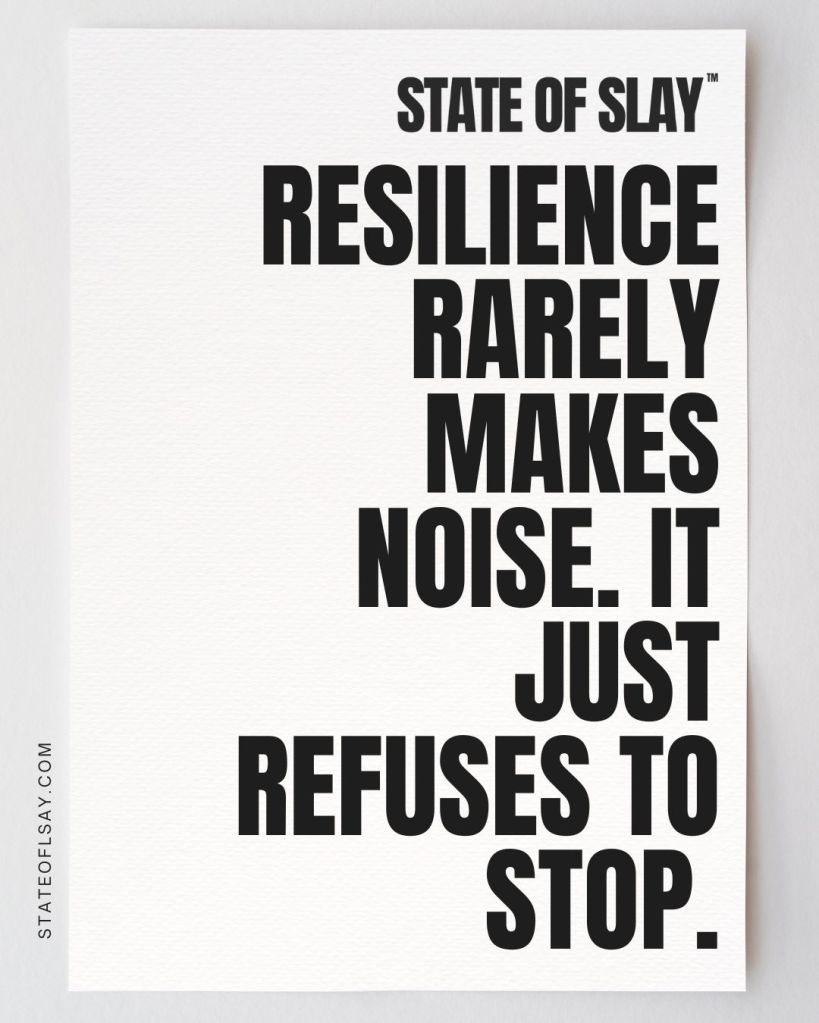
Real resilience doesn’t demand attention.
It doesn’t need to announce itself or prove a point.

It’s the steady breath in the middle of the storm.
The quiet decision to try again.
The choice to keep moving, even when no one is watching.

Power isn’t always loud.
Sometimes it’s the whisper that says, not today.

You’ve survived moments you thought would break you—
not because you shouted through them,
but because you stayed.

This is your reminder that quiet strength
is still strength.

Slay on!

Slay Say

Where You Stand, You Belong

Imposter syndrome whispers that you’re lucky to be here—
but luck didn’t build the path beneath your feet.

You did.

Every risk you took, every doubt you silenced,
every time you showed up scared but still showed up—
that’s what opened the door.

You earned your place.
You belong in every space your growth has brought you to.

The room didn’t make you worthy.
Your courage did.

This is your reminder to stop questioning your seat at the table
and start owning the strength that got you there.

Slay on!

Nothing You Say or Do Is Too Bad to Tell Somebody

For most of my life, I believed there were things about me that were too dark, too shameful, too unforgivable to share. I told myself, no one could handle the truth about me.

So, I kept secrets. I smiled when I was breaking. I said, “I’m fine,” when I wasn’t. I built walls out of silence—strong, tall, and unshakeable.

But what I didn’t know back then was that silence doesn’t protect you. It poisons you.

The belief that “there’s nothing I say or do that is too bad to tell somebody” didn’t come to me easily. It came after years of hiding, years of shame, and years of trying to heal alone.


Shame Thrives in Silence

Shame wants to keep you quiet. It whispers that if anyone knew the truth, they’d leave. That you’d be judged. Rejected. Unlovable.

But here’s what I’ve learned: when you say the thing you’ve been afraid to say, you take away shame’s power.

I’ve watched people share their deepest secrets—addiction, abuse, betrayal, trauma—and instead of being met with disgust, they were met with compassion.

That’s the thing about truth—it connects us.

No matter how different our experiences are, the feelings underneath are universal. Fear. Regret. Guilt. Loneliness. And when we share those feelings, we remind each other we’re human.


The Lie of “Too Much”

Somewhere along the way, many of us learned that vulnerability equals weakness. That we should keep it together, hold it in, and never show the messy parts.

We learned to say, “It’s no big deal,” when it was.
We learned to minimize our pain so others wouldn’t feel uncomfortable.
We learned to smile instead of speak.

But here’s the truth: you are not “too much.” You are not too broken, too complicated, or too far gone.

The things you’re afraid to say out loud are often the things that will set you free.

When you find someone safe—a therapist, a friend, a sponsor, a mentor—and tell them what you’ve been holding, it stops controlling you.

You break the cycle of secrecy.
You interrupt the story shame keeps replaying.
You step into healing.


The Power of Being Heard

When I finally opened up about the things I thought were “too bad to tell anybody,” I was terrified. My voice shook. My stomach twisted. I almost didn’t go through with it.

But I did.

And when I did, something incredible happened—I didn’t fall apart. I was held.

That moment taught me something I’ll never forget:

The human heart is built to hold not only our own pain, but the pain of others too.

We are meant to carry one another.

Healing happens in connection. It happens when someone looks at you and says, “Me too.”

That simple acknowledgment is enough to make the walls you’ve built start to crumble.


You Are Not Your Mistakes

You are not the things you’ve done. You are not the worst decision you’ve made. You are not the shame someone else handed you.

We all make mistakes. We all have moments we wish we could rewrite. But those moments don’t define you—they refine you.

When you find the courage to speak your truth, you stop living in fear of being found out. You realize that nothing you’ve done disqualifies you from love, belonging, or forgiveness.

And the more honest you become, the freer you get.

Honesty is the antidote to shame.


How to Begin Speaking Your Truth

If you’ve spent your life believing there are things too bad to share, here’s where to start:

  1. Find a safe person. This could be a trusted friend, a sponsor, or a counselor. Safety is key.
  2. Start small. You don’t have to unload everything at once. Begin with what feels manageable.
  3. Be honest with yourself first. Write it down, say it out loud to the mirror, or pray about it. Naming your truth gives it form.
  4. Expect discomfort. Vulnerability is brave, and bravery rarely feels comfortable.
  5. Stay open to compassion. People can surprise you. Let them.

The point isn’t to confess for pity—it’s to connect for healing.


Freedom Lives in the Light

Every time you tell the truth about your story, you let the light in.

You start to see that your worst moments were also your teachers. That the parts of you you’ve tried to bury have shaped your strength, empathy, and resilience.

And once you realize that, you can’t go back.

You can’t go back to pretending you’re fine.
You can’t go back to silencing yourself.
You can’t go back to believing you’re unworthy of love.

Because once you’ve been met with compassion where you expected judgment, you know the truth:

There is nothing you can say or do that is too bad to tell somebody.

Not because it wasn’t bad—but because you’re still worthy. Always have been. Always will be.


SLAY Reflection

  1. What’s one truth you’ve been afraid to speak?
  2. Who in your life feels safe enough to share it with?
  3. How has silence kept you stuck?
  4. What might freedom look like if you let someone in?
  5. How can you show that same compassion to someone else today?

S – Speak your truth, even if your voice shakes
L – Let go of the shame that keeps you small
A – Allow yourself to be seen and supported
Y – Yield to healing—connection over isolation


Call to Action: Join the Conversation

I’d love to hear from you.
What truth did you finally speak—and how did it change you?
Share your story in the comments. Let’s cheer each other on.

And if you know someone who’s carrying something they think is “too bad to tell anybody,” send this to them.
Sometimes, all it takes is one brave share to set someone free.

Slay Say

Speak Even If Not Everyone Listens

Not everyone will understand your truth. Some may dismiss it, ignore it, or even resist it. But that doesn’t mean your voice has no value.

Your words will find their way to the ones who are ready to hear them, the ones who need the reminder, the encouragement, or the strength your voice carries.

This is your reminder that silence serves no one. Keep speaking. Keep sharing. Your voice will reach the hearts it was meant for.

Slay on!

An Arrow Can Only Be Shot by Pulling It Backwards

There’s a powerful lesson tucked inside one of life’s simplest metaphors: an arrow can only be launched by first being pulled backwards.

At first, that pull feels like resistance. Pressure. Setback. You’re yanked away from where you want to go, pulled into discomfort, frustration, and sometimes even pain. But the truth is this: without that tension, without that backward stretch, there is no forward release.

Life’s pullbacks are not punishments—they are preparation.

The key is to not get stuck staring at the ground when life pulls you back. Instead, steady yourself, take aim, and get ready. Because what feels like a setback now may be the very momentum that propels you toward something greater.


The Backward Pull Feels Personal

When life pulls us back, it rarely feels neutral. It feels personal.

The relationship ends. The job falls through. The opportunity disappears. Suddenly, it feels like life is conspiring against us, stripping away what we wanted most. And in the middle of that loss, it can feel impossible to see any kind of trajectory forward.

But here’s the truth: the arrow doesn’t know it’s being pulled back to soar further—it only feels the tension. And we’re the same way.

The backward pull of life is often the exact energy we need to realign, refocus, and prepare for a different kind of future.


Take Aim: Purpose in the Pause

An arrow doesn’t just fly aimlessly—it’s aimed. The backward pull isn’t random; it’s part of the process.

When life feels like it’s dragging you back, the invitation is to pause and take aim.

Ask yourself:

  • What am I being redirected toward?
  • What lessons am I meant to carry from this moment?
  • What strength am I building through this resistance?

Taking aim doesn’t mean you’ll have all the answers right away. It means you choose not to waste the pullback. You align yourself with purpose, even if the target feels blurry.


The Release: Trusting the Launch

When the arrow is finally released, it doesn’t hesitate. It doesn’t fight the momentum. It doesn’t question the trajectory. It simply flies.

That’s the moment you’ve been stretched for.

The release is the job that finally matches your calling, the relationship that respects your worth, the moment you realize your strength has carried you further than you thought possible. It’s not about erasing the pullback; it’s about realizing that every inch of that resistance fueled the flight.


The Power of Perspective

Pullbacks and setbacks will always come. But here’s the difference between staying stuck and soaring forward: perspective.

If you see the pullback as failure, you’ll stay grounded. If you see it as preparation, you’ll find the courage to aim higher.

Every backward tug is an opportunity to grow resilience, clarity, and faith. It’s proof that you’re still in motion—that life is stretching you for something greater.


Your Bow, Your Aim, Your Flight

Remember, you are both the archer and the arrow.

You get to choose:

  • Do you fight the pull and call it defeat?
  • Or do you trust the stretch, take aim, and let yourself fly?

The setbacks won’t define you. The release will.

So the next time life pulls you back, don’t panic. Don’t lose heart. Steady your grip. Breathe. Take aim. And get ready—because you are about to soar.


SLAY Reflection

  1. Where in your life right now do you feel like you’re being pulled backwards?
  2. How can you reframe that pullback as preparation instead of punishment?
  3. What’s one target you want to take aim at, even if it feels blurry today?
  4. How can you use resistance as fuel for your momentum?
  5. What would trusting the release look like for you?

S – See setbacks as setups, not endings
L – Let the pullback strengthen your aim
A – Align with purpose, not panic
Y – Yield to the release and trust your flight


Call to Action: Join the Conversation

I’d love to hear from you.
What pullback in your life ended up being the momentum you needed to soar?
Share your story in the comments. Let’s cheer each other on.

And if you know someone who feels stuck in a setback, send this to them.
Sometimes, all we need is a reminder that the stretch is preparing us for the flight.

I Heal Out Loud Because I Nearly Died in Silence

Silence almost killed me.

For years, I bottled everything inside—pain, fear, shame, grief, anger—because I thought speaking it out loud would make me weak, unworthy, or too much. I believed that my feelings were a burden, that no one wanted to hear the truth, and that the safest way to exist was behind a mask.

But here’s the thing about silence: it doesn’t protect you—it suffocates you.

When we swallow our pain instead of releasing it, it eats away at us. The secrets, the shame, the unspoken words—they pile up until they feel unbearable. And for me, they almost were.

That’s why today, I heal out loud. Because staying silent nearly cost me everything.


The Danger of Silent Suffering

We live in a culture that often rewards keeping it together. Smile when you’re breaking inside. Say you’re fine when you’re anything but. Push through no matter how heavy the weight.

I wore that mask for years. I said yes when I wanted to say no. I smiled when I wanted to scream. I denied myself the very human right to feel, because I thought silence kept me safe.

But silence didn’t keep me safe—it made me sick. It fed my depression, deepened my shame, and convinced me that I was alone. And when you believe you’re alone, hopelessness creeps in. That’s a dangerous place to live.

Unspoken pain doesn’t disappear—it festers. And the more we bury it, the more it convinces us we don’t deserve light.


Why Healing Out Loud Matters

Healing out loud doesn’t mean sharing every detail of your life with the world. It doesn’t mean turning your pain into a performance.

It means refusing to carry it alone anymore. It means telling the truth—to yourself, to someone you trust, to a community that understands.

For me, healing out loud started with small steps: admitting to a friend that I wasn’t okay, reaching out for help, speaking the words I had locked away for so long. Each time I spoke, the silence lost some of its power.

When you voice your truth, you cut shame off at the knees. Shame can’t survive in the light.

And as I began to heal out loud, something unexpected happened: people leaned in. They said, “Me too.” They shared their own stories. They told me I wasn’t alone.


The Power of Vulnerability

We think silence makes us strong, but real strength comes from vulnerability.

It takes courage to say: I’m hurting. I’m scared. I need help.

And yet, that’s where transformation begins. Vulnerability is not weakness—it’s the bridge to connection, compassion, and healing.

I learned that my silence kept people out, but my vulnerability drew them close. It built trust. It created bonds rooted in honesty instead of performance. And it allowed me to step into the fullness of who I am—messy, imperfect, human, but alive.

Healing out loud is how we reclaim our power from the very things that tried to silence us.


From Surviving to Thriving

The shift from silent suffering to speaking my truth didn’t happen overnight. It was clumsy, scary, and uncomfortable. But every time I let the words out, I felt a little lighter.

And slowly, my healing turned into living.

I stopped existing just to survive the day. I started building a life rooted in truth, love, and connection. I surrounded myself with people who could hold space for my story without judgment. And I realized that sharing my voice not only saved me—it helped others too.

Because when you heal out loud, you give others permission to do the same. You become a mirror that reflects back courage, honesty, and hope.


Practical Ways to Heal Out Loud

If you’ve been living in silence, here are a few ways to begin:

  • Name it. Write down what hurts, what scares you, what you’ve been carrying. Naming it is the first step to releasing it.
  • Speak it to someone safe. Choose a trusted friend, mentor, therapist, or support group. Let your truth be heard by someone who can hold it with care.
  • Create a ritual of release. Journaling, prayer, meditation, or even saying your truth out loud in private can help shift it from inside to outside.
  • Set boundaries with silence. You don’t owe your story to everyone. Healing out loud means choosing where and when to share, with intention.
  • Celebrate your courage. Every time you speak instead of stuffing it down, acknowledge your strength. Healing is a practice, not a performance.

A New Way to Live

I heal out loud now, not because it’s easy, but because I know what silence nearly cost me. I know the danger of secrets. I know the weight of carrying pain alone.

Healing out loud doesn’t erase the scars. It transforms them into reminders of resilience, proof that you can walk through the fire and come out stronger.

Your voice matters. Your truth matters. You matter.

So, if you’ve been silenced by shame, fear, or judgment—let today be the day you begin to speak. Whisper if you have to. Write it if you can’t yet say it. Share it with one safe person.

Because silence takes life, but truth gives it back.


SLAY Reflection

  1. Where in your life have you been silencing your truth?
  2. How has that silence affected your health, relationships, or self-worth?
  3. Who is one safe person you could begin sharing your truth with?
  4. What fears come up when you imagine speaking out loud?
  5. What freedom might you find if you allowed yourself to heal out loud?

S – Speak your truth instead of burying it
L – Let others in who can hold space for your story
A – Acknowledge the courage it takes to be vulnerable
Y – Yield to healing by bringing light to your silence


Call to Action: Join the Conversation

I’d love to hear from you.
Have you ever found freedom in sharing what you once kept silent?
Share your story in the comments. Let’s cheer each other on.

And if you know someone who’s struggling in silence, send this to them.
Sometimes, hearing “me too” is what saves us.