You Never Look Good Making Someone Else Look Bad

There was a time in my life when I thought winning meant being right.

Having the last word.
Proving my point.
Defending myself loudly.
Making sure my side of the story was known.

I believed that if I made someone else look wrong, I somehow looked better.

But that kind of “power” is hollow.

Because here’s the truth, I had to learn the hard way:

You never look good making someone else look bad.


Prefer to listen? The Audio Blog version is available here.


When Ego Masquerades as Strength

It’s easy to confuse reaction with strength.

Clapping back feels powerful.
Calling someone out feels justified.
Exposing flaws feels like control.

Especially when you’re hurt.

Especially when you feel misunderstood.
Especially when you feel wronged.
Especially when you feel disrespected.

But most of the time, that reaction isn’t strength — it’s pain trying to protect itself.

It’s ego trying to survive.


What It Actually Costs You

Every time we try to elevate ourselves by diminishing someone else, we lose something.

We lose dignity.
We lose integrity.
We lose clarity.
We lose alignment with who we say we are.

It doesn’t bring peace.
It doesn’t bring healing.
It doesn’t bring resolution.

It only brings more noise.

And more distance from ourselves.


I Had to Learn This Through Experience

I’ve been on both sides of this.

I’ve been the one hurt.
I’ve been the one reactive.
I’ve been the one defensive.
I’ve been the one who needed to feel seen.

And I’ve learned that nothing I ever gained by tearing someone else down made me feel better for long.

Not once.

What did change things was choosing restraint.

Choosing silence over spectacle.
Choosing dignity over drama.
Choosing growth over gratification.

That choice didn’t make me weak — it made me free.


Healing Changes How You Handle Conflict

When you’re healing, you stop needing to prove yourself.

You stop needing validation from chaos.
You stop needing to control the narrative.
You stop needing to win every interaction.

Because your worth isn’t up for debate.

You don’t need to make someone else look small to feel big.

You don’t need to expose someone else to feel seen.

You don’t need to damage someone else to feel whole.


Strength Is Quiet

Real power doesn’t announce itself.

It doesn’t need applause.
It doesn’t need witnesses.
It doesn’t need a platform.

It shows up as restraint.
As self-control.
As emotional maturity.
As boundaries.
As integrity.

Sometimes the strongest thing you can do is walk away without explaining.


Your Character Is Always on Display

People may not remember the details of the conflict.

But they remember how you handled it.

They remember your energy.
Your tone.
Your behavior.
Your posture.
Your restraint — or lack of it.

Character speaks louder than argument.


You Can Protect Yourself Without Destroying Others

Boundaries don’t require humiliation.
Truth doesn’t require cruelty.
Healing doesn’t require revenge.
Growth doesn’t require comparison.

You can hold people accountable without making them small.

You can speak truth without tearing someone down.

You can walk away without burning everything behind you.


Choose Who You’re Becoming

Every conflict is a mirror.

It shows you who you are — and who you’re becoming.

You get to choose:

Reaction or reflection
Ego or evolution
Drama or dignity
Noise or peace

Because every response is shaping your identity.


You Don’t Rise by Lowering Others

You rise by becoming more of yourself.

More grounded.
More aware.
More aligned.
More whole.
More healed.

Elevation comes from integrity — not comparison.


SLAY Reflection

Let’s reflect, SLAYER:

S: Where have you felt tempted to make someone else look bad to protect yourself?
L: What emotion was really driving that reaction?
A: What would strength look like instead of reactivity?
Y: How would your life shift if you chose dignity over drama more often?


Call to Action: Join the Conversation

I’d love to hear from you.
Have you ever noticed how different it feels to walk away with dignity instead of winning an argument?
Share your story in the comments. Let’s cheer each other on.

And if you know someone stuck in conflict or comparison, send this to them.
Sometimes, all we need is a nudge.

Slay Say

Fear doesn’t always arrive as chaos.
Sometimes it shows up quietly — in overthinking, in hesitation, in the stories you tell yourself about what might happen.

You don’t stop living because something is happening.
You stop living because you imagine it might.

And over time, those imagined outcomes begin to shape your choices, your risks, your voice, and your freedom.

Not every thought deserves authority.
Not every fear deserves belief.
Not every worry deserves a vote in your future.

This is your reminder to question the thoughts that limit you,
challenge the fears that confine you,
and choose movement over mental captivity.

Slay on.

Slay Say

There’s a quiet voice inside you that notices patterns before your mind explains them.
It senses misalignment early.
It flags what feels off long before consequences appear.

When that voice is ignored, life has a way of circling back—not to punish, but to teach.
What you overlook doesn’t disappear.
It waits.
And it often returns louder, heavier, and harder to avoid.

Trust isn’t built by always getting it right.
It’s built by listening sooner.
By honoring what you already know instead of negotiating against it.

This is your reminder:
Pay attention the first time something feels wrong.
Your inner wisdom is trying to save you a lesson you don’t need to repeat.

Slay on.

Shed Your Shell

There comes a moment in growth when what once protected you starts to restrict you.

The shell that kept you safe.
The space that helped you survive.
The role that made sense for who you were.

At some point, it stops fitting.

Nature offers us a powerful metaphor for this: turtles don’t stay in the same shell forever. The shell grows with them. And in the in-between — the moment when one shell no longer fits and the next is forming — there is vulnerability.

Exposure.
Uncertainty.
Risk.

But there is also expansion.

And the question becomes: Is it time for you to shed a space you’ve outgrown?


Prefer to listen? The Audio Blog version is available here.


When Protection Becomes Confinement

Most of us build shells for a reason.

We create emotional armor to survive pain.
We stay in environments that once felt safe.
We cling to identities that kept us accepted.

Those shells serve a purpose — until they don’t.

What once protected you can begin to suffocate you.
What once felt like safety can start to feel like stagnation.

And when growth begins pressing from the inside, the shell cracks.

Not because you’re failing — but because you’re expanding.


The In Between Is the Scariest Part

Shedding a shell doesn’t mean instantly stepping into something new and perfect.

There is often a space in between.

A season where you don’t quite know who you are yet.
Where the old no longer fits and the new hasn’t fully formed.
Where you feel exposed, tender, and unsure.

This is the part most people try to avoid.

They rush to replace what they’ve outgrown.
They stay longer than they should.
They squeeze themselves back into something familiar, even when it hurts.

But growth doesn’t happen by retreating.

It happens by trusting the in-between.


Vulnerability Is Not Weakness It’s Transition

The time between shells feels vulnerable because it is.

But vulnerability is not failure.
It’s movement.

It’s the space where truth gets clearer.
Where alignment becomes non-negotiable.
Where you stop pretending you still fit somewhere you don’t.

You are not meant to stay exposed forever — but you are meant to pass through this phase honestly.

Avoiding vulnerability delays expansion.


Outgrowing Spaces Is a Sign of Growth

We often shame ourselves for wanting more.

More room.
More truth.
More alignment.

But outgrowing a space doesn’t mean it was wrong.
It means it worked — and now you’ve grown.

You can be grateful for what once held you and still release it.

Growth doesn’t erase the past.
It builds on it.


You Can’t Move Into a Bigger Shell While Clinging to the Old One

This is the part that requires courage.

You cannot expand while holding onto what no longer fits.

You can’t grow into a larger life while shrinking yourself to stay comfortable for others. You can’t access your next level while insisting on staying in the same environment, relationship, or role that limits you.

Letting go doesn’t mean you know exactly what’s next.

It means you trust that what’s next requires more room than what you’re in now.


Discomfort Is Often the Doorway

The urge to shed your shell usually arrives as discomfort.

Restlessness.
Irritation.
A quiet knowing that something is off.

Instead of asking, “What’s wrong with me?”
Try asking, “What no longer fits?”

Discomfort is often the signal that growth is already happening.


You Are Allowed to Choose Expansion

You don’t need permission to grow.

You don’t need everything figured out before you move.
You don’t need certainty to trust yourself.

You only need honesty.

If the space you’re in feels tight, limiting, or misaligned — it may be time to shed it.

Not recklessly.
Not impulsively.
But intentionally.

Growth asks us to release what’s too small so we can step into what’s next.


The Bigger Shell Is Waiting

The next shell doesn’t appear while you’re clinging to the old one.

It forms as you grow.

As you trust yourself.
As you tolerate vulnerability.
As you honor the truth that you are no longer who you were.

You were never meant to stay the same size forever.


SLAY Reflection

Let’s reflect, SLAYER:

S: What space in your life feels tight, limiting, or outgrown?
L: What shell have you been holding onto because it once kept you safe?
A: What fears come up when you imagine letting it go?
Y: What might be possible if you trusted the in-between and allowed yourself to expand?


Call to Action: Join the Conversation

I’d love to hear from you.
Is there a space in your life you know you’ve outgrown — and what’s holding you back from shedding it?
Share your story in the comments. Let’s cheer each other on.

And if you know someone standing at the edge of growth, send this to them.
Sometimes, all we need is a nudge.

You Grow Faster by Subtraction Rather Than Addition

We’re often taught that growth means adding more.

More goals.
More habits.
More productivity.
More people.
More commitments.

So when we feel stuck, our instinct is to pile on — another plan, another promise, another version of ourselves we think we need to become.

But real growth doesn’t usually happen that way.

You grow faster by subtraction rather than addition.

By removing what drains you instead of constantly trying to become more.


Prefer to listen? The Audio Blog version is available here.


Why We Think More Is the Answer

From a young age, we’re conditioned to believe that expansion comes from accumulation.

If something isn’t working, we add effort.
If we’re unhappy, we add distractions.
If we’re insecure, we add validation.

But more doesn’t automatically mean better.

More can mean overwhelmed.
More can mean misaligned.
More can mean further away from yourself.

Growth that relies only on addition often ignores the real issue — that something no longer belongs.


Subtraction Creates Space for Clarity

When you remove what isn’t aligned, something powerful happens.

Your energy returns.
Your focus sharpens.
Your nervous system calms.

Subtraction creates space — and space is where clarity lives.

You can’t hear your own voice when your life is too loud. You can’t feel aligned when everything is pulling at you.

Sometimes the most productive thing you can do is let go.


What Subtraction Often Looks Like

Growth by subtraction doesn’t always look dramatic.

It can look like:

  • Stepping back from relationships that drain you
  • Letting go of habits that numb instead of heal
  • Releasing roles you’ve outgrown
  • Saying no without overexplaining
  • Stopping the pursuit of approval

These choices may feel uncomfortable at first — especially if you’re used to earning your worth through doing or giving.

But discomfort doesn’t mean wrong.
It often means necessary.


Why Letting Go Feels So Hard

Subtraction challenges identity.

When you remove something, you’re forced to ask:
Who am I without this?

That fear keeps many people stuck. They’d rather carry what’s heavy than face the uncertainty of what’s next.

But holding on doesn’t preserve who you are — it prevents who you’re becoming.

Growth requires trust. Trust that what’s meant for you will meet you where you are, not where you were.


Subtraction Is an Act of Self Trust

Every time you let go of something that no longer fits, you’re telling yourself:

I trust my instincts.
I trust my boundaries.
I trust that I don’t need to earn rest, peace, or alignment.

Subtraction isn’t quitting.
It’s refining.

It’s choosing quality over quantity.
Alignment over obligation.
Depth over noise.


Growth Isn’t Always About Becoming It’s About Releasing

We romanticize transformation as becoming something new.

But often, growth is about returning to what was already there — buried under expectations, pressure, and self betrayal.

When you subtract what doesn’t belong, you don’t lose yourself.

You reveal yourself.


Less Makes Room for What Matters

When you stop carrying what isn’t yours, you have room for what is.

More presence.
More peace.
More creativity.
More connection.

Not because you chased them — but because you made space for them.

That’s how growth accelerates.


You Don’t Have to Add to Be Enough

If you’re feeling behind, overwhelmed, or disconnected, ask yourself this:

What am I holding onto that I don’t need anymore?

Growth doesn’t always ask you to do more.

Sometimes it asks you to release.

And that release might be the thing that finally lets you move forward.


SLAY Reflection

Let’s reflect, SLAYER:

S: What in your life feels heavy, draining, or misaligned right now?
L: What have you been afraid to let go of — and why?
A: What could shift if you removed one thing instead of adding another?
Y: How might your growth accelerate if you trusted subtraction as part of the process?


Call to Action: Join the Conversation

I’d love to hear from you.
What’s something you let go of that helped you grow faster or feel more aligned?
Share your story in the comments. Let’s cheer each other on.

And if you know someone overwhelmed by “doing more,” send this to them.
Sometimes, all we need is a nudge.

Self-Betrayal

Self betrayal rarely looks dramatic.

It doesn’t always arrive as a big, obvious choice.
It often shows up quietly — in the moments we go against ourselves just to keep the peace, to avoid conflict, or to feel chosen.

It’s the yes we give when our body is screaming no.
The truth we swallow because it feels inconvenient.
The boundary we erase because we’re afraid to be left.

And every time we do it, a small part of us learns that our needs are optional.


What Self Betrayal Really Is

Self betrayal is not about making mistakes.

It’s about abandoning your inner truth to make someone else comfortable.

It happens when you prioritize being liked over being honest.
When you ignore your intuition.
When you stay in situations that don’t respect who you are.

Over time, self betrayal doesn’t just create discomfort — it creates disconnection. You stop trusting yourself. You stop hearing your own voice. You start needing permission to feel what you feel.

And that’s where resentment and exhaustion are born.


Why We Learn to Betray Ourselves

Most of us didn’t wake up one day and decide to abandon ourselves.

We learned it.

We learned that love was conditional.
That approval came with a price.
That being easy was safer than being real.

So we adapted.

We became agreeable.
We minimized our needs.
We learned how to read the room instead of reading our own heart.

Those patterns might have protected us once — but they don’t serve the people we’re becoming.


The Cost of Self Betrayal

The cost isn’t just emotional.

It shows up as anxiety.
Burnout.
Chronic people pleasing.
A feeling that something is always off.

When you keep betraying yourself, your body knows — even when your mind tries to justify it.

That inner tension is the part of you that refuses to disappear.


Rebuilding Trust With Yourself

Healing from self betrayal begins with listening.

Not to everyone else — to you.

To your discomfort.
To your boundaries.
To the small quiet voice that says, “This doesn’t feel right.”

Every time you honor that voice, you rebuild trust.

You don’t have to get it perfect. You just have to stop ignoring yourself.


Boundaries Are Not Rejection They Are Self Respect

Saying no doesn’t mean you’re selfish.
Speaking up doesn’t mean you’re difficult.
Choosing yourself doesn’t mean you don’t care.

It means you do.

Boundaries are how you protect the relationship you have with yourself — and that relationship shapes every other one you have.


You Are Allowed to Change Your Mind

One of the most powerful ways to stop self betrayal is giving yourself permission to shift.

To grow.
To outgrow.
To choose differently.

You don’t owe anyone the old version of you.

You owe yourself the truth.


Integrity Begins on the Inside

Integrity isn’t just about what you do in public.

It’s about how you treat yourself when no one else is watching.

Are you listening to your needs?
Are you honoring your limits?
Are you telling yourself the truth?

That’s where self respect lives.


SLAY Reflection

Let’s reflect, SLAYER:

S: Where in your life have you been saying yes when you meant no?
L: What fears have kept you from being honest with yourself?
A: What boundary would bring you back into alignment?
Y: How would your life change if you stopped abandoning yourself?


Call to Action: Join the Conversation

I’d love to hear from you.
Where have you noticed self betrayal in your own life and what helped you start choosing yourself again?
Share your story in the comments. Let’s cheer each other on.

And if you know someone who keeps putting themselves last, send this to them.
Sometimes, all we need is a nudge.

Life Is Coming From You Not at You

It’s easy to believe that life is something that happens to us.

The setbacks.
The disappointments.
The unexpected turns.

When things go wrong, it can feel like we’re constantly reacting — bracing for impact, waiting for the next shoe to drop, wondering what we did to deserve it.

But here’s the truth that changes everything:

Life is coming from you, not at you.

And once you understand that, you stop living in defense mode and start living with intention.


The Difference Between Reacting and Creating

When you believe life is happening at you, everything feels personal.

Every delay feels like punishment.
Every challenge feels unfair.
Every obstacle feels like proof you’re doing something wrong.

So you react.
You tighten up.
You operate from fear instead of choice.

But when you realize life is coming from you, something shifts.

You begin to see that your thoughts, beliefs, boundaries, and patterns are shaping the experience you’re having — not in a blame-yourself way, but in an empowering one.

You are not powerless.
You are participating.


What You Carry Shapes What You Experience

Life responds to the energy we bring into it.

When we move through the world carrying unresolved fear, resentment, or shame, we tend to interpret everything through that lens. Neutral situations feel threatening. Challenges feel personal. Growth feels unsafe.

But when we do the inner work — when we heal, set boundaries, and get honest with ourselves — life starts to feel different.

Not easier, necessarily.
But clearer.
More aligned.
More intentional.

The external may not change overnight, but how we experience it does.


Responsibility Is Not the Same as Blame

This is where many people get stuck.

Taking responsibility for your life does not mean blaming yourself for what happened to you.

It means recognizing where your power lives now.

You didn’t choose every circumstance.
You didn’t cause every wound.
You didn’t control everything that shaped you.

But you do get to choose how you respond.
How you heal.
How you move forward.

Responsibility isn’t punishment — it’s freedom.

Because the moment you stop waiting for life to change, you start changing your life.


Your Inner World Sets the Tone

Your mindset doesn’t just affect your mood — it affects your outcomes.

The way you speak to yourself.
The stories you repeat.
The standards you accept.

All of it quietly directs the path you walk.

When you shift from asking, “Why is this happening to me?”
to asking, “What is this showing me about myself?”

You reclaim your agency.

Life stops feeling like an attack and starts feeling like feedback.


You’re Not Here to Survive You’re Here to Participate

Many of us learned to live in survival mode.

Always bracing.
Always reacting.
Always adapting to whatever comes next.

But survival is not the same as living.

Participation means presence.
It means conscious choice.
It means understanding that you’re not just enduring your life — you’re co-creating it.

And when you step into that awareness, you stop waiting for permission to feel better. You start building a life that reflects who you are becoming, not who you had to be to survive.


When You Change the Source the Experience Changes

If life feels heavy, chaotic, or draining, it’s worth asking:

What am I bringing into this moment?
What belief is guiding my choices right now?
What pattern keeps repeating — and why?

This isn’t about control. It’s about alignment.

When the source shifts, the experience shifts.

And the source is you.


You Have More Power Than You Think

You don’t have to control everything to live intentionally.

You just have to stop handing your power over to circumstance.

You get to decide what you tolerate.
What you engage with.
What you release.
What you grow toward.

Life will always bring challenges — but they don’t get to define you unless you let them.

Life is responding to who you are becoming.


SLAY Reflection

Let’s reflect, SLAYER:

S: Where in your life do you feel like things are happening to you instead of from you?
L: What beliefs or patterns might be shaping that experience?
A: How could taking responsibility — without self-blame — empower you right now?
Y: What would change if you trusted that you are an active participant in creating your life?


Call to Action: Join the Conversation

I’d love to hear from you.
When did you realize life wasn’t happening to you — but responding to you?
Share your story in the comments. Let’s cheer each other on.

And if you know someone who feels stuck in reaction mode, send this to them.
Sometimes, all we need is a nudge.


Life Is Full of Joy and Pain, Sometimes at the Same Time

We often think of life in opposites.

Good or bad.
Joy or pain.
Light or dark.

We tell ourselves that if something hurts, it must cancel out what’s good. That if we’re grieving, we’re not allowed to feel grateful. That if we’re struggling, joy must be on pause.

But life doesn’t work that way.

Life is full of joy and pain — sometimes at the very same time.

And learning to hold both is one of the most honest forms of growth there is.


Prefer to listen? The Audio Blog version is available here.


The Myth That We Have to Choose One Feeling

Somewhere along the way, we learned that emotions should be tidy.

That we should “focus on the positive.”
That pain means something is wrong.
That joy must wait until everything is resolved.

So when joy shows up during a painful season, we question it.
When pain appears during a happy moment, we feel guilty.

But emotions don’t operate in single lanes.
They overlap.
They coexist.
They tell a more complete truth together than they ever could apart.

You don’t have to edit your experience to make it acceptable.


Joy Doesn’t Disappear Because Pain Exists

Pain does not erase joy.

It doesn’t invalidate it.
It doesn’t cheapen it.
It doesn’t mean you’re “not healed enough.”

Joy can live in the same breath as heartbreak.
In the same season as loss.
In the same moment as uncertainty.

Sometimes joy is quieter in those moments. More tender. More fleeting.

But it’s still real.

And allowing yourself to feel joy while hurting isn’t betrayal — it’s resilience.


Pain Doesn’t Mean You’re Failing at Life

When pain shows up, many of us immediately ask, What did I do wrong?

We assume pain is proof that we missed something. That we made the wrong choice. That we’re behind.

But pain is not a moral failing.

Pain is part of loving deeply.
Of caring fully.
Of being awake to your life.

A heart that feels pain is a heart that has been open.

And openness is not weakness — it’s courage.


Holding Both Is a Skill We Learn Over Time

Learning to hold joy and pain at the same time doesn’t happen overnight.

At first, we swing between extremes. We either numb ourselves to survive or cling to positivity to avoid the weight of what hurts.

But eventually, with self-trust and honesty, we learn balance.

We learn that it’s okay to laugh and cry in the same day.
That gratitude doesn’t cancel grief.
That healing isn’t the absence of pain — it’s the ability to live alongside it without losing yourself.

That’s emotional maturity.


Presence Is Where Both Can Exist

Joy and pain coexist most clearly when we are present.

Not rushing to fix.
Not trying to escape.
Not demanding clarity before it arrives.

Just being here.

Presence allows us to notice the warmth of a moment even when our heart is heavy. It lets us experience connection, beauty, and meaning without needing life to be perfect first.

You don’t have to resolve everything to feel something good.


This Is What a Full Life Looks Like

A full life isn’t one that avoids pain.

It’s one that allows all of it.

It’s joy with depth.
Pain with purpose.
Love with risk.
Hope with honesty.

Trying to live without pain often shrinks our lives. But allowing both joy and pain expands them.

It makes us more compassionate.
More grounded.
More human.


You Don’t Have to Rush Through What You’re Feeling

If you’re in a season where joy and pain are showing up together, let yourself experience both without judgment.

You don’t need to explain it.
You don’t need to justify it.
You don’t need to choose.

You are allowed to hold complexity.

And in that complexity, you are not broken — you are alive.


SLAY Reflection

Let’s reflect, SLAYER:

S: Where in your life are joy and pain showing up at the same time right now?
L: Which emotion do you tend to judge or suppress?
A: How can you allow both feelings without trying to fix or rush them?
Y: What might change if you trusted that holding both is part of living fully?


Call to Action: Join the Conversation

I’d love to hear from you.
Have you ever experienced joy and pain at the same time — and what did that season teach you?
Share your story in the comments. Let’s cheer each other on.

And if you know someone struggling to make sense of mixed emotions, send this to them.
Sometimes, all we need is a nudge.
Slay Say

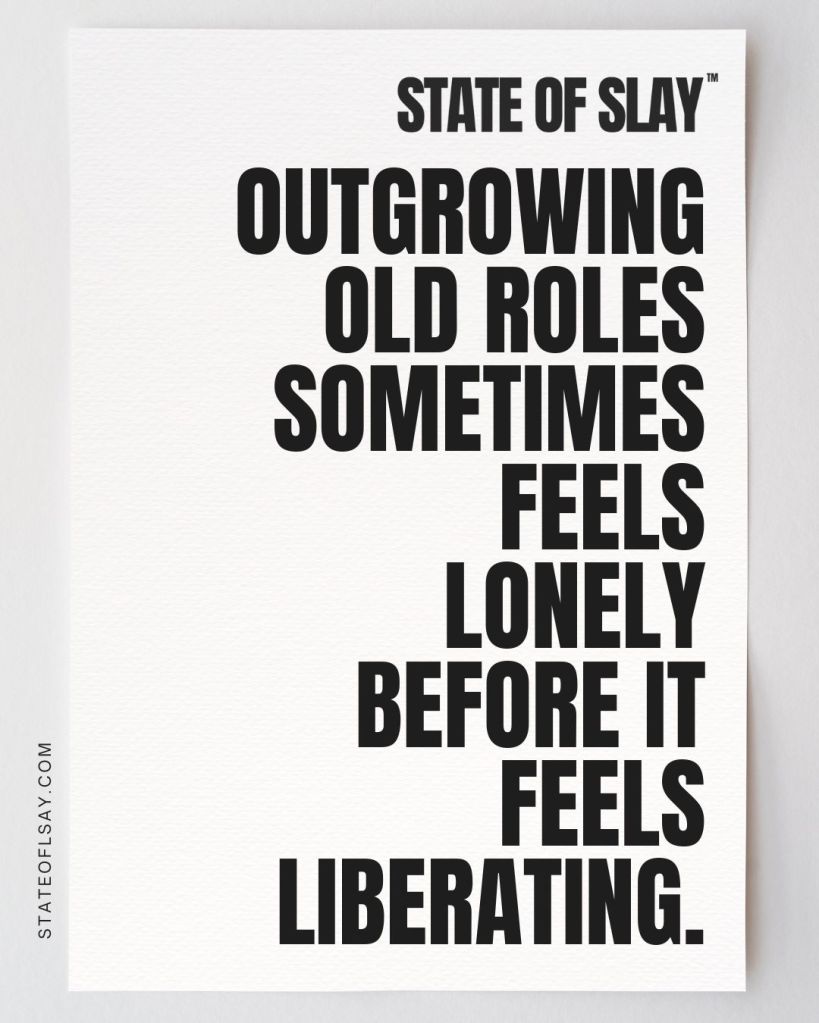
Growth doesn’t always announce itself with conflict or closure.
Sometimes it happens quietly—internally—when your values shift, your boundaries strengthen, and your sense of self becomes clearer.

As you evolve, your needs change.
Your tolerance changes.
Your definition of connection changes.

What once felt aligned may start to feel heavy.
What once fit may begin to chafe.
And that’s not failure—it’s information.

You don’t need to explain every transition.
You don’t need to force endings or justify distance.
When you honor your growth, the misalignments reveal themselves naturally.

This is your reminder to trust the process of becoming more yourself.

Slay on.

Wrong Can Lead Us to Right

We don’t like to admit it, but most of us learn far more from what didn’t work than from what did.

From the wrong turns.
The misjudgments.
The relationships that fell apart.
The choices we wish we could redo.

And yet, we spend so much time shaming ourselves for getting it “wrong” that we miss the quiet truth unfolding beneath it:

Wrong can lead us to right.

Not because the wrong was meant to hurt us—but because it showed us what alignment is not, which is often the only way we learn what alignment is.


Why We’re Taught to Fear Being Wrong

From an early age, we’re conditioned to believe that being wrong means failing.

Wrong answers are penalized.
Wrong choices are judged.
Wrong paths are labeled mistakes.

So when something doesn’t work out, our instinct is to blame ourselves instead of listening to the lesson.

But growth doesn’t happen in perfection.
It happens in contrast.

You don’t learn what peace feels like until you’ve lived without it.
You don’t learn your worth until you’ve accepted less.
You don’t learn alignment until you’ve tried to force what never fit.

Wrong isn’t the enemy—it’s information.


The Choices That Didn’t Work Still Worked for You

Think about it honestly.

That job that drained you.
That relationship you stayed in too long.
That version of yourself you outgrew.

None of it was wasted.

Each experience clarified something essential:

  • What you won’t tolerate again
  • What you need to feel safe and whole
  • What values matter more than comfort
  • What parts of yourself you abandoned—and why

Wrong choices don’t erase progress.
They refine it.

And often, the clarity you have now wouldn’t exist without the confusion you walked through then.


Wrong Often Means You Were Brave Enough to Try

Here’s something we don’t say often enough:

You can’t get it wrong if you never risk anything.

Wrong means you showed up.
Wrong means you chose movement over stagnation.
Wrong means you were willing to step forward instead of staying frozen.

Staying stuck can feel safer—but it teaches you nothing.

Growth comes from movement, even imperfect movement. And wisdom is built by experience, not avoidance.

So instead of asking, “Why did I mess this up?”
Try asking, “What did this teach me?”


When Wrong Breaks You Open

Some “wrong” experiences don’t just redirect us—they crack us open.

They expose where we were living out of fear.
They reveal patterns we didn’t want to see.
They force us to confront truths we were avoiding.

Those moments are painful—but they’re also catalytic.

They end pretending.
They demand honesty.
They strip away illusions.

And once that happens, the right path becomes harder to ignore.


Right Rarely Looks the Way We Expected

Here’s the part no one prepares you for:

The right path doesn’t always look like success at first.

Sometimes it looks like loss.
Like walking away.
Like starting over.
Like being misunderstood.

Right often feels quieter than wrong. Less dramatic. Less validating. But it feels true.

Right brings peace instead of chaos.
Clarity instead of confusion.
Alignment instead of performance.

If you’ve lived in wrong long enough, right can feel unfamiliar—even uncomfortable.

That doesn’t mean turn back.
It means you’re changing.


You Are Not Behind—You Are Becoming

If you’re looking back at your past with regret, hear this:

You are not behind.
You are not late.
You are not broken.

You were learning.

The version of you standing here now—with boundaries, discernment, and self-awareness—could not exist without the version who tried, hoped, trusted, and learned the hard way.

Wrong doesn’t delay us.
Often, it prepares us.


Trust the Path Even When It Loops

Growth isn’t linear.

Sometimes lessons repeat.
Sometimes you circle back.
Sometimes you recognize the red flag sooner—and that is progress.

Wrong doesn’t mean you failed the lesson.
It often means you’re closer to mastering it.

And one day, you realize the things that once felt like detours were quietly guiding you exactly where you needed to go.


SLAY Reflection

Let’s reflect, SLAYER:

S: What past “wrong” choice taught you something essential about yourself?
L: Where are you still shaming yourself instead of honoring what you learned?
A: What clarity do you have now because of something that didn’t work out?
Y: How might your life shift if you trusted that wrong can still lead you right?


Call to Action: Join the Conversation

I’d love to hear from you.
What felt wrong at the time but ultimately led you somewhere right?
Share your story in the comments. Let’s cheer each other on.

And if you know someone stuck in regret over past choices, send this to them.
Sometimes, all we need is a nudge.