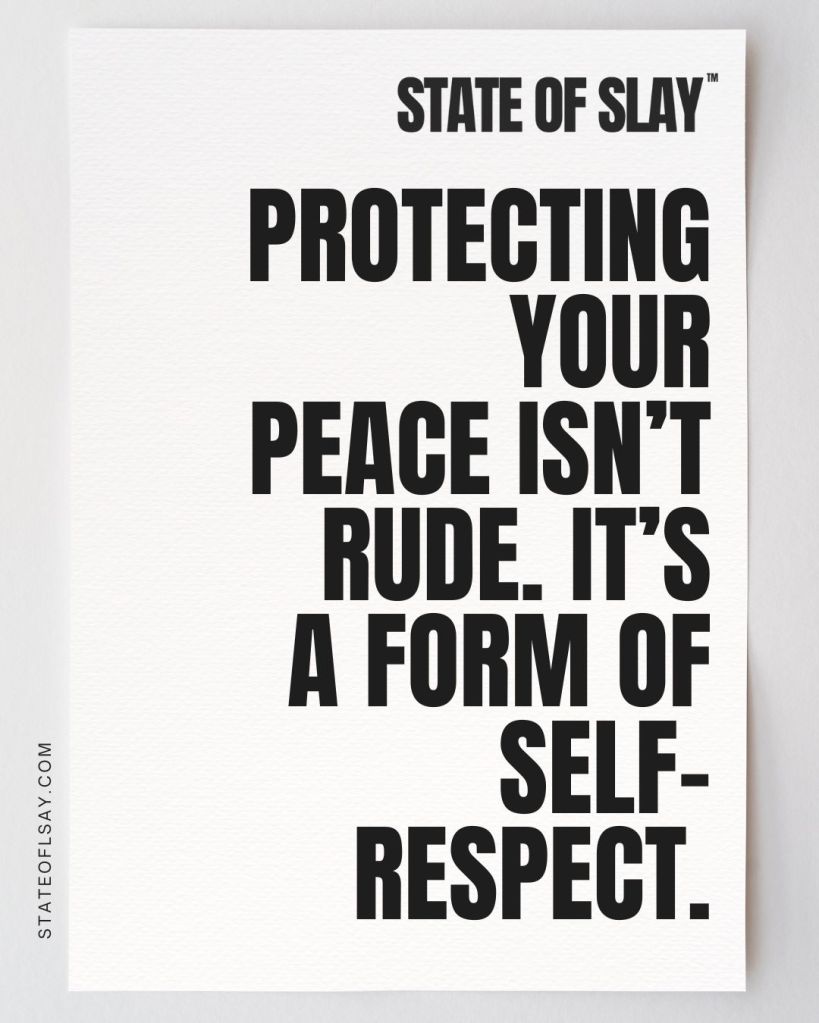
Your time, energy, and attention are not on-demand services.
We live in a world that glorifies being constantly accessible—always replying, always saying yes, always available. But that kind of constant output doesn’t make you kind, it makes you exhausted. Protecting your peace means knowing when to pause, say no, or simply not respond. Your availability doesn’t define your worth. Your boundaries define your self-respect.
This is your reminder that you don’t need to be everywhere for everyone. You just need to be present for yourself.
Not everything deserves your energy. Not everyone deserves your light. And before I began walking this path, I gave too much of myself to things—and people—that didn’t give anything back.
I stayed in relationships long after they served me. I committed to obligations that drained me. I was loyal… but loyal to a fault. And I confused that loyalty with self-worth, not realizing that I was spending my energy in all the wrong places.
The result? I was exhausted. Depleted. And stuck.
What You Feed Grows—So Be Careful What You Water
For years, I never asked myself what I truly enjoyed. What sparked something in me. What made me feel alive. Instead, I filled my schedule with what I thought I should do—and surrounded myself with people who didn’t challenge me to grow.
I gave my energy to places that led me deeper into the dark. And then I wondered why I always felt empty.
When I began my journey of recovery, I had to reevaluate everything—starting with where I spent my time, attention, and heart. I was building a new life, one that was rooted in healing. That meant I had to get honest about where my energy had been going, and whether it fit the future I was trying to create.
Spoiler alert: it didn’t.
Say Yes to What Fills You
But here’s what that shift gave me: Permission to explore. Permission to say yes to new things. Permission to relearn what I actually wanted from my life.
I began investing energy in what inspired me. I sought out supportive friendships, joyful experiences, and moments of growth. I said goodbye to relationships that only existed to keep me small. I stopped chasing validation and started chasing purpose.
That’s what recovery gave me: the ability to choose where I shine my light—and the awareness to know when I’m shining it in the wrong direction.
Energy Is Currency. Spend It Wisely.
I still get it wrong sometimes. I still overextend myself. I still jump in too fast, too hard, too deep. But today, I know how to check in with myself. I know what it feels like to be energized versus drained. And I know when it’s time to pull back, realign, and reinvest my energy where it belongs.
Energy is precious. It’s your power. Protect it. Spend it wisely. Let it guide you toward the light, not drag you back into the dark.
SLAY on.
SLAY OF THE DAY: Reflect & Rise
Where are you spending your energy—and is it worth the cost?
Do you find yourself giving too much to people, places, or things that don’t give back?
What makes you feel depleted? What fills you up?
Are there relationships or obligations you’ve outgrown?
Why do you think you stay? What would it look like to step back?
How can you redirect your energy toward what brings you joy, purpose, and peace?
You are allowed to protect your energy. You are allowed to choose yourself.
Call to Action: Join the Conversation
I’d love to hear from you. What’s one way you’re reclaiming your energy and investing it where it matters? Share your story in the comments. Let’s cheer each other on.
And if you know someone who’s giving too much of themselves to the wrong things, send this to them. Sometimes, all we need is a reminder: your energy is sacred. Treat it that way.
This week has been heavy. Not just in the day-to-day busyness, but emotionally, mentally, spiritually.
And as I took a step back, I asked myself a question I’ve learned to come back to again and again: Is all of this mine to carry?
The answer? No. But that hasn’t stopped me from dragging it around—tight-chested, overwhelmed, and bone-tired.
Like many of us, I juggle a lot every day. And most of the time, I believe I can handle it all. Until I can’t. Until I hit a wall. And when I do, I don’t always meet myself with grace. Sometimes, I meet myself with frustration and shame.
Even when I knowbetter, I still find myself slipping into old habits—trying to carry it all. No one is asking me to. Help is there if I reach for it. But there I go, dragging the weight of the world across some invisible finish line I made up in my head.
It’s time to pause. To take a breath—or a few—and ask myself what I’ve picked up along the way that never belonged to me in the first place.
Prefer to listen? The Audio Blog version is available here.
We Learn to Carry What We Don’t Need
Before recovery, I carried everything. It never occurred to me that I could set anything down.
The emotional weight. The resentment. The guilt. The responsibility for people and problems that were never mine to begin with.
I just kept going—until I couldn’t.
Eventually, I hit a wall. Hard. And that wall was the wake-up call I needed. I couldn’t live that way anymore. It was slowly destroying me.
So I asked for help. Not just with what I was carrying—but with how I lived.
Learning to Let Go of What’s Not Yours
Through recovery, I discovered something profound: A lot of what I was carrying wasn’t mine.
Some of it was inherited—passed down through family, expectations, trauma. Some of it I volunteered to carry—because I wanted to feel helpful, needed, or in control.
And some of it… I carried on purpose to sabotage myself. To stay small. To stay exhausted. To prove that I couldn’t do more, be more, live more.
That’s the hard truth. Sometimes, we don’t just carry what’s not ours—we choose it.
But once I got honest with myself, I realized I had a choice. To let go. To say no. To only carry what actually belonged to me.
And that changed everything.
What’s Yours—and What’s Not
There will always be people who would gladly let you carry their weight. There will be moments when youtry to carry someone else’s pain, fear, or responsibility—uninvited.
But that doesn’t mean you have to.
Being helpful doesn’t mean taking on someone else’s journey. Being strong doesn’t mean carrying more than you should. Being loving doesn’t mean sacrificing yourself.
We are responsible for ourselves. For our peace. For honoring what we need.
That starts with putting down what was never yours to carry in the first place.
SLAY Reflection: What Are You Carrying?
Do you tend to carry more weight than you need to—physically, emotionally, or mentally? What does that weight feel like?
What are you carrying that doesn’t actually belong to you? Who gave it to you—and why did you accept it?
Are there responsibilities, emotions, or expectations you’ve taken on to feel valuable or in control? How are they serving you? How are they hurting you?
What would it feel like to put that weight down—even just a little? What would change?
What can you do today to lighten your load and honor your limits? Where can you say no, ask for help, or simply rest?
Call to Action: Join the Conversation
I’d love to hear from you. What’s one burden you’ve been carrying that isn’t actually yours—and how are you learning to let it go? Share your story in the comments. Let’s cheer each other on.
And if you know someone who’s overwhelmed by weight they were never meant to carry, send this to them. Sometimes, all we need is a nudge.
We’ve all done it. Gone along with something we didn’t believe in. Put our needs aside to fix someone else’s mess. Jumped into a problem that wasn’t ours to solve.
And let’s be honest—sometimes, we did it because it made us feel needed. Valued. Important.
But here’s the truth: you are not responsible for cleaning up someone else’s willful choices.
When someone makes a bad decision—especially if it’s part of a pattern—and ends up in crisis, it is notyour job to bail them out. And rushing to do so over and over? That’s not kindness. That’s co-signing their bullsh*t.
The Emotional Vampire Tactic
I’ve written before about Emotional Vampires—those who feed off our time, energy, and attention. And one of the tactics they use is convincing you to validate their chaos.
They want you to:
Validate their story
Co-sign their drama
Confirm their narrative that they’re always the victim
You are not required to be a supporting character in someone else’s self-destructive script.
Yes, we all need help sometimes. And yes, it’s okay to ask for it. But there’s a massive difference between someone reaching out for support and someone handing you a flaming mess they created—and expecting you to carry it while they sit back and light another match.
Been There, Done That
Before I walked this path, I was veryfamiliar with this dynamic—because I was the one doing it.
I would avoid reality, avoid responsibility, and let things spiral until they became unmanageable. Then I’d panic, cry, and call for help. And when someone came running? I felt a high. A quick, fleeting sense of love and validation.
But it never lasted. Because deep down, I knew I had created the crisis. And I wasn’t learning anything from it—except how to get better at playing the victim.
That cycle drained me. And it wore out the people around me. I’m grateful I don’t live that way anymore. And when I see it in others now, I recognize it for what it is: a trap. For them—and for me.
Help Should Be a Two-Way Street
Being supportive doesn’t mean sacrificing yourself.
You can help someone—as long as they’re helping themselves. If they’re taking action, being honest, and working toward change, that’s one thing.
But if they keep coming back with the same drama, expecting you to fix it while they do nothing? That’s not support. That’s codependency.
And here’s the hard truth: Helping someone who isn’t helping themselves doesn’t help anyone.
If they’re repeating the same mistakes… If they’re ignoring their own well-being… If they’re draining your energy without ever filling their own cup… You don’t have to step in.
Sometimes the most loving thing you can do is step back.
Stand Tall, Not in the Mess
Next time someone comes calling, ask yourself:
Are they asking for help—or a savior?
Is this a one-time situation—or a repeated pattern?
Are you working withthem—or doing all the heavy lifting yourself?
If the facts don’t add up… If your energy is being drained… If your needs are constantly pushed aside for theirs…
That’s your answer.
You were not put on this earth to fix people who have no intention of changing. You’re here to build and protect a life that’s worth living—and that includes knowing when to say no.
So the next time someone tries to pull you into their storm, remember: You can love someone and still choose yourself. You can care deeply and still walk away from the chaos.
SLAY Reflection: Are You Co-Signing the Chaos?
Do you have people in your life who always seem to be in crisis? How often do they turn to you to fix it?
Are you helping—or doing all the work for them? What toll does that take on you?
Have you been in this dynamic more than once with the same person? Why do you think it keeps happening?
What would it look like to support someone without sacrificing yourself? Can you draw that boundary?
What’s one step you can take today to protect your energy and stop co-signing someone else’s drama? What would choosing yourself look like in this situation?
Call to Action: Join the Conversation
I’d love to hear from you. What’s one situation where you realized helping someone was actually hurting you—and how did you take your power back? Share your story in the comments. Let’s cheer each other on.
And if you know someone who’s stuck playing the fixer, send this to them. Sometimes, all we need is a nudge.