Perspective is a powerful thing. It shapes how we interpret events, understand other people, and navigate the world around us.
But perspective can also quietly become a limitation when we begin to treat it as the complete picture rather than just one angle of a much larger reality.
Every person carries experiences, assumptions, and beliefs that influence how they see the world. Those influences are not inherently wrong, but they can become dangerous when we stop questioning them or refuse to consider that someone else may see something we cannot.
Growth often begins with humility. The willingness to pause, listen, and recognize that our view may not capture the full truth can open the door to deeper understanding and stronger relationships.
This is your reminder that wisdom is not found in believing we see everything clearly, but in recognizing that our vision will always have edges.
There was a time when my past followed me everywhere.
Not physically, of course. But emotionally, mentally, and spiritually, it was always there. Old memories, regrets, mistakes, and moments I wished had gone differently replayed in my mind like a story that never reached its ending.
For a long time, I believed holding on to those memories was important. I told myself I needed to remember them so I would never repeat them. I believed revisiting those moments meant I was learning from them.
But eventually I realized something.
I was not learning from my past.
I was living inside it.
And when we stay emotionally rooted in yesterday, we miss the life unfolding right in front of us.
Prefer to listen? The Audio Blog version is available here.
The Past Is Meant to Teach, Not Trap
Our past experiences matter. They shape who we are, what we value, and how we see the world.
The lessons we learn from difficult moments can make us stronger, wiser, and more compassionate.
But there is a difference between learning from the past and carrying it everywhere we go.
When we replay old mistakes constantly, relive painful conversations, or keep punishing ourselves for choices we can no longer change, the past stops being a teacher.
It becomes a prison.
And prisons are not where growth happens.
I Had to Learn to Release My Story
For years, I defined myself by parts of my past that I was not proud of.
I held onto moments where I felt I had failed, hurt someone, or lost control of my life. Those memories felt like permanent labels attached to who I was.
Letting go of them felt dangerous. It almost seemed like forgetting meant I was ignoring responsibility.
But I slowly began to understand that releasing the past does not mean pretending it never happened.
It means allowing it to be what it was. A moment in time. Not the identity I would carry forever.
When I stopped reliving those moments and instead focused on who I was becoming, something shifted.
I finally felt free to grow.
Holding On Keeps Old Pain Alive
When we refuse to let the past rest, we keep the emotions connected to it alive.
Regret. Anger. Shame. Resentment.
Those emotions continue to influence how we see ourselves and others. They shape our reactions, our confidence, and our willingness to trust.
In many ways, holding onto the past can recreate the pain again and again.
We suffer from events that are no longer happening.
And that suffering prevents us from fully experiencing the present.
Forgiveness Creates Space for Living
One of the most powerful ways to release the past is through forgiveness.
Sometimes that forgiveness is directed toward another person. Sometimes it is directed toward ourselves.
Self-forgiveness can be especially difficult because we often believe we should have known better, done better, or handled things differently.
But growth means recognizing that we were operating with the awareness we had at the time.
Forgiveness does not erase responsibility. It allows healing to begin.
And healing makes space for a different future.
The Present Deserves Your Attention
Life only happens in one place.
Right now.
The conversations we have today, the choices we make today, and the people we become today shape the direction of our lives far more than any memory from years ago.
When we release our grip on the past, our energy returns to the present moment.
We begin to see opportunities we once overlooked. We become more open to connection, creativity, and possibility.
And we stop measuring our worth against moments that no longer exist.
Growth Requires Forward Movement
Letting the past rest is not about denial. It is about direction.
We acknowledge what happened. We take responsibility where it is needed. We learn from it.
Then we move forward.
Growth cannot occur when we are emotionally anchored to yesterday.
It happens when we allow ourselves to evolve.
Every new decision we make has the power to shape who we become next.
And that future deserves our attention far more than the past deserves our attachment.
Release What No Longer Serves You
Your past may explain parts of your story, but it does not have to control the rest of it.
The mistakes, heartbreaks, and regrets you carry do not define the person you are becoming.
They are chapters. Not the entire book.
Let them teach you.
Let them inform you.
But do not let them imprison you.
Because if you refuse to let the past die, it will keep you from living the life waiting for you now.
SLAY on.
SLAY Reflection
S — See the Weight What parts of your past do you still carry emotionally today?
L — Look for the Lesson What did those experiences teach you that can guide you moving forward?
A — Allow Forgiveness Is there someone you need to forgive, including yourself, to release that weight?
Y — Your Next Step What would your life feel like if you allowed the past to stay where it belongs?
Call to Action: Join the Conversation
I’d love to hear from you. Have you ever experienced a moment where letting go of the past helped you finally move forward?
Share your story in the comments. Let’s cheer each other on.
And if you know someone who might need this reminder, send this to them. Sometimes, all we need is a nudge.
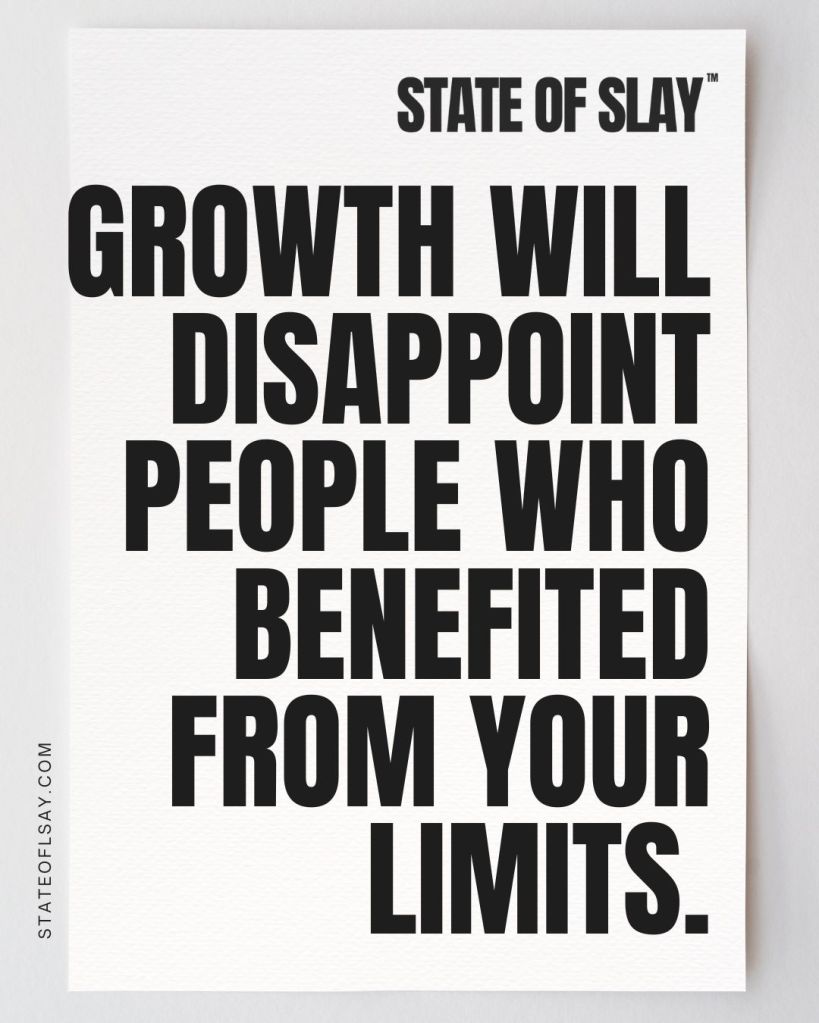
Growth does not always feel comfortable, especially when it changes how others experience you.
Sometimes the people around us become familiar with a version of us that was quieter, more accommodating, or easier to predict. That version may have been shaped by old fears, past circumstances, or a time when we had not yet discovered the strength to take up more space in our own lives.
As we grow, priorities shift. Confidence develops. Boundaries become clearer. The qualities that once kept the peace may begin to give way to a stronger sense of direction and self-respect.
Not everyone will celebrate that change. Some people were comfortable with the version of you that fit neatly inside their expectations.
This is your reminder that growth is not measured by how comfortable it makes everyone else. Sometimes, becoming who you are meant to be will challenge the expectations that once kept you small.
There was a time in my life when I believed being nice meant being good.
I went out of my way to help people. I showed up when someone needed support. I tried to be generous with my time, my attention, and my energy.
And if I am being completely honest, there were moments when I expected something in return.
Gratitude. Loyalty. Support. Recognition.
When those things did not come back the way I hoped, I felt hurt. Confused. Sometimes, even resentful.
It took time and a lot of self-reflection to understand something that shifted my perspective.
Kindness that comes with expectations is not really kindness. It is a transaction.
Prefer to listen? The Audio Blog version is available here.
The Difference Between Kindness And Approval Seeking
Doing something kind should come from a genuine place. A place where you choose to give because it feels right, not because you are trying to secure a future outcome.
But many of us grow up learning that kindness earns approval. We are praised for being helpful, agreeable, and accommodating. Over time, it can become easy to connect our value to how much we do for others.
Without realizing it, kindness can slowly turn into people pleasing.
And people pleasing often carries a hidden contract.
I will do this for you so that you will appreciate me, support me, or treat me the way I want to be treated.
When that contract is not fulfilled, disappointment follows.
I Had To Look At My Own Motives
This was not a comfortable realization.
There were moments when I had to ask myself a difficult question.
Was I being kind because it was the right thing to do, or because I wanted something in return?
Sometimes the answer surprised me.
I began noticing the subtle expectations attached to my actions. If someone did not respond the way I hoped, I would feel irritated. If my effort went unnoticed, I would feel overlooked.
That reaction revealed the truth.
My kindness was not always unconditional.
Recognizing that allowed me to shift how I approached giving.
True Kindness Does Not Keep Score
Authentic kindness is not about tallying favors.
It is about choosing generosity because it aligns with who you are, not because it guarantees a reward.
When kindness becomes transactional, it creates emotional pressure for both people involved. The person giving feels entitled to a response. The person receiving may feel obligated rather than grateful.
That dynamic can quietly damage relationships.
When kindness is genuine, there is freedom on both sides.
You give because it feels right. Not because you are expecting something back.
Boundaries Protect Real Generosity
Learning this lesson does not mean you should give endlessly without considering your own needs.
Healthy boundaries are essential.
There is a difference between genuine kindness and overextending yourself. True generosity respects both the other person and your own well-being.
When you give from a place of fullness instead of obligation, your kindness becomes sustainable.
And when you say no where necessary, your yes becomes more meaningful.
Let Go Of The Invisible Contracts
One of the most liberating things you can do is release the silent agreements you place on your kindness.
If you choose to help someone, do it because it aligns with your values. If appreciation comes back, receive it with gratitude.
If it does not, let your peace remain intact.
Your character should not depend on someone else’s response.
Kindness is a reflection of who you are, not a strategy for controlling outcomes.
Authentic Kindness Strengthens Relationships
When generosity is genuine, relationships feel lighter.
There is no hidden pressure. No silent expectation. No emotional accounting.
People feel the difference.
Authentic kindness creates trust because it is rooted in sincerity rather than strategy.
And when kindness flows naturally, it encourages others to respond with the same spirit.
Not because they owe you something, but because genuine care inspires connection.
Be Kind Because It Reflects Your Values
At the end of the day, kindness is about alignment with who you want to be.
Not about what you receive in return.
When you act from your values, you no longer measure your goodness through someone else’s reaction. Your actions become an extension of your character rather than a tool for validation.
That shift removes resentment.
And resentment is often the signal that our kindness had conditions attached to it.
When kindness is authentic, peace follows.
SLAY Reflection
S — See Your Motivation When you do something kind, what are you hoping will happen afterward?
L — Look For Hidden Expectations Do you ever feel disappointed if appreciation or kindness is not returned?
A — Adjust Your Perspective How could you practice giving without attaching an outcome to the act?
Y — Your Next Step What would change if your kindness came purely from your values rather than your expectations?
Call to Action: Join the Conversation
I’d love to hear from you. Have you ever realized that some of your kindness carried hidden expectations? What changed when you let go of them?
Share your story in the comments. Let’s cheer each other on.
And if you know someone who might benefit from this reminder, send this to them. Sometimes, all we need is a nudge.
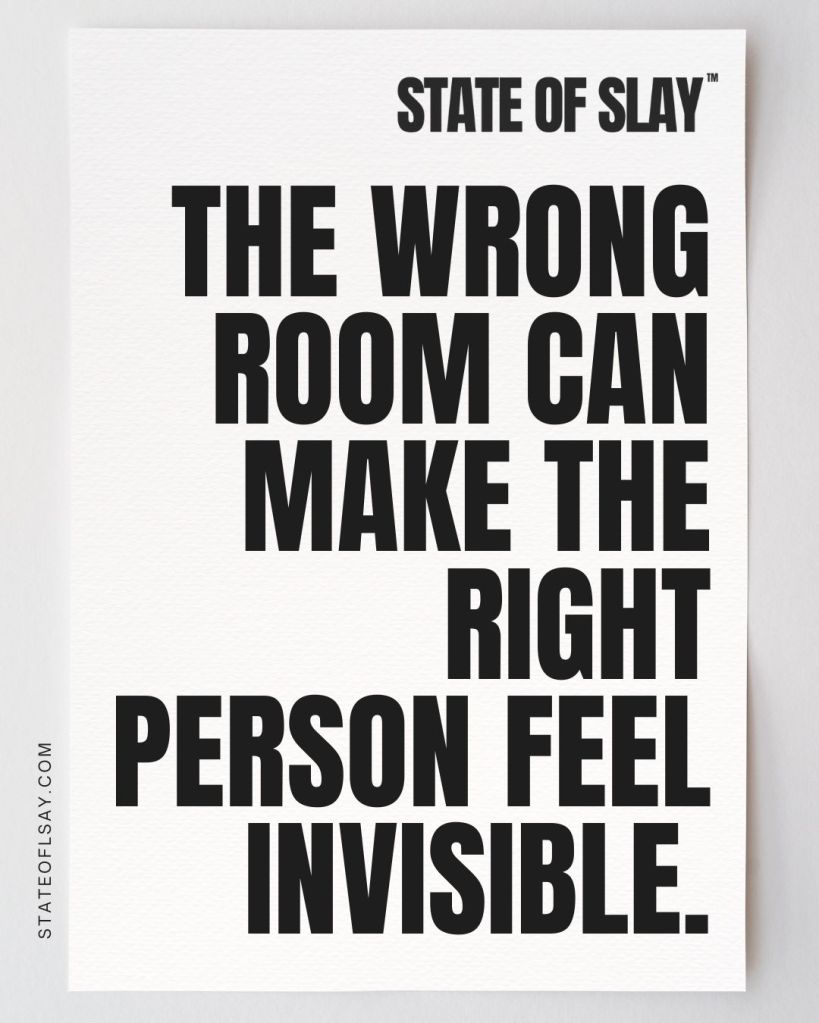
Sometimes we question our worth when what we are really experiencing is misalignment.
The environment we place ourselves in can shape how our strengths are recognized, supported, and appreciated. In the wrong setting, even talent, kindness, creativity, or dedication can go unnoticed. That absence of recognition can quietly make us doubt qualities that were never the problem to begin with.
Growth often comes from understanding that value does not disappear simply because it is overlooked. Often, it just means the environment is not the right place for it to be seen.
This is your reminder to pay attention to where you place your energy and where your presence is appreciated.
We often think of health in terms of what we eat, how we move, and how well we sleep.
But there is another influence on our well-being that many of us overlook.
The words we speak.
Not just the words we say to others, but the words we say to ourselves.
For years, I did not realize how much my internal language was affecting my emotional and physical health. The way I talked about myself, my circumstances, and my struggles was often harsh, negative, and unforgiving. I thought I was simply being honest with myself.
But over time, I began to understand something powerful.
The words we repeat become the environment our minds live in.
And if that environment is filled with criticism, fear, and negativity, it begins to shape how we feel, how we act, and even how our bodies respond.
Prefer to listen? The Audio Blog version is available here.
The Language We Use Becomes Our Reality
Our brains are constantly listening to us.
Every time we say things like “I am terrible at this,” “Nothing ever works out for me,” or “I always mess things up,” the brain absorbs those messages. It begins to accept them as facts rather than temporary feelings.
Eventually, those words form patterns.
And those patterns influence behavior, motivation, and confidence.
I used to underestimate how powerful this internal dialogue was. I believed negative self-talk was harmless. I thought it was simply part of being self-critical or striving to improve.
But negative language does not inspire growth. It creates a limitation.
The more we repeat discouraging messages, the more believable they become.
I Had To Change How I Spoke To Myself
There was a point in my life where my internal dialogue became impossible to ignore.
I noticed how often I spoke to myself in ways I would never speak to someone I loved. I used language that was judgmental, impatient, and unforgiving.
And it showed.
My stress levels increased. My confidence shrank. My outlook became more pessimistic.
Eventually, I asked myself a simple question.
Would I talk to a friend the way I talk to myself?
The answer was an immediate no.
That realization made it clear that something needed to change.
Words Can Heal Or Harm
Language carries energy.
Encouraging words can build resilience. Kind words can restore hope. Honest words can create clarity.
But harsh words can also erode confidence, increase anxiety, and deepen self-doubt.
This is especially true when those words come from within.
When we repeatedly tell ourselves that we are incapable, unworthy, or doomed to fail, our minds begin to operate under those assumptions.
But when we shift our language, something remarkable happens.
Our perspective shifts with it.
The Difference Between Honesty And Harm
Changing your internal language does not mean ignoring challenges or pretending everything is perfect.
It means choosing honesty without cruelty.
Instead of saying “I always fail,” you might say “I did not succeed this time, but I can learn from it.”
Instead of “I am terrible at this,” you might say “I am still developing this skill.”
Those small shifts matter.
They create space for improvement instead of shutting the door on possibility.
And possibility is where growth lives.
Your Body Listens Too
Stress does not only live in the mind. It shows up in the body.
Negative internal language can increase tension, anxiety, and emotional fatigue. When we constantly criticize ourselves, our nervous system often responds as if it is under threat.
Over time, that stress can affect sleep, energy levels, and emotional balance.
Positive language does not magically erase problems, but it can reduce unnecessary stress and create a healthier mental environment.
Your words become signals to your brain about how safe or unsafe the world feels.
Choosing supportive language can help restore balance.
Awareness Is The First Step
Most of us are not fully aware of how often we speak negatively about ourselves.
The first step is simply noticing.
Pay attention to the words that appear when you make a mistake, face a challenge, or feel frustrated.
Ask yourself whether those words support your growth or undermine it.
If they undermine it, consider how you might reframe them.
Small adjustments in language can lead to powerful shifts in mindset.
Compassion Creates Strength
One of the greatest lessons I have learned is that self-compassion does not weaken us.
It strengthens us.
When we treat ourselves with patience and encouragement, we create the emotional stability needed to keep moving forward.
Harsh self-judgment may feel motivating in the moment, but it rarely leads to sustainable growth.
Compassion allows us to learn without destroying our confidence.
And confidence is essential for lasting change.
Speak To Yourself Like Someone Worth Healing
You deserve words that support your well-being.
Words that acknowledge effort. Words that encourage growth. Words that allow mistakes to become lessons rather than identity.
Changing your internal language will not transform your life overnight.
But over time, it can change the atmosphere of your mind.
And when the atmosphere changes, your perspective begins to change with it.
Your thoughts become kinder.
Your actions become stronger.
Your health becomes steadier.
So the next time you notice yourself speaking harshly about your abilities, your worth, or your future, pause.
And ask yourself a simple question.
Are my words helping me heal, or are they making me sick?
Choose wisely.
SLAY Reflection
S — See the Pattern What words do you most often use when talking about yourself during a difficult moment?
L — Listen Closely Would you speak to someone you care about using those same words?
A — Adjust Your Language How could you reframe those statements to be honest but supportive?
Y — Your Next Step What encouraging phrase could you begin practicing when you face a setback or challenge?
Call to Action: Join the Conversation
I’d love to hear from you. Have you ever noticed how your words affect your mood, confidence, or well-being?
Share your story in the comments. Let’s cheer each other on.
And if you know someone who might need a reminder to speak to themselves with more kindness, send this to them. Sometimes, all we need is a nudge.
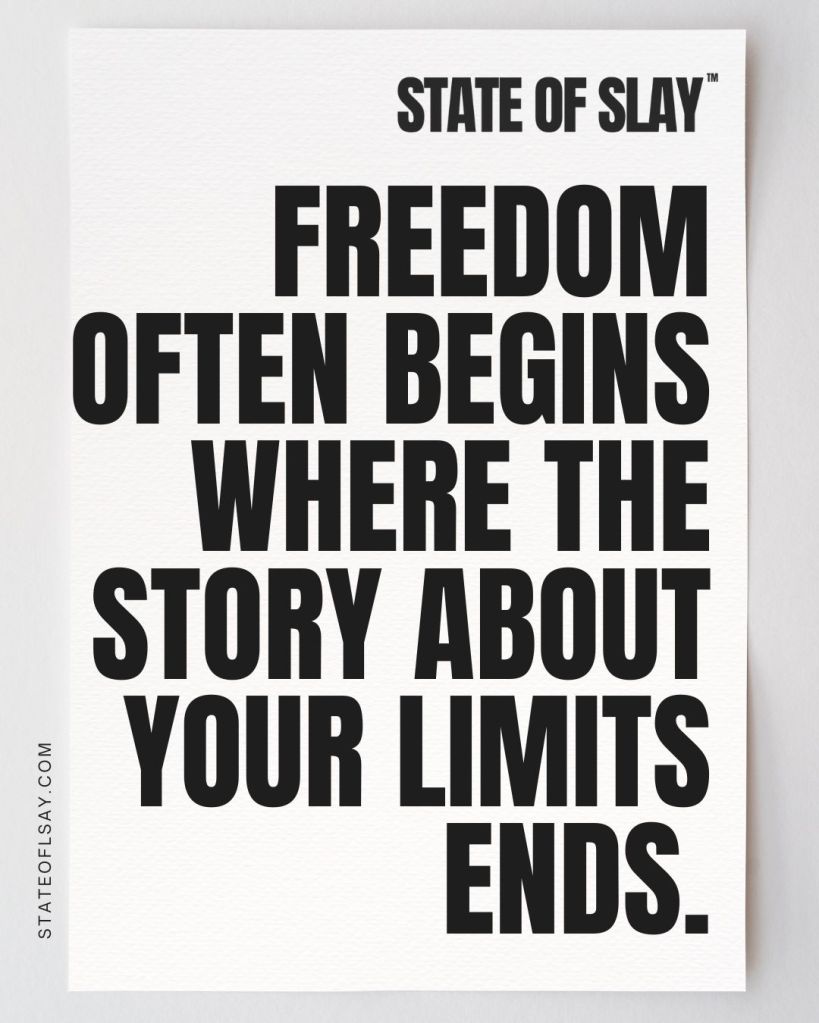
Sometimes what feels like a limitation is actually just a story we have been repeating for so long that it begins to feel permanent.
Many of the boundaries we believe in were shaped by old expectations, past experiences, or the voices of people who never imagined a different path for us. Over time, those ideas can quietly become rules we never agreed to but continue to live by.
Growth often begins the moment we question those assumptions. When we allow ourselves to look at life with a fresh perspective, we realize that what once looked like a fixed wall may have been a door we simply had not tried to open yet.
This is your reminder to reconsider the limits you may have accepted without question, and to explore what becomes possible when you give yourself permission to see beyond them.
One of the hardest lessons I have ever had to learn is this:
Sometimes the truth is right in front of us, but we refuse to see it.
Not because we are unintelligent. Not because we are careless. But because we want the story to be different. We want the outcome to be different. We want the person to be different.
So we interpret reality through hope instead of honesty.
I have done this more times than I can count. In relationships. In friendships. In professional situations. Even in how I viewed myself.
And every time I ignored what was actually happening, the result was the same.
Disappointment.
Because when we see things as we wish they were instead of how they are, we build expectations on an illusion.
Prefer to listen? The Audio Blog version is available here.
Hope Is Beautiful But It Cannot Replace Reality
Hope is powerful. It keeps us moving forward when things are difficult. It allows us to believe in possibility and growth.
But hope becomes dangerous when it replaces truth.
When we hope someone will change without evidence of change. When we hope a situation will improve without action. When we hope circumstances will magically align without acknowledging what is actually unfolding.
Hope should inspire action, not replace awareness.
There is strength in optimism, but there is wisdom in clarity.
I Had To Learn This Through Experience
There were times in my life when I ignored warning signs because they did not fit the story I wanted.
I overlooked behaviors that made me uncomfortable. I rationalized actions that did not align with my values. I convinced myself that if I just waited long enough, the situation would turn into what I hoped it could be.
But reality always revealed itself eventually.
And each time I avoided that truth, the consequences felt heavier.
Eventually I understood something important.
Seeing reality clearly is not pessimism. It is self protection.
Clarity Creates Better Decisions
When we look at situations honestly, we gain information.
We see patterns instead of excuses. We notice consistency instead of promises. We understand where our energy is being returned and where it is not.
That clarity allows us to make better decisions.
Sometimes it means walking away. Sometimes it means setting stronger boundaries. Sometimes it means adjusting expectations.
But almost always, it brings relief.
Because living in truth removes the constant mental effort of trying to maintain an illusion.
Emotional Honesty Is A Form Of Self Respect
It takes courage to see things clearly.
Admitting that a relationship is not healthy. Accepting that a goal may need to change. Recognizing that someone cannot give us what we hoped they would.
Those moments can be painful.
But they are also powerful.
Because emotional honesty is an act of self respect. It means you trust yourself enough to face reality, even when it challenges your expectations.
And that trust builds resilience.
Seeing Clearly Does Not Mean Losing Compassion
Recognizing reality does not require becoming cold or cynical.
You can still care about people while acknowledging their limitations. You can still appreciate memories while accepting that circumstances have changed.
Compassion and clarity can exist together.
In fact, when we stop forcing situations to be something they are not, compassion often becomes easier. We stop trying to control outcomes and start accepting people and circumstances as they truly are.
Acceptance creates peace.
Truth Creates Freedom
There is something incredibly freeing about seeing things clearly.
When you stop negotiating with reality, your energy returns. Your decisions become more grounded. Your expectations become healthier.
You stop chasing what could be and start responding to what actually is.
And from that place, growth becomes easier.
Because your foundation is truth.
SLAY Reflection
Let’s reflect, SLAYER:
S: Is there a situation in your life where you may be seeing what you hope instead of what is actually happening?
L: What signs or patterns might you be overlooking because they are uncomfortable?
A: How could greater honesty with yourself change the decisions you make moving forward?
Y: What would choosing clarity over illusion bring into your life right now?
Call to Action: Join the Conversation
I’d love to hear from you. Have you ever had a moment where seeing a situation clearly changed everything for you? What did you learn from it? Share your story in the comments. Let’s cheer each other on.
And if you know someone who might be struggling to face a difficult truth, send this to them. Sometimes, all we need is a nudge.
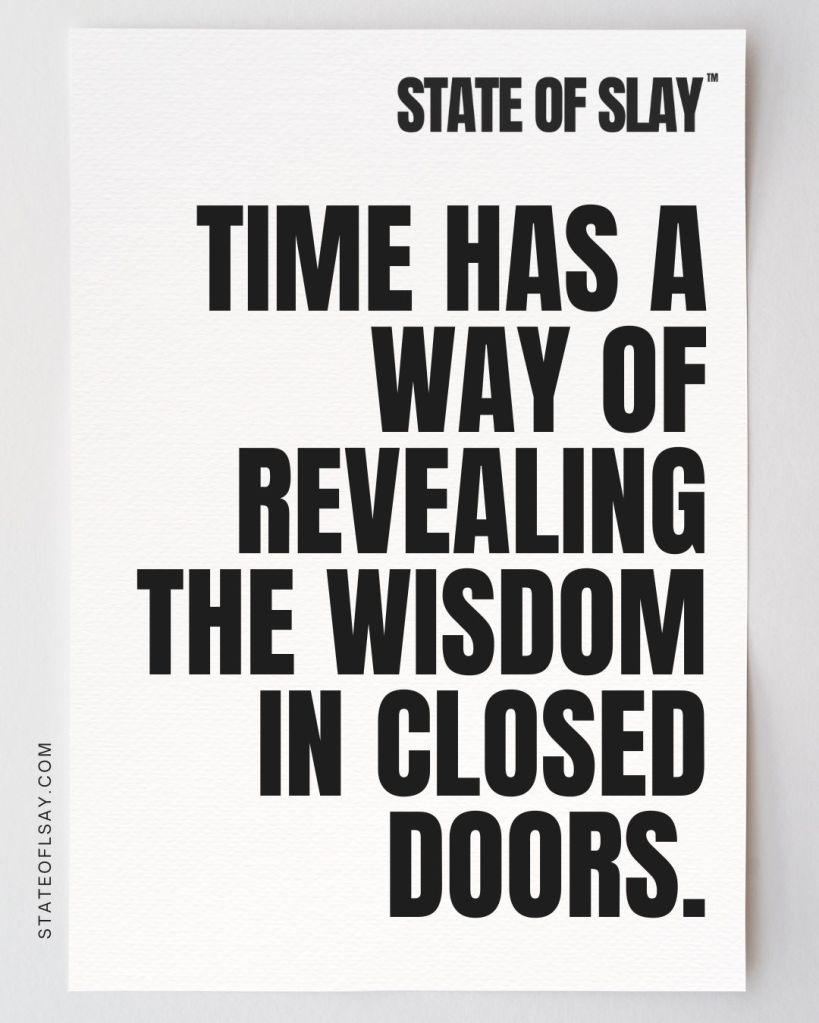
In the moment, closed doors can feel frustrating, confusing, or even unfair. We often see them as interruptions to the path we carefully planned.
But time has a way of widening perspective. What once felt like rejection can later reveal itself as protection. What looked like a setback can quietly redirect you toward something more aligned with your growth, values, or well-being.
Some lessons are only visible in hindsight.
This is your reminder to trust that clarity often arrives after the door closes.
There was a season in my life when I expected results I had not earned.
I wanted growth without discomfort. Success without consistency. Connection without vulnerability. Peace without doing the internal work.
And when those things did not show up the way I imagined, I felt frustrated. Disappointed. Sometimes, even resentful.
But eventually I had to face a hard truth.
Expectation without effort breeds disappointment.
And that lesson changed how I approach almost everything.
Prefer to listen? The Audio Blog version is available here.
Effort Builds Alignment
We all have dreams. Goals. Desires. Vision boards full of possibility.
But wanting something is not the same as working toward it.
There is nothing wrong with ambition. In fact, ambition can be healthy and motivating. The problem begins when expectation outpaces action.
If we want deeper relationships, we have to practice communication and emotional honesty. If we want physical strength, we have to move our bodies. If we want career growth, we have to develop skills and consistency.
Alignment between effort and expectation creates peace.
Misalignment creates frustration.
I Had To Learn This Personally
There were moments when I wanted to be seen differently without changing my behavior. I wanted trust without rebuilding credibility. I wanted confidence without confronting insecurity.
Once I accepted that, something shifted. Instead of feeling entitled to outcomes, I focused on earning them.
And that shift empowered me.
Because effort is something we control.
Discipline Creates Self-Respect
There is a quiet confidence that comes from knowing you showed up fully.
Not perfectly. Not flawlessly. But consistently.
Discipline is not punishment. It is commitment to your future self.
When you follow through on what you say you will do, trust builds internally. That internal trust strengthens resilience. It reduces anxiety. It increases clarity.
Self-respect grows from keeping promises to yourself.
And that foundation supports sustainable success.
Expectations Without Work Can Damage Relationships
This lesson extends beyond career and goals.
It applies deeply to relationships.
Expecting loyalty without offering it. Expecting communication without practicing it. Expecting emotional safety without creating it.
Relationships thrive on reciprocity.
When we expect more than we contribute, imbalance follows. Resentment builds. Connection weakens.
But when we invest effort intentionally, relationships strengthen naturally.
Contribution matters.
Patience Is Part Of The Process
One of the hardest parts of growth is timing.
We live in a culture that celebrates immediate results. Overnight success. Quick transformations.
When we focus on building strong patterns, outcomes become more predictable. Not guaranteed. But aligned.
And when outcomes do not match effort, we adjust. We learn. We refine.
Growth becomes dynamic instead of discouraging.
That shift keeps momentum alive.
SLAY Reflection
Let’s reflect, SLAYER:
S: Where in your life are your expectations outpacing your effort?
L: What small daily action could bring your effort into alignment with your goals?
A: How does following through on commitments impact your self-trust?
Y: What would change if you focused more on building than expecting?
Call to Action: Join the Conversation
I’d love to hear from you. What goal in your life shifted once you committed to matching your effort with your expectations? Share your story in the comments. Let’s cheer each other on.
And if you know someone feeling discouraged about slow progress, send this to them. Sometimes, all we need is a nudge.