Slay Say

Stand Steady in the Storm

Life will always bring uncertainty. Plans shift, paths twist, and storms roll in when you least expect them. The measure of your strength isn’t found in avoiding the storm, but in standing steady within it.

Resilience is not about waiting for calm skies—it’s about learning that you can endure, adapt, and rise even when the winds are against you.

This is your reminder that the challenges you face don’t define you. How you meet them does.

Slay on!

An Arrow Can Only Be Shot by Pulling It Backwards

There’s a powerful lesson tucked inside one of life’s simplest metaphors: an arrow can only be launched by first being pulled backwards.

At first, that pull feels like resistance. Pressure. Setback. You’re yanked away from where you want to go, pulled into discomfort, frustration, and sometimes even pain. But the truth is this: without that tension, without that backward stretch, there is no forward release.

Life’s pullbacks are not punishments—they are preparation.

The key is to not get stuck staring at the ground when life pulls you back. Instead, steady yourself, take aim, and get ready. Because what feels like a setback now may be the very momentum that propels you toward something greater.


The Backward Pull Feels Personal

When life pulls us back, it rarely feels neutral. It feels personal.

The relationship ends. The job falls through. The opportunity disappears. Suddenly, it feels like life is conspiring against us, stripping away what we wanted most. And in the middle of that loss, it can feel impossible to see any kind of trajectory forward.

But here’s the truth: the arrow doesn’t know it’s being pulled back to soar further—it only feels the tension. And we’re the same way.

The backward pull of life is often the exact energy we need to realign, refocus, and prepare for a different kind of future.


Take Aim: Purpose in the Pause

An arrow doesn’t just fly aimlessly—it’s aimed. The backward pull isn’t random; it’s part of the process.

When life feels like it’s dragging you back, the invitation is to pause and take aim.

Ask yourself:

  • What am I being redirected toward?
  • What lessons am I meant to carry from this moment?
  • What strength am I building through this resistance?

Taking aim doesn’t mean you’ll have all the answers right away. It means you choose not to waste the pullback. You align yourself with purpose, even if the target feels blurry.


The Release: Trusting the Launch

When the arrow is finally released, it doesn’t hesitate. It doesn’t fight the momentum. It doesn’t question the trajectory. It simply flies.

That’s the moment you’ve been stretched for.

The release is the job that finally matches your calling, the relationship that respects your worth, the moment you realize your strength has carried you further than you thought possible. It’s not about erasing the pullback; it’s about realizing that every inch of that resistance fueled the flight.


The Power of Perspective

Pullbacks and setbacks will always come. But here’s the difference between staying stuck and soaring forward: perspective.

If you see the pullback as failure, you’ll stay grounded. If you see it as preparation, you’ll find the courage to aim higher.

Every backward tug is an opportunity to grow resilience, clarity, and faith. It’s proof that you’re still in motion—that life is stretching you for something greater.


Your Bow, Your Aim, Your Flight

Remember, you are both the archer and the arrow.

You get to choose:

  • Do you fight the pull and call it defeat?
  • Or do you trust the stretch, take aim, and let yourself fly?

The setbacks won’t define you. The release will.

So the next time life pulls you back, don’t panic. Don’t lose heart. Steady your grip. Breathe. Take aim. And get ready—because you are about to soar.


SLAY Reflection

  1. Where in your life right now do you feel like you’re being pulled backwards?
  2. How can you reframe that pullback as preparation instead of punishment?
  3. What’s one target you want to take aim at, even if it feels blurry today?
  4. How can you use resistance as fuel for your momentum?
  5. What would trusting the release look like for you?

S – See setbacks as setups, not endings
L – Let the pullback strengthen your aim
A – Align with purpose, not panic
Y – Yield to the release and trust your flight


Call to Action: Join the Conversation

I’d love to hear from you.
What pullback in your life ended up being the momentum you needed to soar?
Share your story in the comments. Let’s cheer each other on.

And if you know someone who feels stuck in a setback, send this to them.
Sometimes, all we need is a reminder that the stretch is preparing us for the flight.

Slay Say

Silence Your Own Doubt First

The world will always have critics, doubters, and voices ready to tell you what you can’t do. But the most dangerous voice is the one inside your own head. When you start believing you’re not capable, you hand your power away before the fight even begins.

This is your reminder to guard your self-talk, to build yourself up, and to never let your own doubt be the thing that holds you back.

SLAY on!

Slay Say

WHEN PROTECTION BEGINS WITH YOU

You weren’t always guarded, seen, or nurtured when you were small. But protection isn’t just for children—it’s something you can learn to give yourself now.

When you grow into the person who would’ve shielded your younger self, you reclaim safety, dignity, and the peace you longed for.

This is your reminder: you can be your own defender.

SLAY on!

Slay Say

THE REFLECTION ISN’T YOURS

Unkindness is not a reflection of your worth, but of someone else’s struggle. People often project what they haven’t healed, and their cruelty is more about their unrest than your value.

When you remember this truth, you free yourself from carrying pain that was never yours to hold.

This is your reminder: you don’t need to absorb the darkness someone else hasn’t learned to face.

SLAY on!

Laugh in the Places You Cried

There’s something profoundly healing about returning to the places that once broke you—and finding yourself laughing there.

It doesn’t erase what happened. It doesn’t mean the tears weren’t valid. But it does mean you’ve grown. It means that grief, loss, or hardship no longer has the same power over you that it once did.

To laugh in the places you cried is not about pretending the pain never happened—it’s about showing yourself that joy can exist there too. It’s proof of resilience. It’s a reminder that your story didn’t end in the sorrow of that moment.


Pain Leaves Marks—But So Does Joy

The truth is, we all carry places inside us that feel haunted by memory. A room you once walked out of in tears. A street where your heart shattered. A house where you fought, lost, or grieved.

For a long time, those places can feel unbearable. You avoid them, you numb yourself, or you pretend they don’t matter. But eventually, life has a way of bringing you back.

And when it does, you’re not the same person who stood there before.

When you can laugh in the same space where you once cried, you prove that your spirit is bigger than your suffering. You transform the memory. You remind yourself that you are not stuck in the story of what happened there.


Your Scars Tell the Story of Your Strength

Think of the scars you carry—not just on your body, but on your heart. They’re proof that something hurt you, but also proof that you healed.

Your tears were real, but so is your laughter.

That’s the beauty of allowing yourself to live fully in both. You don’t have to deny the moments that broke you. But you also don’t have to live there forever.

When you let joy back into the places that once felt like endings, you’re not betraying your pain. You’re honoring it by showing what came after.


Turning Memory Into Medicine

For me, there have been places I thought I could never face again—rooms where I felt humiliated, benches where I cried from heartbreak, doorways I left with shame.

At first, I avoided them. I told myself it was better to never go back. But life pulled me there anyway. And when I found myself standing in those same spaces, I realized something powerful:

I could either let the pain live there forever, or I could write a new chapter.

The first time I laughed in one of those places, it felt strange—like I was trespassing on sacred ground reserved only for grief. But the truth is, grief doesn’t own that ground. I do. And so do you.

Every time you smile, laugh, or find joy in a space where you once broke down, you reclaim a piece of yourself that once felt lost.


You’re Not Erasing the Past—You’re Expanding It

Let’s be clear: laughing in the places you cried doesn’t mean you’ve forgotten. It doesn’t mean you’ve dismissed what happened or denied your feelings.

It means you’ve grown enough to hold both truths at once.

Yes, you were hurt here.
Yes, you cried here.
Yes, you thought you might never move past it.

And yes—you are also capable of joy here now.

That’s not erasure. That’s expansion. You’ve made room for more than one emotion, more than one story, more than one version of yourself.


Healing Is Circular, Not Linear

Sometimes we think healing means “moving on” and never looking back. But often, healing looks like returning to old ground with new eyes.

You circle back—not to stay stuck in the past, but to measure how far you’ve come.

And when you can laugh where you once cried, you see the full circle of your healing. You’re no longer in survival mode. You’re no longer defined by that wound. You’ve created space for something bigger: life after pain.


Reclaim Your Spaces

What if the places that broke you could become the places that build you?

That café where you ended things with someone toxic could also be the café where you laugh with a friend years later.

That park bench where you grieved could also be the park bench where you sit and watch a sunset in peace.

That room where you cried in shame could also be the room where you stand today with pride.

Your past doesn’t get the final word. You do.


SLAY Reflection

  1. What space in your life feels tied to a painful memory?
  2. How would it feel to reclaim that space with joy?
  3. Can you think of a time when you surprised yourself by laughing in a place that once felt heavy?
  4. How did that shift your perspective on healing?
  5. What step can you take this week to create a new memory in an old space?

S – See the spaces that still carry your pain
L – Let yourself imagine joy returning there
A – Allow both tears and laughter to exist in the same place
Y – Yield to healing that expands, not erases


Call to Action: Join the Conversation

I’d love to hear from you.
Have you ever laughed in a place you once cried—and how did it change you?
Share your story in the comments. Let’s cheer each other on.

And if you know someone who’s still haunted by the places they’ve cried, send this to them.
Sometimes, all we need is a reminder that healing makes room for joy too.
Slay Say

THE POWER OF CONTRAST

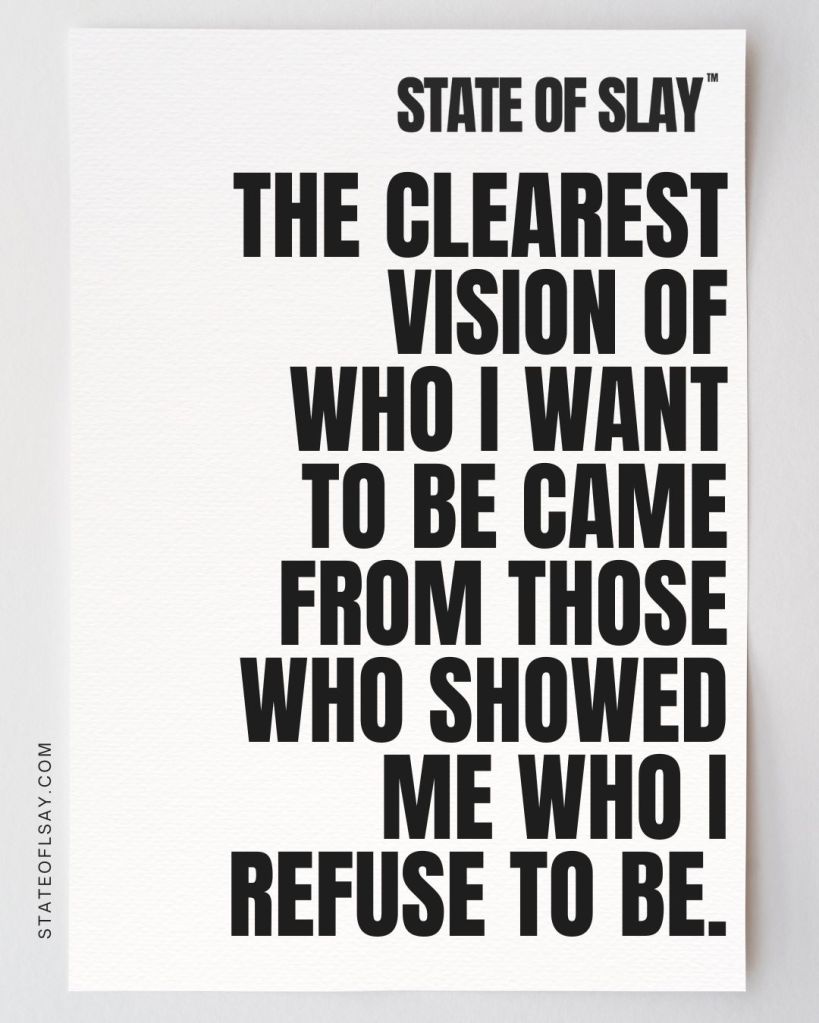
Not every influence shapes us through admiration. Some shape us through opposition. It’s in watching behavior we don’t want to repeat, words we won’t use, or choices we refuse to make that we find clarity in who we are.

This is the quiet gift of contrast—it sharpens our vision and strengthens our commitment to live differently.

This is your reminder: even painful examples can become powerful teachers.

SLAY on!

Is There a Better Version of You?

There’s a quiet question that can either empower us or paralyze us: Is there a better version of me out there?

Sometimes, that question pushes us toward growth. Other times, it whispers like doubt, telling us we’ll never measure up. The truth is, the “better version” of you isn’t some unreachable ideal. It’s not a stranger waiting at the finish line. It’s you—already here—waiting to be uncovered, nurtured, and expressed.


The Trap of Perfection

For years, I lived in the shadow of “not enough.” No matter what I accomplished, there was always that voice in my head saying: You should be further along. You should be doing more. You should be better.

Maybe you know that voice too. It’s the one that thrives on comparison, that scrolls through social media and whispers that everyone else has it figured out. It’s the one that insists your worth depends on productivity, appearance, approval, or someone else’s validation.

But here’s the thing: chasing perfection keeps us running in circles. We’ll never outrun the feeling of not enoughness if we keep feeding it.

The better version of you isn’t about being flawless—it’s about being free. Free from the lies that keep you small. Free from the fear of being misunderstood. Free from the chains of perfectionism that whisper you can’t begin until you’ve “arrived.”


Better Doesn’t Mean Different

One of the biggest misconceptions is that becoming a “better you” means transforming into someone else entirely. That’s not true.

The better version of you doesn’t erase the current you—it includes you. It’s your lessons, your scars, your wins, and your setbacks, refined into wisdom. It’s not a makeover. It’s an unfolding.

Think of it this way: a diamond isn’t created by swapping out the rock for something else. It’s created by pressure, time, and patience. The diamond was always there.

The better version of you isn’t an invention. It’s a revelation.


Stop Asking If You’re Enough—Start Asking If You’re Aligned

When I was stuck in cycles of self-sabotage, I constantly asked: Am I enough? That question never brought peace. It only invited judgment.

But when I shifted the question to: Am I aligned? everything changed.

Alignment asks:

  • Am I living according to my values?
  • Am I showing up with integrity?
  • Am I honoring my energy instead of over-giving it away?

When we’re aligned, we stop obsessing over “better” and start focusing on truer. Because when you live in truth, growth is inevitable.


Growth Is Messy, Not Linear

I used to think self-improvement meant climbing a straight staircase, each step higher than the last. But growth? It’s more like a spiral. You circle back to old lessons, but each time you’re stronger, wiser, and better equipped.

Sometimes, the “better version” of you looks like setting boundaries. Sometimes it looks like falling apart and finally asking for help. Sometimes it looks like saying “no” without explanation.

Better doesn’t always look shiny. Sometimes it looks like survival. And that’s okay.


How to Step Into the Better Version of You

If you’re ready to shift from chasing perfection to uncovering your truth, here are some practices that helped me:

  1. Get Honest About Your Patterns
    Where do you keep tripping up? Are you people-pleasing? Overworking? Seeking approval? Honesty is the doorway to change.
  2. Redefine Success
    Instead of measuring success by how others see you, measure it by peace of mind, self-respect, and alignment with your values.
  3. Let Go of Comparisons
    Your journey is not supposed to look like anyone else’s. A flower doesn’t envy another flower—it blooms where it’s planted.
  4. Celebrate Small Wins
    Don’t wait until you’ve “arrived” to feel proud. Every step forward—no matter how small—is evidence of growth.
  5. Forgive the Old You
    The person you were made choices with the tools they had at the time. Forgive them. They carried you here.

The Better Version of You Already Exists

Here’s the truth: there is a better version of you. But it’s not waiting in some distant future. It’s already inside you, asking to be let out.

It’s the version that knows her worth without needing validation. The version that sets boundaries without guilt. The version that chooses peace over chaos, truth over performance, and alignment over approval.

The better version of you isn’t about becoming someone else—it’s about finally becoming yourself.

So the next time you catch yourself wondering if there’s a better you, remind yourself: Yes. And she’s already here.


SLAY Reflection

  1. What does the “better version” of you look like—not in appearance, but in energy, choices, and peace of mind?
  2. Where in your life are you still trying to chase perfection instead of alignment?
  3. What old patterns keep pulling you back—and what lessons are they asking you to learn?
  4. How can you forgive the past versions of yourself for what they didn’t know?
  5. What’s one small step you can take today to align with the truest version of you?

S – Stop comparing your growth to others
L – Let go of perfectionism and people-pleasing
A – Align your choices with your truth
Y – Yield to the better version of you already inside


Call to Action: Join the Conversation

I’d love to hear from you.
When did you realize there was a better version of you waiting inside—and what changed when you began to live it?
Share your story in the comments. Let’s cheer each other on.

And if you know someone who’s still chasing perfection, send this to them.
Sometimes, all we need is a reminder that better isn’t somewhere out there—it’s already inside.

Slay Say

THE POWER OF PATIENCE

You don’t always need to explain yourself to be understood. True clarity isn’t forced—it unfolds with time.

When we rush to defend our side of the story, we often drain our energy trying to convince others who have already decided what they want to believe. That battle isn’t yours to fight.

Instead, let your actions, your consistency, and your integrity speak for you. Time has a way of revealing what words cannot.

This is your reminder that truth doesn’t need protection—it needs patience.

SLAY on!

Slay Say

FORWARD IS THE ONLY DIRECTION

Standing still might feel safe, but it’s also where dreams go to die. Waiting for the perfect moment only delays the life that’s waiting for you to claim it.

Growth requires movement—sometimes messy, sometimes uncertain, but always forward. Each step, no matter how small, breaks the cycle of waiting and creates momentum.

If you’re longing for change, stop looking for it to arrive on its own. The shift begins with you—when you take action, however imperfect, toward what you want.

This is your reminder that movement is the bridge between who you are and who you’re becoming.

SLAY on!