Slay Say

There’s a quiet voice inside you that notices patterns before your mind explains them.
It senses misalignment early.
It flags what feels off long before consequences appear.

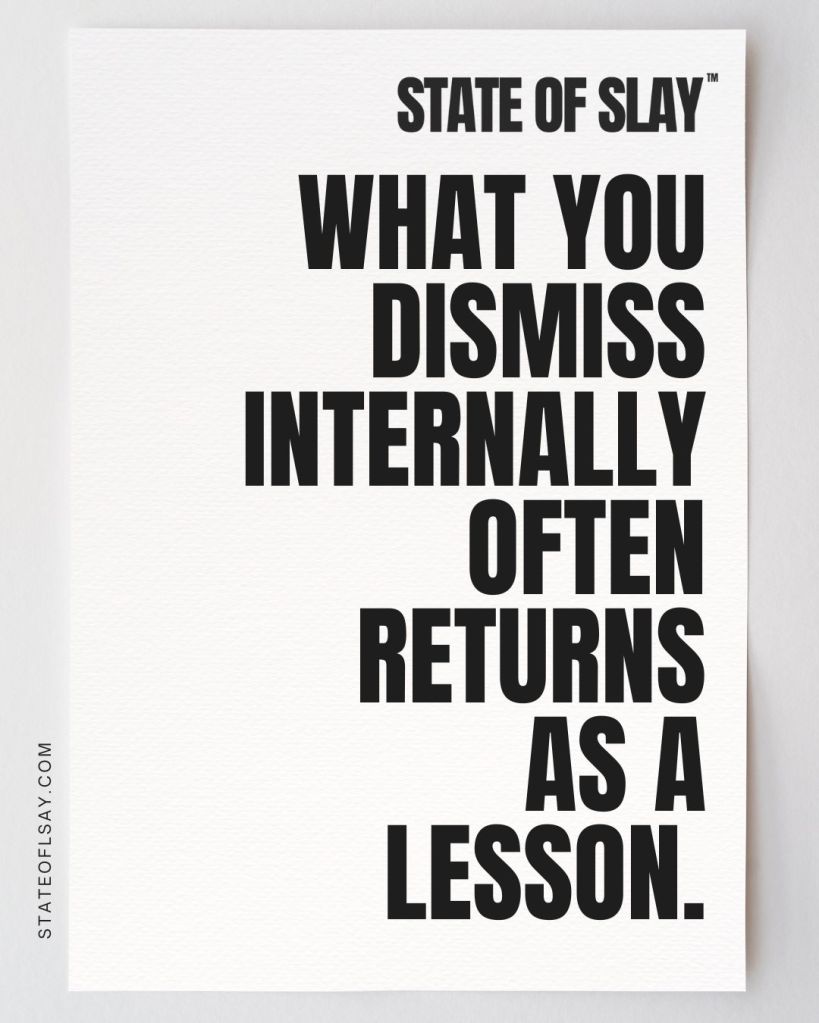
When that voice is ignored, life has a way of circling back—not to punish, but to teach.
What you overlook doesn’t disappear.
It waits.
And it often returns louder, heavier, and harder to avoid.

Trust isn’t built by always getting it right.
It’s built by listening sooner.
By honoring what you already know instead of negotiating against it.

This is your reminder:
Pay attention the first time something feels wrong.
Your inner wisdom is trying to save you a lesson you don’t need to repeat.

Slay on.

Self-Betrayal

Self betrayal rarely looks dramatic.

It doesn’t always arrive as a big, obvious choice.
It often shows up quietly — in the moments we go against ourselves just to keep the peace, to avoid conflict, or to feel chosen.

It’s the yes we give when our body is screaming no.
The truth we swallow because it feels inconvenient.
The boundary we erase because we’re afraid to be left.

And every time we do it, a small part of us learns that our needs are optional.


What Self Betrayal Really Is

Self betrayal is not about making mistakes.

It’s about abandoning your inner truth to make someone else comfortable.

It happens when you prioritize being liked over being honest.
When you ignore your intuition.
When you stay in situations that don’t respect who you are.

Over time, self betrayal doesn’t just create discomfort — it creates disconnection. You stop trusting yourself. You stop hearing your own voice. You start needing permission to feel what you feel.

And that’s where resentment and exhaustion are born.


Why We Learn to Betray Ourselves

Most of us didn’t wake up one day and decide to abandon ourselves.

We learned it.

We learned that love was conditional.
That approval came with a price.
That being easy was safer than being real.

So we adapted.

We became agreeable.
We minimized our needs.
We learned how to read the room instead of reading our own heart.

Those patterns might have protected us once — but they don’t serve the people we’re becoming.


The Cost of Self Betrayal

The cost isn’t just emotional.

It shows up as anxiety.
Burnout.
Chronic people pleasing.
A feeling that something is always off.

When you keep betraying yourself, your body knows — even when your mind tries to justify it.

That inner tension is the part of you that refuses to disappear.


Rebuilding Trust With Yourself

Healing from self betrayal begins with listening.

Not to everyone else — to you.

To your discomfort.
To your boundaries.
To the small quiet voice that says, “This doesn’t feel right.”

Every time you honor that voice, you rebuild trust.

You don’t have to get it perfect. You just have to stop ignoring yourself.


Boundaries Are Not Rejection They Are Self Respect

Saying no doesn’t mean you’re selfish.
Speaking up doesn’t mean you’re difficult.
Choosing yourself doesn’t mean you don’t care.

It means you do.

Boundaries are how you protect the relationship you have with yourself — and that relationship shapes every other one you have.


You Are Allowed to Change Your Mind

One of the most powerful ways to stop self betrayal is giving yourself permission to shift.

To grow.
To outgrow.
To choose differently.

You don’t owe anyone the old version of you.

You owe yourself the truth.


Integrity Begins on the Inside

Integrity isn’t just about what you do in public.

It’s about how you treat yourself when no one else is watching.

Are you listening to your needs?
Are you honoring your limits?
Are you telling yourself the truth?

That’s where self respect lives.


SLAY Reflection

Let’s reflect, SLAYER:

S: Where in your life have you been saying yes when you meant no?
L: What fears have kept you from being honest with yourself?
A: What boundary would bring you back into alignment?
Y: How would your life change if you stopped abandoning yourself?


Call to Action: Join the Conversation

I’d love to hear from you.
Where have you noticed self betrayal in your own life and what helped you start choosing yourself again?
Share your story in the comments. Let’s cheer each other on.

And if you know someone who keeps putting themselves last, send this to them.
Sometimes, all we need is a nudge.
Words Can Hurt And Words Can Heal

Words can build bridges.
Words can burn them down.

They can make someone feel seen, valued, loved—or they can tear open wounds that never fully heal. The truth is, words are some of the most powerful tools we have. And yet, many of us throw them around carelessly, forgetting that once spoken, they can’t be taken back.

We’re living in a world that feels more divided and reactive than ever. Which is why this matters so much: the way we speak—to others and to ourselves—matters. It always has. And it always will.


Prefer to listen? The Audio Blog version is available here.


The Language of My Past

Before I began walking this path, I used words as weapons.
I used them to hurt, to manipulate, to control the narrative.

Even more painfully, I used them on myself. Quietly. Cruelly. I would tell myself I wasn’t good enough, that I didn’t deserve love, that I was destined to fail. And those words? They stuck. They festered. They kept me small.

I remember being told early in my recovery that I had a barbed tongue. At the time, I almost wore it like a badge of honor—proof I could defend myself in any verbal battle. But really, I was just scared. I was always in fear. And fear made me lash out. It made me forget that love—real love—starts with what we say when no one else is listening.


The Way You Speak to Yourself Shapes Everything

If you wouldn’t say it to someone you love, why say it to yourself?

That was the question that changed everything for me. Because the truth is, we’re always listening to our own inner dialogue. And when we speak harshly to ourselves, our body, heart, and mind all take that in.

So I started small.
I started with one kind sentence a day.
Sometimes I didn’t believe it. Sometimes it felt fake.
But I kept going.

And eventually, those gentle words turned into something bigger: compassion. Forgiveness. Even love.

Speak Like It Matters—Because It Does

When I shifted the way I spoke to myself, something else changed: the way I spoke to others. And sometimes that was easier—giving kind words to others, even when I couldn’t give them to myself. But what I found is that the more kindness I gave away, the more I saw myself as someone capable of kindness. The cycle slowly started to shift.

Today, I try to ask myself before I speak:
Will these words hurt or heal?

That one question has the power to change a conversation. A relationship. A life. Let your words be the ones that bring light—not pain.

SLAY on.


SLAY OF THE DAY: Reflect & Rise

  • Do you pause before you speak, or do your words just pour out?
  • Have your words ever hurt someone you love? What happened?
  • How do you speak to yourself—especially when you’re struggling?
  • Can you remember a time when your words helped someone heal?
  • What would change if you made kindness your default language?

Call to Action: Join the Conversation
I’d love to hear from you.
What’s one small way you can use your words today to heal instead of hurt—either for yourself or someone else?
Share your story in the comments. Let’s cheer each other on.

And if you know someone who’s been hard on themselves lately, send this to them.
Sometimes, the right words come at the right time—and change everything.

See With Your Eyes, Hear With Your Ears

I used to live with blinders on.
Not the kind you wear—but the kind you believe.

I only saw what I wanted to see. I filtered everything through my pain, my fear, and the false narratives I told myself over and over again. If I thought I was a bad person, I looked for proof. If I believed I was unlovable, I focused on every moment that could validate that. If I thought life was unfair, I zeroed in on all the ways I’d been wronged.

I wasn’t seeing the truth—I was seeing my trauma.
And I was listening through it too.


A Filtered Life Isn’t a Full Life

When we don’t see with our eyes and hear with our ears—when we see and hear through the noise of our past or our pain—we miss what’s right in front of us. We convince ourselves of stories that may not be true. We act on distorted feelings. And slowly, we begin to disconnect from reality, from the people around us, and from ourselves.

That’s where I was before I began this path.

My perspective was warped. My sense of truth was tangled in denial and self-destruction. But I couldn’t live that way anymore. And when I started my recovery journey, the very first thing I had to do was get honest—with myself, and with the world around me.


The Moment I Took the Blinders Off

Truth didn’t come all at once—it came in pieces.
Each time I stripped away a lie I had believed, the world became clearer. Each time I sat in the discomfort of a moment instead of running from it, I reclaimed a little more power. I learned how to be present, how to focus on what was right in front of me, and how to listen with compassion.

That’s when I stopped reacting and started responding.

Because here’s what I know now:
We can’t live fully if we’re not looking and listening fully.


The Danger of Disengaging

It’s easy to get lost in our distractions—our phones, our playlists, our screens. But when we do that, we cut ourselves off from the life happening around us.
We ignore truth.
We disconnect from others.
We retreat into the stories we already believe.

But life isn’t meant to be background noise.
It’s meant to be lived, seen, heard, and felt.
And the only way we can do that is by taking off the blinders.


Choose to Show Up

When we truly see and hear what’s happening around us, something shifts. We become part of the world again. We stop reacting through old patterns and start participating in real connection. We begin to move with clarity and intention.

Let go of the need to be right.
Let go of the comfort of the old narrative.
And open yourself to what is actually real, here, now.

Because your truth lives in the present.
All you have to do is look. And listen.

SLAY on.


SLAY OF THE DAY: Reflect & Rise

Are you seeing and hearing the truth—or just what you’ve trained yourself to expect?

  • Do you move through life fully engaged, or are you walking with emotional blinders on?

  • What truths might you be avoiding? What stories do you replay that might not be real?

  • How does this affect your relationships? Your inner peace?

  • When’s the last time you truly paused, took in your surroundings, and responded instead of reacting?

Challenge yourself to listen differently.
Look deeper.
And live fully.


Call to Action: Join the Conversation

I’d love to hear from you.
What’s something you’ve learned to see clearly—once you stopped seeing it through the lens of your past?
Share your story in the comments. Let’s cheer each other on.

And if you know someone who might be stuck in an old story, send this to them.
Sometimes, truth is what sets us free—but only when we choose to see it.