There are moments when it feels easier to prioritize someone else.
To seek approval, maintain connection, or hold onto a relationship, even when it begins to cost you something internally.
It can be subtle at first. You adjust your thoughts, your reactions, or your needs just enough to keep things steady. Over time, those small adjustments can start to pull you further away from yourself.
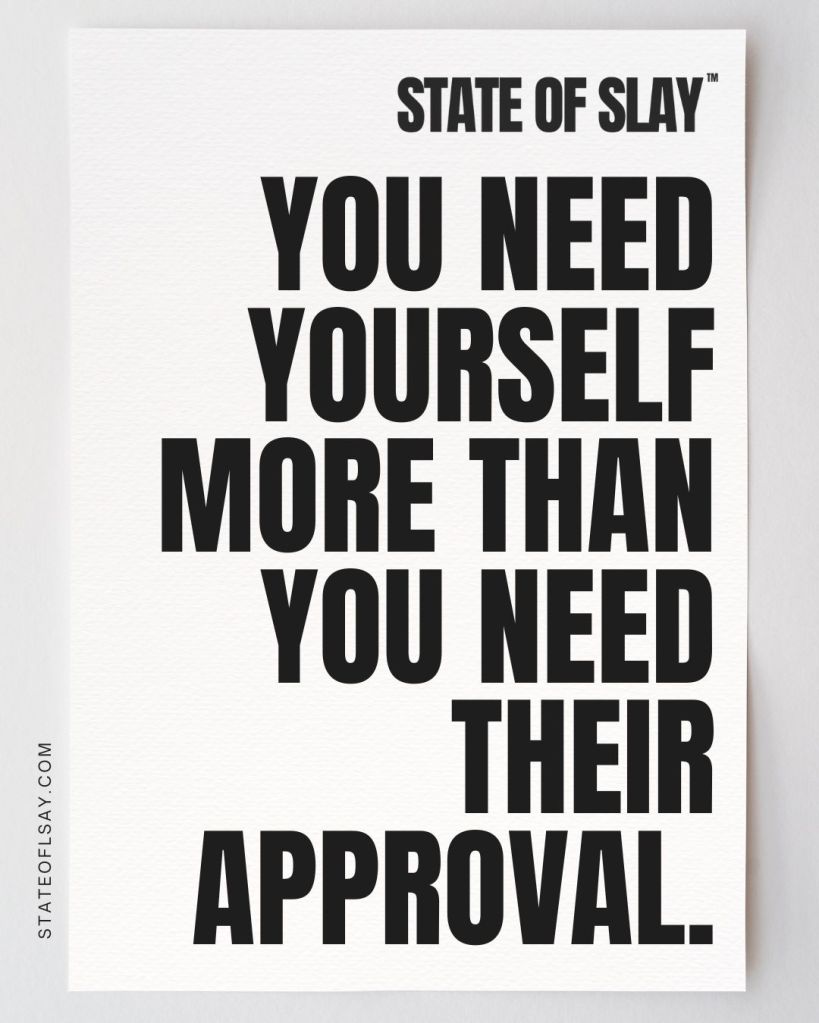
But the truth is, you are not meant to come second in your own life.
Your clarity, your well-being, and your sense of direction depend on your ability to stay connected to who you are, not who someone else needs you to be.
Choosing yourself is not selfish. It is necessary.
It is how you maintain your sense of stability, your growth, and your ability to show up fully in every area of your life.
This is your reminder that the relationship you have with yourself will always set the tone for every other relationship you experience.
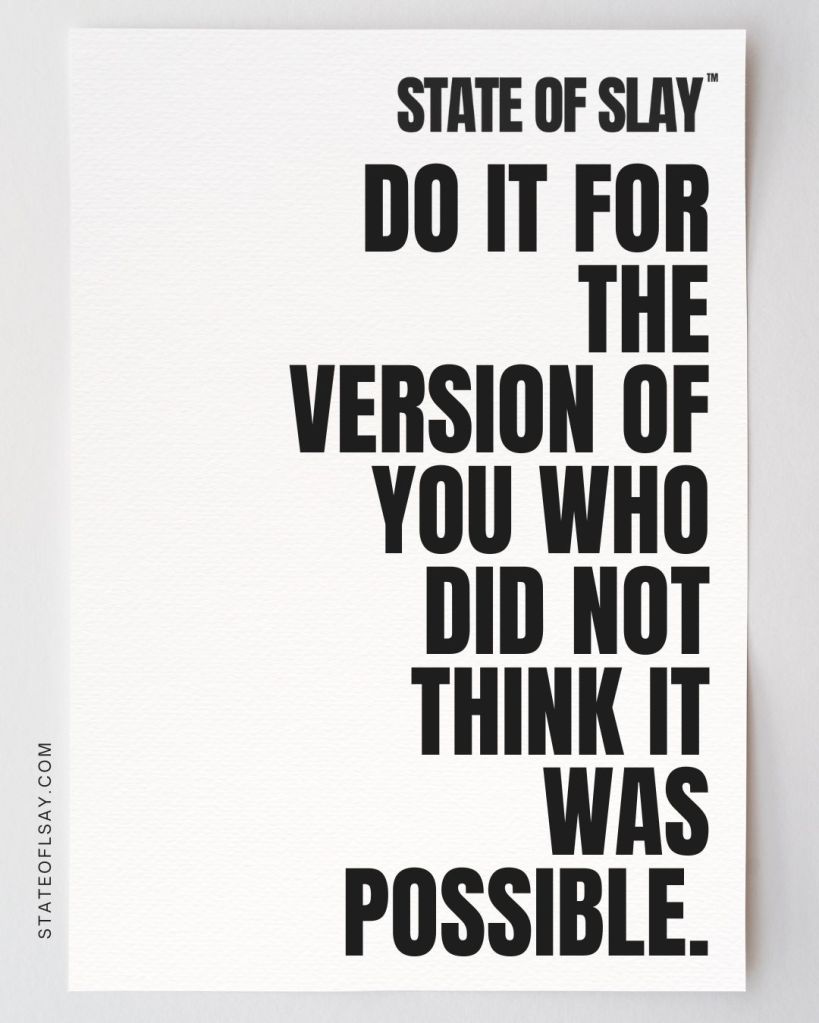
There was a version of you who doubted this was possible.
A version who questioned whether things would ever change, whether growth would come, or whether you would find the strength to keep going when it felt easier to stop.
That version of you did not have the perspective you have now. They could not see what was ahead. They only knew what felt hard, uncertain, and out of reach.
But you kept going.
Step by step, decision by decision, you moved forward even when you did not have proof that it would all work out. And in doing so, you became the proof.
This is your reminder that your progress is not just about where you are going. It is also a reflection of how far you have come.
Safer than saying what I really thought. Safer than expressing what I needed. Safer than risking how someone might respond.
So I stayed quiet.
I swallowed words that wanted to come out. I avoided difficult conversations. I convinced myself that keeping the peace was more important than speaking the truth.
But over time, that silence came at a cost.
Because every time I chose not to speak, I was choosing not to stand up for myself.
Prefer to listen? The Audio Blog version is available here.
Silence Does Not Protect You, It Hides You
It can feel like staying quiet keeps things stable.
No conflict. No discomfort. No immediate consequences.
But silence does not actually protect you.
It hides you.
Your needs go unmet. Your boundaries remain unclear. Your voice becomes smaller each time you choose not to use it.
And eventually, that silence turns into frustration. Resentment. Disconnection.
Not just from others.
From yourself.
I Had To Learn To Use My Voice
Speaking up did not come naturally to me.
There were moments when my heart would race, my hands would shake, and my thoughts would feel scattered. Even when I knew what I wanted to say, getting the words out felt overwhelming.
But I started small.
I spoke up in situations that felt manageable. I practiced expressing my thoughts without over-explaining or apologizing for them. I reminded myself that my voice mattered, even if it was not perfect.
And slowly, something began to shift.
The more I used my voice, the stronger it became.
Courage Does Not Mean Comfort
One of the biggest misconceptions about courage is that it feels confident.
Most of the time, it does not.
Courage often feels like fear.
It feels like uncertainty. Like vulnerability. Like stepping into something unknown.
But courage is not about feeling ready.
It is about acting anyway.
Speaking up even when your voice shakes is courage in its purest form.
Your Voice Is Part Of Your Identity
Your thoughts, your feelings, your perspective all matter.
When you silence them, you are not just avoiding a moment.
You are disconnecting from a part of who you are.
Using your voice is not about being loud or dominating conversations.
It is about being honest.
It is about allowing yourself to be seen and heard.
And that kind of authenticity creates deeper, more meaningful connections.
Not Everyone Will Receive It Well
This is important.
Speaking your truth does not guarantee that everyone will agree with you, understand you, or respond the way you hope.
And that can be uncomfortable.
But the goal of using your voice is not to control how others respond.
It is to honor yourself.
The right people will respect your honesty, even if they do not fully agree. And those who cannot may simply not be aligned with where you are going.
That clarity is valuable.
Boundaries Begin With Expression
You cannot have healthy boundaries without communication.
If people do not know what you need, what you are comfortable with, or what you expect, they cannot meet you there.
Speaking up creates clarity.
It defines what is acceptable and what is not. It allows you to participate in your relationships rather than quietly adapting to them.
And that participation is what creates balance.
You Do Not Need Perfect Words
This was something I struggled with.
I thought I needed to say things perfectly. That I needed to find the exact right words, tone, and timing.
But perfection is not required.
Honesty is.
Sometimes your voice will shake. Sometimes your words will not come out exactly as you planned.
And that is okay.
Because showing up imperfectly is still showing up.
And that matters more than saying nothing at all.
Every Time You Speak You Grow
Each time you choose to express yourself, you build confidence.
You strengthen your sense of self. You reinforce your value. You remind yourself that your voice deserves space.
And over time, what once felt terrifying becomes more natural.
Not because fear disappears.
But because your trust in yourself grows stronger than your fear.
SLAY Reflection
S — See the Silence Where in your life are you holding back from speaking your truth?
L — Look at the Fear What are you afraid might happen if you speak up?
A — Acknowledge Your Voice What is something you have been wanting to say but have not?
Y — Your Next Step What is one small way you can begin using your voice today?
Call to Action: Join the Conversation
I’d love to hear from you. Have you ever spoken up in a moment when it felt difficult, and what did that experience teach you?
Share your story in the comments. Let’s cheer each other on.
And if you know someone who needs the reminder that their voice matters, send this to them. Sometimes, all we need is a nudge.
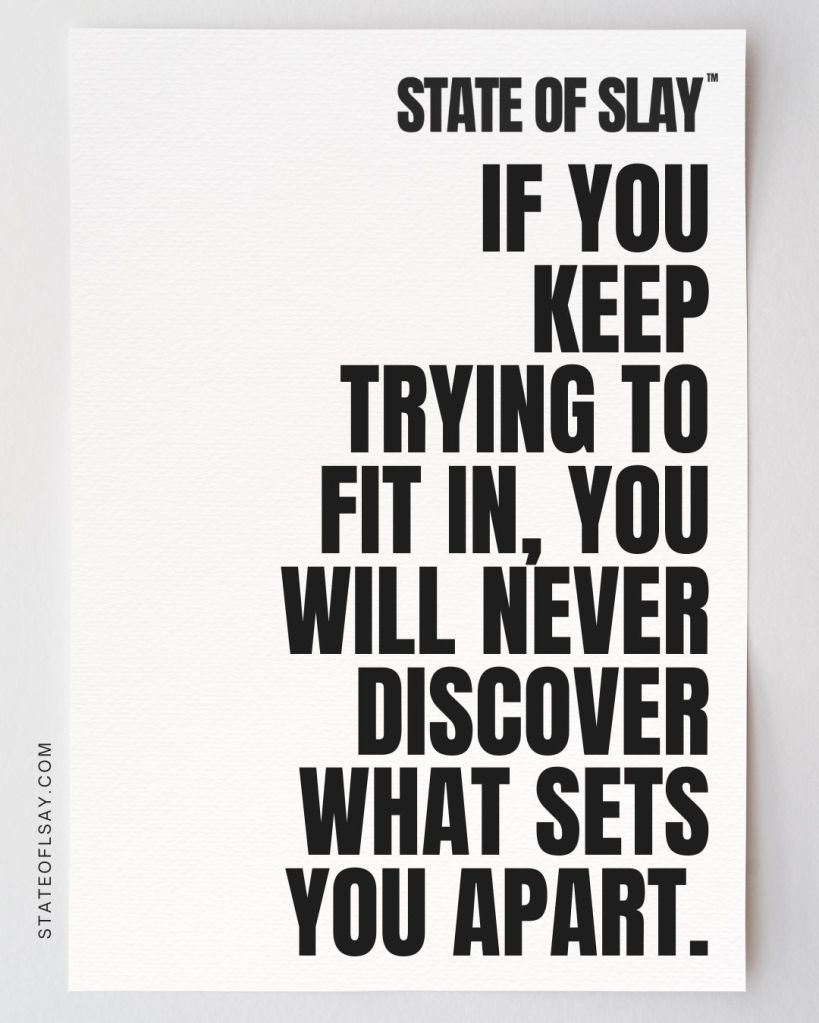
From a young age, many of us are taught to adapt, to adjust, and to fit into what is expected. We learn how to be agreeable, predictable, and easy to understand.
While those traits can feel safe, they can also quietly pull us away from what makes us unique.
The more we focus on blending in, the easier it becomes to lose sight of the qualities that set us apart. The ideas we hesitate to share, the instincts we second-guess, and the parts of ourselves we tone down often hold the very potential we are meant to explore.
Growth does not usually come from staying within what is familiar or expected. It comes from allowing yourself to take up space, express what feels true, and move beyond the version of yourself that was shaped by fitting in.
This is your reminder that what makes you different may be exactly what moves your life forward.
There was a time when I believed my worth had to be proven.
Through achievement. Through approval. Through being everything everyone needed me to be.
I thought if I worked harder, showed up more, gave more, did more, I would finally feel secure in who I was. That I would earn the validation I was searching for.
But no matter how much I did, it never felt like enough.
Because the problem was not my effort.
The problem was that I had forgotten something fundamental.
My value was never meant to be earned.
Prefer to listen? The Audio Blog version is available here.
Proving Yourself Is an Exhausting Cycle
When we believe our worth is something to be proven, we enter a loop that never truly ends.
We look for external confirmation that we are good enough. We measure ourselves by other people’s responses. We adjust our behavior to maintain approval.
And when that approval fades or shifts, we start over again.
It is exhausting.
Because external validation is unpredictable. It changes based on circumstances, opinions, and perspectives that are outside of our control.
If our sense of value depends on something unstable, we will always feel unstable too.
I Had to Face This in My Own Life
There were moments when I could clearly see how much I was performing for worth.
I said yes when I wanted to say no. I stretched myself thin trying to meet expectations that were not even mine. I shaped myself to fit environments where I did not truly belong.
And beneath all of that effort was a quiet belief.
If I just do enough, I will finally feel like I matter.
But that feeling never came from doing more.
It came from remembering who I was without needing to prove it.
Your Value Is Not Conditional
Your worth does not increase because someone recognizes it.
And it does not decrease because someone overlooks it.
Value is inherent.
It exists regardless of performance, productivity, or perception.
That can be difficult to accept in a world that often rewards output and comparison. But the truth remains.
You are not more valuable on your best day than you are on your hardest one.
When we understand that, the need to constantly prove ourselves begins to soften.
Overproving Often Hides Fear
Trying to prove your worth is often rooted in fear.
Fear of rejection. Fear of not being enough. Fear of being misunderstood or overlooked.
Those fears can drive us to overextend, overexplain, and overdeliver.
But when we operate from fear, our actions are not aligned with our true selves.
They are attempts to control how we are perceived.
And control over perception is never guaranteed.
What is guaranteed is how we treat ourselves.
Self-Worth Changes How You Show Up
When you begin to reconnect with your value, your behavior shifts.
You stop chasing approval and start choosing alignment. You stop overgiving and start giving intentionally. You stop shrinking and start standing in your truth.
This does not mean you stop caring about others.
It means you stop abandoning yourself to be accepted.
And that shift creates stronger, healthier relationships.
Because people connect more deeply with authenticity than performance.
Boundaries Reinforce Value
One of the clearest expressions of self-worth is boundaries.
When you know your value, you protect your time, your energy, and your emotional space.
You recognize when something is not aligned. You allow yourself to step back when needed. You understand that saying no is not rejection, it is clarity.
Boundaries are not about pushing people away.
They are about staying connected to yourself.
And when you stay connected to yourself, your value becomes steady rather than situational.
You Do Not Have to Perform to Belong
This is a powerful shift.
You do not need to earn your place by constantly proving your worth. You do not need to exhaust yourself to be accepted. You do not need to become someone else to be valued.
The right environments, the right people, and the right opportunities will not require you to perform for belonging.
They will recognize your value as it is.
And until you believe that, you may continue seeking validation in places that cannot give it to you.
Remember Who You Are
At some point, we all forget.
We forget our strength. Our resilience. Our inherent worth.
Life, experiences, and challenges can cloud that truth.
But it is still there.
Remembering your value is not about becoming someone new.
It is about reconnecting with who you have always been beneath the noise of expectation and comparison.
And once you remember, everything begins to shift.
You stop trying to prove your worth.
Because you finally know you already have it.
SLAY Reflection
S — See the Pattern Where in your life do you feel the need to prove your worth?
L — Look Beneath It What fear might be driving that need for validation?
A — Affirm Your Value What is one truth about your worth that exists regardless of external approval?
Y — Your Next Step What would change if you showed up today believing you were already enough?
Call to Action: Join the Conversation
I’d love to hear from you. Have you ever realized you were trying to prove your worth, and what helped you shift out of that pattern?
Share your story in the comments. Let’s cheer each other on.
And if you know someone who needs this reminder, send this to them. Sometimes, all we need is a nudge.
Growth does not always feel comfortable, especially when it changes how others experience you.
Sometimes the people around us become familiar with a version of us that was quieter, more accommodating, or easier to predict. That version may have been shaped by old fears, past circumstances, or a time when we had not yet discovered the strength to take up more space in our own lives.
As we grow, priorities shift. Confidence develops. Boundaries become clearer. The qualities that once kept the peace may begin to give way to a stronger sense of direction and self-respect.
Not everyone will celebrate that change. Some people were comfortable with the version of you that fit neatly inside their expectations.
This is your reminder that growth is not measured by how comfortable it makes everyone else. Sometimes, becoming who you are meant to be will challenge the expectations that once kept you small.
Sometimes we question our worth when what we are really experiencing is misalignment.
The environment we place ourselves in can shape how our strengths are recognized, supported, and appreciated. In the wrong setting, even talent, kindness, creativity, or dedication can go unnoticed. That absence of recognition can quietly make us doubt qualities that were never the problem to begin with.
Growth often comes from understanding that value does not disappear simply because it is overlooked. Often, it just means the environment is not the right place for it to be seen.
This is your reminder to pay attention to where you place your energy and where your presence is appreciated.
We often think of health in terms of what we eat, how we move, and how well we sleep.
But there is another influence on our well-being that many of us overlook.
The words we speak.
Not just the words we say to others, but the words we say to ourselves.
For years, I did not realize how much my internal language was affecting my emotional and physical health. The way I talked about myself, my circumstances, and my struggles was often harsh, negative, and unforgiving. I thought I was simply being honest with myself.
But over time, I began to understand something powerful.
The words we repeat become the environment our minds live in.
And if that environment is filled with criticism, fear, and negativity, it begins to shape how we feel, how we act, and even how our bodies respond.
Prefer to listen? The Audio Blog version is available here.
The Language We Use Becomes Our Reality
Our brains are constantly listening to us.
Every time we say things like “I am terrible at this,” “Nothing ever works out for me,” or “I always mess things up,” the brain absorbs those messages. It begins to accept them as facts rather than temporary feelings.
Eventually, those words form patterns.
And those patterns influence behavior, motivation, and confidence.
I used to underestimate how powerful this internal dialogue was. I believed negative self-talk was harmless. I thought it was simply part of being self-critical or striving to improve.
But negative language does not inspire growth. It creates a limitation.
The more we repeat discouraging messages, the more believable they become.
I Had To Change How I Spoke To Myself
There was a point in my life where my internal dialogue became impossible to ignore.
I noticed how often I spoke to myself in ways I would never speak to someone I loved. I used language that was judgmental, impatient, and unforgiving.
And it showed.
My stress levels increased. My confidence shrank. My outlook became more pessimistic.
Eventually, I asked myself a simple question.
Would I talk to a friend the way I talk to myself?
The answer was an immediate no.
That realization made it clear that something needed to change.
Words Can Heal Or Harm
Language carries energy.
Encouraging words can build resilience. Kind words can restore hope. Honest words can create clarity.
But harsh words can also erode confidence, increase anxiety, and deepen self-doubt.
This is especially true when those words come from within.
When we repeatedly tell ourselves that we are incapable, unworthy, or doomed to fail, our minds begin to operate under those assumptions.
But when we shift our language, something remarkable happens.
Our perspective shifts with it.
The Difference Between Honesty And Harm
Changing your internal language does not mean ignoring challenges or pretending everything is perfect.
It means choosing honesty without cruelty.
Instead of saying “I always fail,” you might say “I did not succeed this time, but I can learn from it.”
Instead of “I am terrible at this,” you might say “I am still developing this skill.”
Those small shifts matter.
They create space for improvement instead of shutting the door on possibility.
And possibility is where growth lives.
Your Body Listens Too
Stress does not only live in the mind. It shows up in the body.
Negative internal language can increase tension, anxiety, and emotional fatigue. When we constantly criticize ourselves, our nervous system often responds as if it is under threat.
Over time, that stress can affect sleep, energy levels, and emotional balance.
Positive language does not magically erase problems, but it can reduce unnecessary stress and create a healthier mental environment.
Your words become signals to your brain about how safe or unsafe the world feels.
Choosing supportive language can help restore balance.
Awareness Is The First Step
Most of us are not fully aware of how often we speak negatively about ourselves.
The first step is simply noticing.
Pay attention to the words that appear when you make a mistake, face a challenge, or feel frustrated.
Ask yourself whether those words support your growth or undermine it.
If they undermine it, consider how you might reframe them.
Small adjustments in language can lead to powerful shifts in mindset.
Compassion Creates Strength
One of the greatest lessons I have learned is that self-compassion does not weaken us.
It strengthens us.
When we treat ourselves with patience and encouragement, we create the emotional stability needed to keep moving forward.
Harsh self-judgment may feel motivating in the moment, but it rarely leads to sustainable growth.
Compassion allows us to learn without destroying our confidence.
And confidence is essential for lasting change.
Speak To Yourself Like Someone Worth Healing
You deserve words that support your well-being.
Words that acknowledge effort. Words that encourage growth. Words that allow mistakes to become lessons rather than identity.
Changing your internal language will not transform your life overnight.
But over time, it can change the atmosphere of your mind.
And when the atmosphere changes, your perspective begins to change with it.
Your thoughts become kinder.
Your actions become stronger.
Your health becomes steadier.
So the next time you notice yourself speaking harshly about your abilities, your worth, or your future, pause.
And ask yourself a simple question.
Are my words helping me heal, or are they making me sick?
Choose wisely.
SLAY Reflection
S — See the Pattern What words do you most often use when talking about yourself during a difficult moment?
L — Listen Closely Would you speak to someone you care about using those same words?
A — Adjust Your Language How could you reframe those statements to be honest but supportive?
Y — Your Next Step What encouraging phrase could you begin practicing when you face a setback or challenge?
Call to Action: Join the Conversation
I’d love to hear from you. Have you ever noticed how your words affect your mood, confidence, or well-being?
Share your story in the comments. Let’s cheer each other on.
And if you know someone who might need a reminder to speak to themselves with more kindness, send this to them. Sometimes, all we need is a nudge.
Sometimes what feels like a limitation is actually just a story we have been repeating for so long that it begins to feel permanent.
Many of the boundaries we believe in were shaped by old expectations, past experiences, or the voices of people who never imagined a different path for us. Over time, those ideas can quietly become rules we never agreed to but continue to live by.
Growth often begins the moment we question those assumptions. When we allow ourselves to look at life with a fresh perspective, we realize that what once looked like a fixed wall may have been a door we simply had not tried to open yet.
This is your reminder to reconsider the limits you may have accepted without question, and to explore what becomes possible when you give yourself permission to see beyond them.
There was a season in my life when I expected results I had not earned.
I wanted growth without discomfort. Success without consistency. Connection without vulnerability. Peace without doing the internal work.
And when those things did not show up the way I imagined, I felt frustrated. Disappointed. Sometimes, even resentful.
But eventually I had to face a hard truth.
Expectation without effort breeds disappointment.
And that lesson changed how I approach almost everything.
Prefer to listen? The Audio Blog version is available here.
Effort Builds Alignment
We all have dreams. Goals. Desires. Vision boards full of possibility.
But wanting something is not the same as working toward it.
There is nothing wrong with ambition. In fact, ambition can be healthy and motivating. The problem begins when expectation outpaces action.
If we want deeper relationships, we have to practice communication and emotional honesty. If we want physical strength, we have to move our bodies. If we want career growth, we have to develop skills and consistency.
Alignment between effort and expectation creates peace.
Misalignment creates frustration.
I Had To Learn This Personally
There were moments when I wanted to be seen differently without changing my behavior. I wanted trust without rebuilding credibility. I wanted confidence without confronting insecurity.
Once I accepted that, something shifted. Instead of feeling entitled to outcomes, I focused on earning them.
And that shift empowered me.
Because effort is something we control.
Discipline Creates Self-Respect
There is a quiet confidence that comes from knowing you showed up fully.
Not perfectly. Not flawlessly. But consistently.
Discipline is not punishment. It is commitment to your future self.
When you follow through on what you say you will do, trust builds internally. That internal trust strengthens resilience. It reduces anxiety. It increases clarity.
Self-respect grows from keeping promises to yourself.
And that foundation supports sustainable success.
Expectations Without Work Can Damage Relationships
This lesson extends beyond career and goals.
It applies deeply to relationships.
Expecting loyalty without offering it. Expecting communication without practicing it. Expecting emotional safety without creating it.
Relationships thrive on reciprocity.
When we expect more than we contribute, imbalance follows. Resentment builds. Connection weakens.
But when we invest effort intentionally, relationships strengthen naturally.
Contribution matters.
Patience Is Part Of The Process
One of the hardest parts of growth is timing.
We live in a culture that celebrates immediate results. Overnight success. Quick transformations.
When we focus on building strong patterns, outcomes become more predictable. Not guaranteed. But aligned.
And when outcomes do not match effort, we adjust. We learn. We refine.
Growth becomes dynamic instead of discouraging.
That shift keeps momentum alive.
SLAY Reflection
Let’s reflect, SLAYER:
S: Where in your life are your expectations outpacing your effort?
L: What small daily action could bring your effort into alignment with your goals?
A: How does following through on commitments impact your self-trust?
Y: What would change if you focused more on building than expecting?
Call to Action: Join the Conversation
I’d love to hear from you. What goal in your life shifted once you committed to matching your effort with your expectations? Share your story in the comments. Let’s cheer each other on.
And if you know someone feeling discouraged about slow progress, send this to them. Sometimes, all we need is a nudge.