It can feel heavy, confusing, and at times completely unnecessary. In the middle of it, it is easy to wish it away, to want to move past it as quickly as possible, or to question why it is happening at all.
But struggle has a way of shaping you, even when you do not see it right away.
It builds awareness. It sharpens perspective. It reveals strength, boundaries, and truths that may have otherwise remained hidden.
The experience itself may not be something you would choose, but what you take from it can become something meaningful.
Growth does not come from avoiding difficult moments. It comes from allowing them to teach you something you can carry forward.
This is your reminder that even the hardest chapters can leave you with something valuable.
Build Your Life on Purpose, Not People or Possessions is a lesson I had to learn the hard way.
There was a time when I tied my happiness to things outside of me.
To people. To outcomes. To moments I believed would finally make everything feel complete.
If this relationship works, I will be happy. If I achieve this, I will feel fulfilled. If I get this thing, I will feel secure.
And sometimes, for a moment, I did.
But it never lasted.
Because anything that lives outside of you can shift, change, or disappear. And when your happiness is tied to something that is not stable, your sense of peace becomes unstable too.
Prefer to listen? The Audio Blog version is available here.
External Attachments Create Internal Instability
It is natural to care about people. To value experiences. To enjoy the things we work hard for.
But when we attach our identity and happiness to them, we give away our center.
People change. Circumstances shift. Possessions lose their meaning. Achievements fade into the next goal.
And when those things are what we rely on to feel whole, we are constantly adjusting, constantly chasing, constantly trying to hold onto something that was never meant to define us.
That is not peace.
That is pressure.
I Had to Redefine What Fulfillment Meant
There were moments in my life when I truly believed that happiness would arrive once everything lined up.
Once the relationship was right. Once the career felt secure. Once, life looked the way I imagined it should.
But what I learned is that fulfillment is not something you arrive at.
It is something you build.
And what you build it on matters.
When I began to shift my focus away from external validation and toward internal direction, everything started to feel different.
Not easier.
But steadier.
Goals Give You Direction Without Taking Your Power
Goals are different from attachments.
A goal is something you move toward. It gives you purpose, direction, and momentum.
But it does not define your worth.
It does not control your identity.
And most importantly, it stays with you even when everything else changes.
When you tie your life to goals, you are grounding yourself in growth rather than circumstance.
You are choosing progress over dependency.
And that is where real empowerment begins.
People Should Be Part of Your Life, Not the Center of It
This does not mean you stop valuing relationships.
It means you stop building your identity around them.
Healthy relationships enhance your life.
They support you. They grow with you. They add to your experience.
But they are not meant to carry the weight of your happiness.
When someone becomes the center of your world, you risk losing yourself in the process.
And when that relationship shifts, as all things do, it can feel like everything is falling apart.
Keeping yourself at the center changes that.
Possessions Do Not Create Lasting Fulfillment
We are often told that success looks like what we have.
The house. The car. The lifestyle.
And while there is nothing wrong with enjoying those things, they are not designed to create lasting happiness.
Possessions can enhance your experience.
But they cannot replace purpose.
And without purpose, even the most beautiful things can feel empty over time.
Purpose Creates Stability
When your life is tied to goals that reflect who you are becoming, your sense of self becomes more grounded.
You are no longer waiting for something or someone to complete you.
You are actively participating in your own growth.
That creates stability.
Because even when circumstances change, your direction remains.
You still know who you are.
You still know where you are going.
You Carry Your Fulfillment With You
One of the most freeing realizations is this.
You do not have to wait for the right person, the right moment, or the right situation to feel fulfilled.
You can create that within yourself.
Through your goals. Through your growth. Through the choices you make every day.
When your life is tied to something internal, something you are actively building, fulfillment becomes something you carry with you.
Not something you chase.
Build a Life That Cannot Be Taken From You
People will come and go.
Circumstances will change.
Things will be gained and lost.
That is part of life.
But when your sense of purpose is rooted in your goals, your growth, and your direction, you create something that cannot be taken from you.
A life that is not dependent on external conditions.
A life that is built from the inside out.
And that is where true happiness lives.
SLAY Reflection
S — See the Attachment Where in your life are you tying your happiness to a person, outcome, or possession?
L — Look at the Impact How does that attachment affect your sense of stability and peace?
A — Align With Purpose What goal could you focus on that reflects your growth and values?
Y — Your Next Step What is one small step you can take today toward building a life rooted in purpose?
Call to Action: Join the Conversation
I’d love to hear from you. Have you ever shifted your focus from external validation to internal goals, and what changed for you? Share your story in the comments. Let’s cheer each other on.
And if you know someone who might need this reminder, send this to them. Sometimes, all we need is a nudge.
There are moments when the answer comes quietly and clearly.
A feeling. A knowing. A sense that something is not right or not aligned, even if you cannot fully explain why.
But then something else begins to take over.
Doubt creeps in. Logic starts trying to reshape what you felt. You begin to question yourself, soften the truth, or search for reasons to stay where you are.
What was once clear becomes complicated.
Fear has a way of doing that. It does not always shout. Sometimes it simply rewrites the truth in a way that feels easier to accept, safer to hold, or more comfortable to stay within.
Growth often begins with recognizing that the first feeling was not confusion. It was clarity.
This is your reminder to trust what you knew before fear had the chance to change the narrative.
There was a version of you who doubted this was possible.
A version who questioned whether things would ever change, whether growth would come, or whether you would find the strength to keep going when it felt easier to stop.
That version of you did not have the perspective you have now. They could not see what was ahead. They only knew what felt hard, uncertain, and out of reach.
But you kept going.
Step by step, decision by decision, you moved forward even when you did not have proof that it would all work out. And in doing so, you became the proof.
This is your reminder that your progress is not just about where you are going. It is also a reflection of how far you have come.
Safer than saying what I really thought. Safer than expressing what I needed. Safer than risking how someone might respond.
So I stayed quiet.
I swallowed words that wanted to come out. I avoided difficult conversations. I convinced myself that keeping the peace was more important than speaking the truth.
But over time, that silence came at a cost.
Because every time I chose not to speak, I was choosing not to stand up for myself.
Prefer to listen? The Audio Blog version is available here.
Silence Does Not Protect You, It Hides You
It can feel like staying quiet keeps things stable.
No conflict. No discomfort. No immediate consequences.
But silence does not actually protect you.
It hides you.
Your needs go unmet. Your boundaries remain unclear. Your voice becomes smaller each time you choose not to use it.
And eventually, that silence turns into frustration. Resentment. Disconnection.
Not just from others.
From yourself.
I Had To Learn To Use My Voice
Speaking up did not come naturally to me.
There were moments when my heart would race, my hands would shake, and my thoughts would feel scattered. Even when I knew what I wanted to say, getting the words out felt overwhelming.
But I started small.
I spoke up in situations that felt manageable. I practiced expressing my thoughts without over-explaining or apologizing for them. I reminded myself that my voice mattered, even if it was not perfect.
And slowly, something began to shift.
The more I used my voice, the stronger it became.
Courage Does Not Mean Comfort
One of the biggest misconceptions about courage is that it feels confident.
Most of the time, it does not.
Courage often feels like fear.
It feels like uncertainty. Like vulnerability. Like stepping into something unknown.
But courage is not about feeling ready.
It is about acting anyway.
Speaking up even when your voice shakes is courage in its purest form.
Your Voice Is Part Of Your Identity
Your thoughts, your feelings, your perspective all matter.
When you silence them, you are not just avoiding a moment.
You are disconnecting from a part of who you are.
Using your voice is not about being loud or dominating conversations.
It is about being honest.
It is about allowing yourself to be seen and heard.
And that kind of authenticity creates deeper, more meaningful connections.
Not Everyone Will Receive It Well
This is important.
Speaking your truth does not guarantee that everyone will agree with you, understand you, or respond the way you hope.
And that can be uncomfortable.
But the goal of using your voice is not to control how others respond.
It is to honor yourself.
The right people will respect your honesty, even if they do not fully agree. And those who cannot may simply not be aligned with where you are going.
That clarity is valuable.
Boundaries Begin With Expression
You cannot have healthy boundaries without communication.
If people do not know what you need, what you are comfortable with, or what you expect, they cannot meet you there.
Speaking up creates clarity.
It defines what is acceptable and what is not. It allows you to participate in your relationships rather than quietly adapting to them.
And that participation is what creates balance.
You Do Not Need Perfect Words
This was something I struggled with.
I thought I needed to say things perfectly. That I needed to find the exact right words, tone, and timing.
But perfection is not required.
Honesty is.
Sometimes your voice will shake. Sometimes your words will not come out exactly as you planned.
And that is okay.
Because showing up imperfectly is still showing up.
And that matters more than saying nothing at all.
Every Time You Speak You Grow
Each time you choose to express yourself, you build confidence.
You strengthen your sense of self. You reinforce your value. You remind yourself that your voice deserves space.
And over time, what once felt terrifying becomes more natural.
Not because fear disappears.
But because your trust in yourself grows stronger than your fear.
SLAY Reflection
S — See the Silence Where in your life are you holding back from speaking your truth?
L — Look at the Fear What are you afraid might happen if you speak up?
A — Acknowledge Your Voice What is something you have been wanting to say but have not?
Y — Your Next Step What is one small way you can begin using your voice today?
Call to Action: Join the Conversation
I’d love to hear from you. Have you ever spoken up in a moment when it felt difficult, and what did that experience teach you?
Share your story in the comments. Let’s cheer each other on.
And if you know someone who needs the reminder that their voice matters, send this to them. Sometimes, all we need is a nudge.
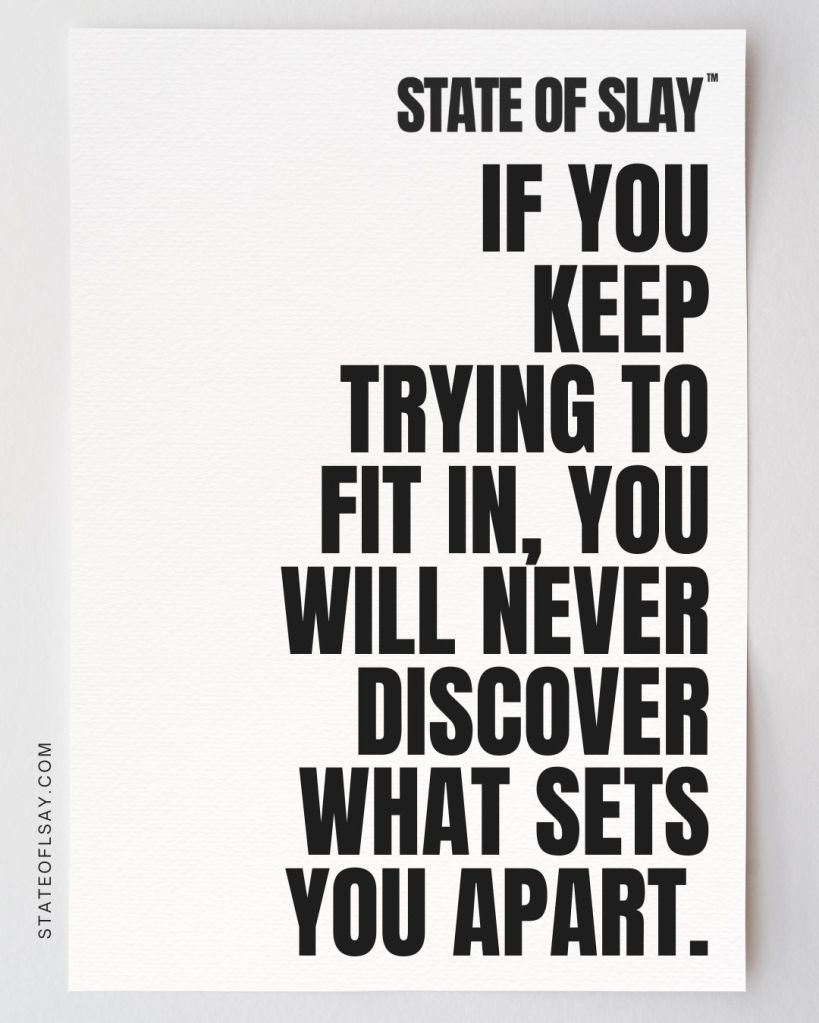
From a young age, many of us are taught to adapt, to adjust, and to fit into what is expected. We learn how to be agreeable, predictable, and easy to understand.
While those traits can feel safe, they can also quietly pull us away from what makes us unique.
The more we focus on blending in, the easier it becomes to lose sight of the qualities that set us apart. The ideas we hesitate to share, the instincts we second-guess, and the parts of ourselves we tone down often hold the very potential we are meant to explore.
Growth does not usually come from staying within what is familiar or expected. It comes from allowing yourself to take up space, express what feels true, and move beyond the version of yourself that was shaped by fitting in.
This is your reminder that what makes you different may be exactly what moves your life forward.
There was a time when I did not realize I was in love with an idea.
Not the person standing in front of me. Not the reality of how they showed up. But the version of them I believed they could become.
I saw their potential.
Who they could be if they just healed a little more. If they tried a little harder. If they chose differently. If circumstances shifted.
And because I could see that version so clearly, I held on.
Longer than I should have.
Prefer to listen? The Audio Blog version is available here.
Potential Is Not a Promise
Potential is powerful.
It allows us to see beyond the present moment. It helps us believe in growth, transformation, and possibility.
But potential is not a guarantee.
It is not a commitment. It is not a plan. And it is certainly not a substitute for consistent action.
When we build a relationship around potential, we are often attaching ourselves to a future that may never arrive.
And in the meantime, we ignore what is actually happening right now.
I Had to Get Honest With Myself
There were moments when I knew something was not right.
The inconsistency. The lack of follow-through. The feeling that I was giving more than I was receiving.
But I justified it.
I told myself they were going through something. Those things would change. That I just needed to be patient.
And if I am being honest, part of me believed that if I loved them enough, supported them enough, showed up enough, I could help them become that version I saw.
But love does not create change.
Choice does.
And that was a difficult truth to accept.
You Cannot Love Someone Into Who They Could Be
This was one of the hardest lessons for me.
You cannot do the work for someone else. You cannot force growth. You cannot carry potential into reality on your own.
People change when they choose to change.
Not when they are encouraged, pushed, or supported into it.
And while support can help, it cannot replace personal responsibility.
When we take on the role of trying to help someone reach their potential, we often lose ourselves in the process.
Reality Always Reveals Itself
At some point, what is real becomes impossible to ignore.
Patterns repeat. Promises remain unfulfilled. The gap between words and actions becomes clear.
And that is where the real question appears.
Are you in a relationship with who this person is, or who you hope they will become?
Because those are two very different things.
One is grounded in reality.
The other is rooted in possibility.
And only one of them is something you can build a life on.
Loving Someone Should Not Cost You Yourself
When you stay attached to someone’s potential, you often begin to compromise your own needs.
You accept less than you deserve. You lower your expectations. You silence your intuition.
All in the hope that things will change.
But your needs matter now.
Your peace matters now.
Your well-being cannot be placed on hold for a future that is uncertain.
Healthy relationships are built on what exists today, not what might exist someday.
Choose Presence Over Possibility
There is nothing wrong with believing in people.
But belief should be supported by action.
Growth should be visible. Effort should be consistent. Change should be chosen.
When those things are present, potential becomes something real.
But when they are not, potential remains just that.
Potential.
Choosing to see what is actually in front of you allows you to make decisions that are grounded, clear, and aligned with your values.
And that clarity protects you.
You Deserve What Is Real
You deserve consistency.
You deserve effort.
You deserve someone who meets you where you are, not someone you have to wait for.
Letting go of potential does not mean giving up on love.
It means choosing a version of love that is real, present, and mutual.
And that kind of love does not require you to imagine it.
It shows up.
SLAY Reflection
S — See the Reality Are you focusing more on who someone could be than who they are right now?
L — Look at the Patterns Do their actions consistently match the potential you see in them?
A — Acknowledge Your Needs What are you currently accepting that does not align with what you truly need?
Y — Your Next Step What would change if you chose reality over potential in this relationship?
Call to Action: Join the Conversation
I’d love to hear from you. Have you ever realized you were holding onto someone’s potential instead of their reality? What helped you shift?
Share your story in the comments. Let’s cheer each other on.
And if you know someone who might need this reminder, send this to them. Sometimes, all we need is a nudge.
There was a time when I believed my worth had to be proven.
Through achievement. Through approval. Through being everything everyone needed me to be.
I thought if I worked harder, showed up more, gave more, did more, I would finally feel secure in who I was. That I would earn the validation I was searching for.
But no matter how much I did, it never felt like enough.
Because the problem was not my effort.
The problem was that I had forgotten something fundamental.
My value was never meant to be earned.
Prefer to listen? The Audio Blog version is available here.
Proving Yourself Is an Exhausting Cycle
When we believe our worth is something to be proven, we enter a loop that never truly ends.
We look for external confirmation that we are good enough. We measure ourselves by other people’s responses. We adjust our behavior to maintain approval.
And when that approval fades or shifts, we start over again.
It is exhausting.
Because external validation is unpredictable. It changes based on circumstances, opinions, and perspectives that are outside of our control.
If our sense of value depends on something unstable, we will always feel unstable too.
I Had to Face This in My Own Life
There were moments when I could clearly see how much I was performing for worth.
I said yes when I wanted to say no. I stretched myself thin trying to meet expectations that were not even mine. I shaped myself to fit environments where I did not truly belong.
And beneath all of that effort was a quiet belief.
If I just do enough, I will finally feel like I matter.
But that feeling never came from doing more.
It came from remembering who I was without needing to prove it.
Your Value Is Not Conditional
Your worth does not increase because someone recognizes it.
And it does not decrease because someone overlooks it.
Value is inherent.
It exists regardless of performance, productivity, or perception.
That can be difficult to accept in a world that often rewards output and comparison. But the truth remains.
You are not more valuable on your best day than you are on your hardest one.
When we understand that, the need to constantly prove ourselves begins to soften.
Overproving Often Hides Fear
Trying to prove your worth is often rooted in fear.
Fear of rejection. Fear of not being enough. Fear of being misunderstood or overlooked.
Those fears can drive us to overextend, overexplain, and overdeliver.
But when we operate from fear, our actions are not aligned with our true selves.
They are attempts to control how we are perceived.
And control over perception is never guaranteed.
What is guaranteed is how we treat ourselves.
Self-Worth Changes How You Show Up
When you begin to reconnect with your value, your behavior shifts.
You stop chasing approval and start choosing alignment. You stop overgiving and start giving intentionally. You stop shrinking and start standing in your truth.
This does not mean you stop caring about others.
It means you stop abandoning yourself to be accepted.
And that shift creates stronger, healthier relationships.
Because people connect more deeply with authenticity than performance.
Boundaries Reinforce Value
One of the clearest expressions of self-worth is boundaries.
When you know your value, you protect your time, your energy, and your emotional space.
You recognize when something is not aligned. You allow yourself to step back when needed. You understand that saying no is not rejection, it is clarity.
Boundaries are not about pushing people away.
They are about staying connected to yourself.
And when you stay connected to yourself, your value becomes steady rather than situational.
You Do Not Have to Perform to Belong
This is a powerful shift.
You do not need to earn your place by constantly proving your worth. You do not need to exhaust yourself to be accepted. You do not need to become someone else to be valued.
The right environments, the right people, and the right opportunities will not require you to perform for belonging.
They will recognize your value as it is.
And until you believe that, you may continue seeking validation in places that cannot give it to you.
Remember Who You Are
At some point, we all forget.
We forget our strength. Our resilience. Our inherent worth.
Life, experiences, and challenges can cloud that truth.
But it is still there.
Remembering your value is not about becoming someone new.
It is about reconnecting with who you have always been beneath the noise of expectation and comparison.
And once you remember, everything begins to shift.
You stop trying to prove your worth.
Because you finally know you already have it.
SLAY Reflection
S — See the Pattern Where in your life do you feel the need to prove your worth?
L — Look Beneath It What fear might be driving that need for validation?
A — Affirm Your Value What is one truth about your worth that exists regardless of external approval?
Y — Your Next Step What would change if you showed up today believing you were already enough?
Call to Action: Join the Conversation
I’d love to hear from you. Have you ever realized you were trying to prove your worth, and what helped you shift out of that pattern?
Share your story in the comments. Let’s cheer each other on.
And if you know someone who needs this reminder, send this to them. Sometimes, all we need is a nudge.
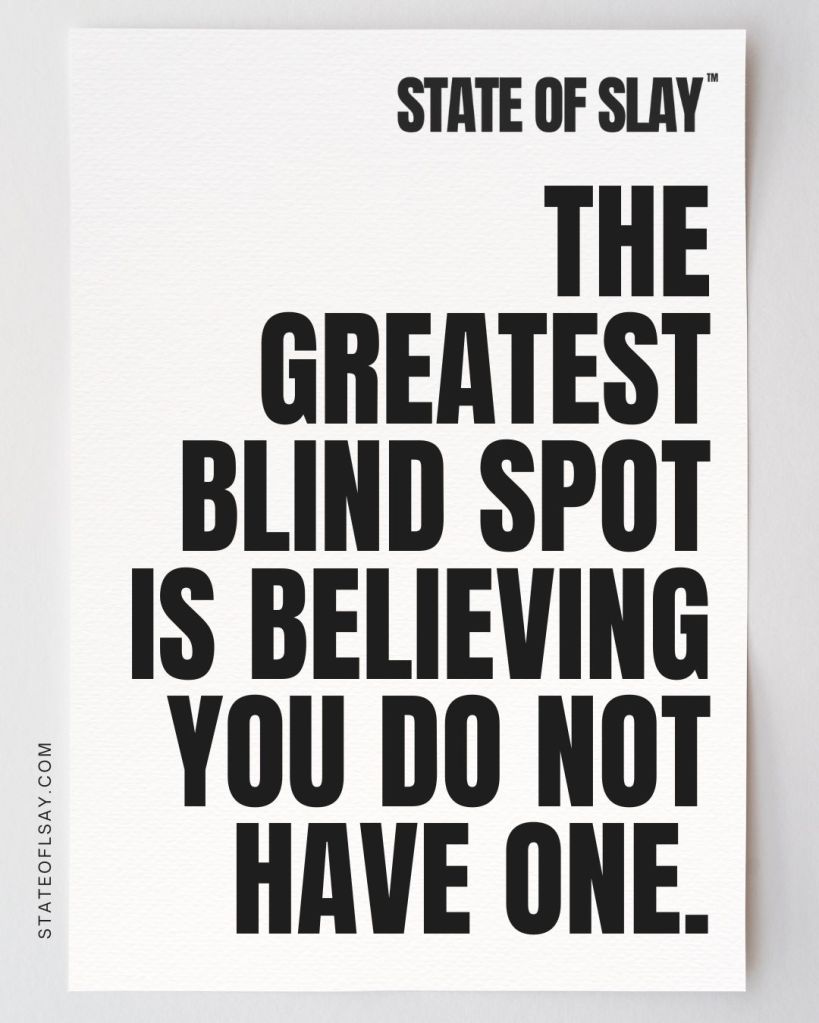
Perspective is a powerful thing. It shapes how we interpret events, understand other people, and navigate the world around us.
But perspective can also quietly become a limitation when we begin to treat it as the complete picture rather than just one angle of a much larger reality.
Every person carries experiences, assumptions, and beliefs that influence how they see the world. Those influences are not inherently wrong, but they can become dangerous when we stop questioning them or refuse to consider that someone else may see something we cannot.
Growth often begins with humility. The willingness to pause, listen, and recognize that our view may not capture the full truth can open the door to deeper understanding and stronger relationships.
This is your reminder that wisdom is not found in believing we see everything clearly, but in recognizing that our vision will always have edges.