Slay Say

So much of what weighs on you happens quietly, internally.
The second-guessing.
The overthinking.
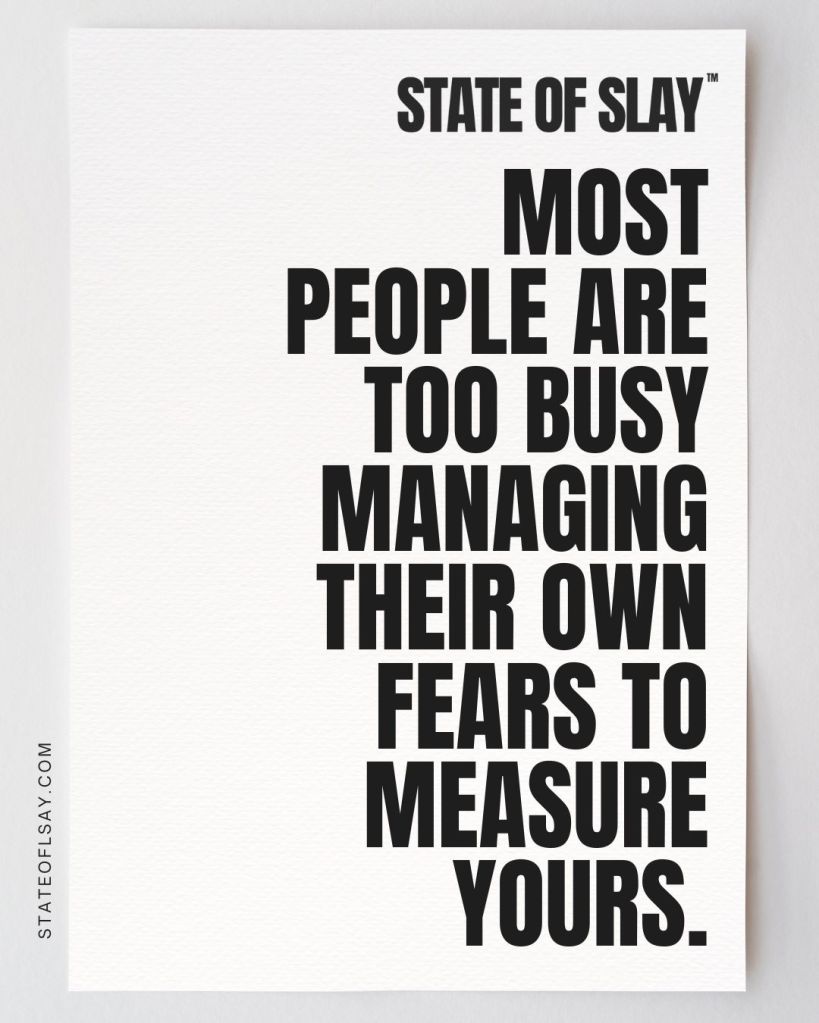
The fear that you’re being watched, measured, judged.

But most of that pressure isn’t real — it’s imagined.
It’s the mind looping through worries that no one else is replaying.
While you’re dissecting every move, most people are navigating their own uncertainties, carrying their own doubts, and trying to find their footing too.

You don’t need to be flawless to move forward.
You don’t need to shrink to stay safe.
You don’t need to carry a spotlight that isn’t actually on you.

Freedom begins when you stop living as if you’re being graded —
and start living as if you’re allowed to learn.

This is your reminder to release the unnecessary weight you’re carrying and move with more ease, more grace, and far less fear.

Slay on!

If You’re Thinking Long You’re Thinking Wrong

Overthinking is something most of us know all too well. Whether we’re trying to talk ourselves into a decision we know deep down isn’t right, delaying a choice we don’t want to face, or spinning our wheels in solo analysis instead of asking for help—we waste a lot of time trying to force a result that usually isn’t meant for us.

I’ve done it more times than I can count. I would think a situation to death, trying to make it make sense or to justify an action I wanted to take. And almost always, that thinking led me in circles. No resolution. No peace. Just more confusion.


Thinking Isn’t the Problem—Overthinking Is

There’s value in pausing to make a thoughtful choice. But when that pause becomes paralysis? That’s usually a red flag.

In my past, I often sat in silence with my thoughts. I wouldn’t share them. I wouldn’t ask for help. I just stayed stuck—spinning in fear, doubt, and self-sabotage. My negative inner voice had full control, and the longer I stayed in my head, the more power I gave it. That thinking nearly cost me my life. Because at some point, I had to face the truth: my thinking alone wasn’t always trustworthy.

Recovery taught me something vital: just because I think it doesn’t make it true. And just because I want something to work, doesn’t mean it’s right.


Gut Check: What’s Really Going On?

When we find ourselves overthinking, it’s often because we’re trying to:

  • Force something that isn’t right
  • Avoid something we don’t want to face
  • Convince ourselves to go against our intuition

Sometimes, our mind will fight our gut. Our fear will argue with our truth. That’s why it’s so important to stay honest—and to talk it out with someone you trust.

You don’t have to think your way out of everything alone. Insight often comes when we open up, ask questions, and let others help us see clearly.


Action Beats Inaction

Long thinking is often a mask for fear. But taking action—even one small step—can break the loop.

If you’ve been stuck in thought, ask yourself:

  • What am I really afraid of?
  • What’s one action I can take to move forward?
  • Who can I talk to about this?

Not every decision needs weeks of thought. Sometimes, you already know the answer—you’re just scared to act on it.

Trust yourself enough to try. And if it’s the wrong move? You can course correct. But don’t let thinking be the reason you stay stuck.

SLAY on.


SLAY Reflection: What’s Keeping You Stuck?

  • Do you find yourself overthinking important decisions? What does that usually look like for you?
  • Have you talked yourself out of action before? Why?
  • What’s one decision you’ve been sitting on for too long?
  • What’s one step you can take today to move forward?
  • Who could you talk to for clarity or support?

Call to Action: Join the Conversation

I’d love to hear from you.
What’s one decision you’re ready to stop overthinking and finally act on?
Share your story in the comments. Let’s cheer each other on.

And if you know someone who’s stuck in their head, send this to them.
Sometimes, all we need is a little clarity—and a nudge to begin.

Overthinking Overtalking

There is so much power in a pause—not just from our mouths, but from our minds.

Before walking this path, I was always thinking and talking too much. Worried that I wasn’t going to get what I wanted or that I would lose what I had, my mind and mouth were always running. Part of it was my desire to control the uncontrollable—people, places, and things around me. And part of it was that I didn’t trust myself, or that I was enough or had done enough.

My overthinking and overtalking would kick in, exhausting me and causing my mind to spiral as I tried to figure out every possible angle. I had to learn to trust myself—and the footwork I had done. I had to believe that I, and it, were enough.


The Root of the Noise

Reaching that point took a lot of work. When I stepped onto this path, I realized that I didn’t trust myself or believe I was enough in any way that counted. To counteract that feeling, I overthought and overtalked, hoping to appear prepared and to prove I had something of value to add. But in reality, I was only closing myself off from the world.

I was so determined to think and talk my way through life that I wasn’t listening, observing, or just being in the moment. It’s in those quiet spaces where we learn and take in the most. Not knowing how to calm my mind, I let it—and my mouth—run wild, assuming I’d hit the mark eventually if I just kept shooting in the general direction. I wasted a lot of energy shooting in the dark.


Learning to Trust Myself

Learning to love myself and to accept that I was enough became the turning point. It became less important to prove that to others. I knew I was enough, and that was enough.

I learned to slow down—through breathing, pausing, and listening. It’s amazing what we learn when we listen and allow ourselves to not know everything. I committed to saying yes to new things, to learning what I truly liked, rather than assuming or condemning something before even trying it. Once I opened myself up, I realized how little I did know.

The answers tend to come in those quiet spaces—in the moments when we stop, find some peace, and just be. And finding that peace took time and trust. I had always felt I had good intuition, so I began to connect with that place, practicing it daily. When I’m uncertain about the next right thing, I go there to listen for the answers. They don’t always come when I’d like, but they do when they’re meant to.

I also discovered the magic of writing. When I sit and write how I feel, I’m always amazed at the insights that emerge. The answers begin to form right before my eyes.


The Power of Listening

Today, I often find myself quiet—not because I don’t have anything to say, but because I know something better might come if I just listen. And when I know I’ve done what I can, I let it go and allow it to unfold as it’s meant to. I don’t get in the way or continue doing the work I’ve already done, hoping I can force the outcome. I’ve learned the hard way that I cannot.

Allow yourself to listen and find the answers. None of us knows everything, and you might be amazed at what’s right in front of you, showing you the way. Leave room for exploration, humility, and direction. You might be surprised at what you discover if you step aside and let it in.


SLAY OF THE DAY:

  • Do you tend to overthink and overtalk? How does it show up for you?

  • Why do you think you do this? Have you always done it?

  • How does it harm you? How can you create space today to pause and just listen?

  • When have answers come to you because you allowed yourself to be quiet? Write down an example.

  • Remember: when we let go and listen, we give the answers space to come in.


Call to Action: Join the Conversation

I’d love to hear from you.
What’s one way you’ll practice quieting your mind and listening for the answers today?
Share your story in the comments. Let’s cheer each other on.

And if you know someone who struggles with overthinking or overtalking, send this to them.
Sometimes, all we need is a nudge.