When Who You Were Can’t Take You Where You’re Going
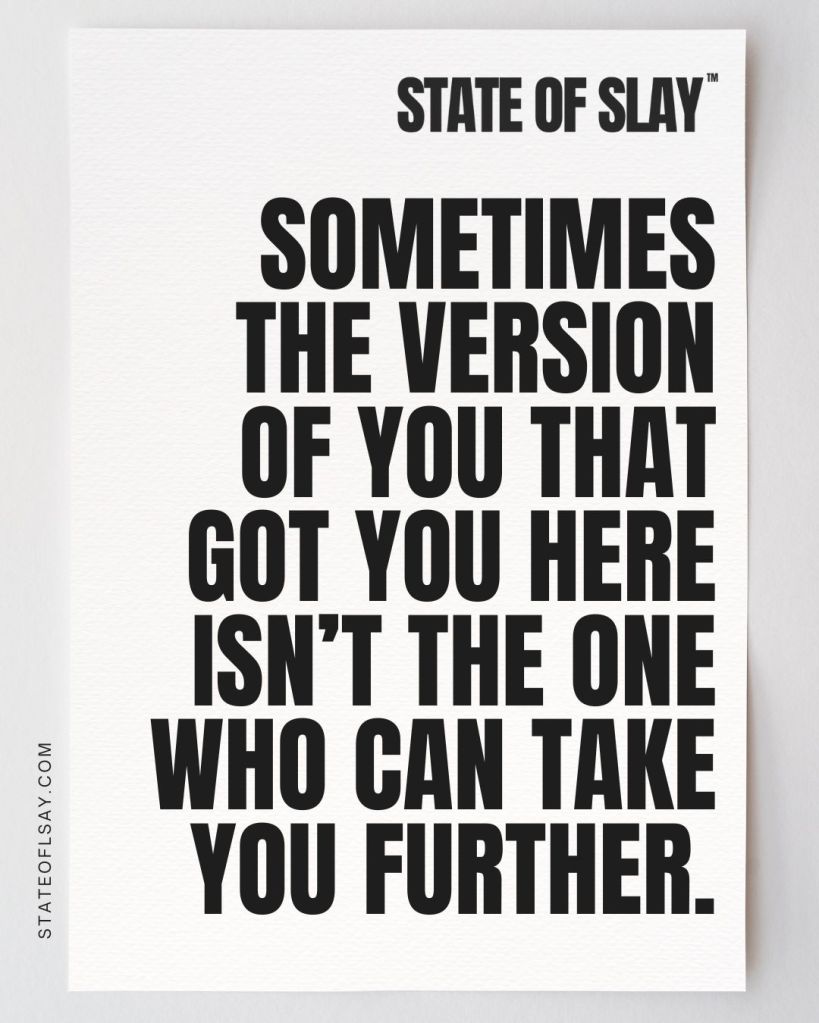
Every version of you has had a job to do.
There was a version who learned how to survive.
One who became independent because relying on other people felt risky.
One who learned to keep the peace.
One who worked harder than everyone else because achievement became proof of worth.
One who stayed guarded because being vulnerable had once been expensive.
One who said yes because disappointing people felt worse than disappointing yourself.
Those versions of you weren’t mistakes.
They developed for reasons.
They helped you navigate the life you were living with the tools, understanding, and circumstances you had at the time.
Some of them got you through things you weren’t sure you could survive.
But something can save you in one chapter and limit you in the next.
The independence that once protected you can make it difficult to ask for help.
The walls that kept you safe can prevent anyone from getting close.
The drive that helped you succeed can make rest feel like failure.
The ability to keep everyone happy can leave you disconnected from what you actually want.
The habit of expecting the worst can protect you from disappointment while making it difficult to recognize when something good has arrived.
And that’s where growth gets complicated.
Because we become attached to the qualities that helped us get here.
We call them personality.
We say, That’s just who I am.
But sometimes what feels like identity is actually adaptation.
And eventually, life may ask something different from you.
Not because who you were was wrong.
Because where you’re going requires something new.
Maybe strength now means letting someone help you.
Maybe confidence means admitting you don’t know.
Maybe loyalty means choosing yourself.
Maybe courage means becoming visible after years of making yourself small.
Maybe success means building a life you actually enjoy instead of one that simply looks impressive.
Growth doesn’t always require becoming more.
Sometimes it requires releasing what you no longer need.
That can feel surprisingly uncomfortable.
There is familiarity in our old ways of being, even when they’re exhausting.
We know how to survive with them.
We know who we are inside them.
Changing means entering a space where the old rules no longer apply and the new ones haven’t become natural yet.
You may feel less capable for a while.
Less certain.
Less like yourself.
But perhaps that discomfort isn’t evidence that you’re losing yourself.
Perhaps you’re discovering which parts of you were built for a life you’re no longer living.
You don’t have to reject who you were to become who you’re becoming.
Thank that version of you.
Honor what they carried.
Recognize what they made possible.
Then allow them to put the bags down.
You can appreciate the person who got you this far without asking them to lead you forever.
Because the next chapter may require a version of you who trusts more, receives more, risks differently, speaks more clearly, rests without guilt, or finally chooses according to what you want now.
This is your reminder:
Growth sometimes means retiring the survival skills that have finished their job.
Most of us are willing to give people the benefit of the doubt.
Someone disappoints us, and we consider what they were going through.
Someone says something hurtful, and we accept that they were angry.
Someone breaks a promise, and we understand that life got complicated.
Someone disappears when we need them, and we tell ourselves they probably had their own problems.
There is nothing wrong with allowing people to be human.
People make mistakes.
They have bad days.
They get overwhelmed.
They fail to communicate.
They make choices they regret.
But there comes a point when what we’re looking at is no longer an isolated event.
It’s a pattern.
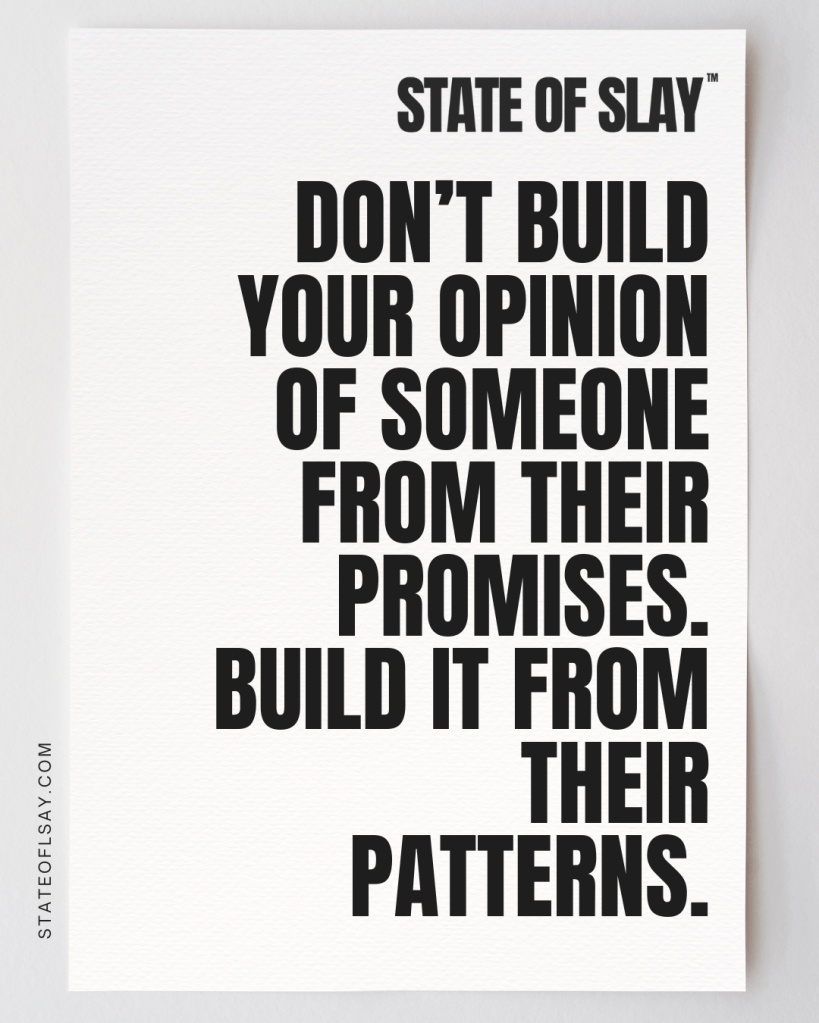
And patterns are information.
The difficult part is that we don’t always want the information they’re giving us.
Prefer to listen? The Audio Blog version is available here.
WE ARE VERY GOOD AT EXPLAINING THINGS AWAY
One disappointing moment is easy to explain.
So is a second.
Sometimes even a third.
They’re stressed.
They’re busy.
They didn’t mean it.
They’ve been through a lot.
This isn’t who they really are.
Any one of those things may be true.
The problem begins when we use explanations to keep ourselves from seeing repetition.
Because every incident comes with its own circumstances.
There is always a reason.
There is always context.
There is always another detail that makes this time seem different from the last time.
So instead of stepping back and looking at the whole picture, we keep examining each individual piece.
Eventually, we can become so focused on understanding why someone behaves a certain way that we stop noticing how consistently they behave that way.
AN EXPLANATION TELLS YOU WHY, A PATTERN TELLS YOU WHAT TO EXPECT
Understanding why someone behaves a certain way can help us have compassion.
Maybe they struggle with trust because they’ve been betrayed.
Maybe they shut down during conflict because that’s what they learned growing up.
Maybe they have difficulty showing affection.
Maybe they become defensive when they’re afraid.
Understanding those things can help us see another person more clearly.
But understanding the reason for a behavior doesn’t change the experience of living with it.
That’s an important distinction.
An explanation can tell you why something happened.
A pattern tells you what you can expect.
If someone repeatedly avoids difficult conversations, that is information.
If someone regularly makes promises and doesn’t keep them, that is information.
If someone repeatedly becomes cruel when they’re angry, that is information.
The reason may help you understand them.
The pattern helps you make decisions for yourself.
WORDS TELL YOU WHAT SOMEONE WANTS YOU TO KNOW
Actions tell you what they repeatedly choose.
We tend to give enormous weight to words.
I’ll do better.
It won’t happen again.
You know how much you mean to me.
I’m going to change.
And those words may be sincere when they’re spoken.
Someone can genuinely regret hurting you.
They can genuinely intend to change.
They can genuinely wish they had handled things differently.
But intention isn’t the same as change.
Change eventually becomes visible.
Not through a better explanation.
Not through a more emotional apology.
Not through another promise.
Through a different pattern.
When someone’s words and behavior keep telling you two different stories, pay attention to the story that keeps happening.
A PATTERN ISN’T ALWAYS SOMETHING BAD
We usually talk about patterns when something is wrong.
But patterns reveal the good, too.
Someone checks on you when they know you’re struggling.
Someone follows through when they say they’ll be there.
Someone respects your no without punishing you for it.
Someone celebrates your success without making it about themselves.
Someone tells you the truth even when it would be easier not to.
Someone makes a mistake, owns it, and behaves differently afterward.
That’s information.
Trust isn’t built from one grand gesture.
It’s built from patterns.
So is safety.
So is respect.
So is reliability.
The people who make us feel secure often aren’t doing anything dramatic.
They’re simply consistent.
Over time, their behavior tells us:
You don’t have to guess who I’m going to be with you.
There is something incredibly peaceful about that.
POTENTIAL CAN DISTRACT US FROM PATTERNS
Sometimes we don’t fall in love with what is happening.
We fall in love with what we believe could happen.
We see someone’s potential.
We see the person they could become.
The relationship they could create.
The life we could have together if a few things changed.
Potential is seductive because it keeps our attention on the future.
Patterns bring us back to the present.
Potential says:
Look at what this could become.
Patterns ask:
What has it actually been?
There is nothing wrong with believing people can grow.
They can.
People change every day.
But you don’t have to make decisions based on a version of someone who hasn’t arrived yet.
You are allowed to make decisions based on the person who keeps showing up now.
WE SOMETIMES KEEP RESETTING THE CLOCK
A painful pattern can continue for years when we keep treating every apology as a fresh beginning.
Something happens.
There is an argument.
There is an explanation.
There is an apology.
There is a promise.
We reset the clock.
Then it happens again.
And because the clock was reset, we experience it as another individual failure instead of another point on an existing line.
Forgiveness can be healthy.
Second chances can be beautiful.
People deserve room to grow.
But forgiveness doesn’t require amnesia.
You can forgive someone and still remember what experience has taught you.
Otherwise, every apology erases the very information you need to decide whether anything is actually changing.
COMPASSION DOESN’T REQUIRE CONFUSION
Sometimes we resist recognizing patterns because doing so feels unkind.
We know someone’s history.
We know what they’ve survived.
We understand their fears.
We see their wounds.
And because we understand them, we begin believing that acknowledging the effect of their behavior means we lack compassion.
It doesn’t.
You can understand why someone behaves the way they do and still recognize that their behavior hurts you.
You can have compassion for someone’s wounds without volunteering to be wounded by them.
You can hope someone heals without making your life dependent on whether they do.
Understanding someone should give you clarity.
It shouldn’t require you to ignore what you know.
PAY ATTENTION TO WHAT HAPPENS AFTER THE APOLOGY
Everyone gets things wrong.
So a mistake alone doesn’t tell us everything we need to know about someone.
What happens afterward often tells us much more.
Do they take responsibility?
Do they become defensive?
Do they blame you for their behavior?
Do they minimize what happened?
Do they listen?
Do they make an effort to repair the damage?
Most importantly, does anything actually change?
An apology can be meaningful.
But the strongest apology is often the pattern that doesn’t repeat.
That is how trust gets repaired.
Not because someone found the perfect words.
Because eventually their behavior made those words believable.
STOP ASKING THE SAME QUESTION
When someone repeatedly behaves in a way that hurts or disappoints us, we can spend enormous amounts of energy asking:
Why do they keep doing this?
Sometimes that’s worth understanding.
But eventually there may be a more useful question:
What am I going to do with what I now know?
That question changes where the power sits.
You cannot control whether someone becomes more dependable.
More honest.
More emotionally available.
More respectful.
More accountable.
But you can decide what their repeated behavior means for your participation.
Maybe you adjust your expectations.
Maybe you stop relying on them for something they’ve repeatedly shown you they cannot provide.
Maybe you create distance.
Maybe you have a conversation.
Maybe you leave.
Or maybe their pattern has shown you that this is someone you can trust more deeply.
The information doesn’t make the decision for you.
It simply gives you something real to make the decision from.
THEIR PATTERN BECOMES YOUR INFORMATION
Patterns don’t require us to judge someone as good or bad.
They help us understand what is consistently true.
Someone can be a good person and still be unreliable.
Someone can love you and still be unable to give you the kind of relationship you need.
Someone can mean well and repeatedly hurt you.
Someone can have a painful past and still be responsible for how they treat you in the present.
And someone can surprise you by consistently showing up in ways your past taught you not to expect.
Patterns aren’t verdicts.
They’re information.
And information gives us choices.
You don’t have to keep being shocked by behavior you’ve seen many times before.
You don’t have to keep turning repeated evidence into another mystery to solve.
You don’t have to stop caring about someone in order to start believing what their behavior has taught you.
Their pattern belongs to them.
What you do with that information belongs to you.
SLAY REFLECTION
S — Step back from the individual moment Is there something you’ve been treating as a series of unrelated incidents that looks different when you view it as a pattern?
L — Look at actions alongside words Where do someone’s actions consistently support what they tell you? Where do the two keep telling different stories?
A — Accept the information you already have Is there a pattern you’ve been explaining away because accepting what it means would require you to make a difficult decision?
Y — Your next choice belongs to you You cannot control someone else’s pattern, but you can decide what you do with the information it gives you. Choose one place where you can respond to what is actually happening instead of what you hope will eventually happen.
CALL TO ACTION: JOIN THE CONVERSATION
I’d love to hear from you.
Have you ever had a moment when you stopped looking at someone’s behavior as a series of isolated incidents and finally recognized the pattern?
What changed when you stopped asking why they kept doing it and started asking what you were going to do with what you knew?
Share your thoughts in the comments. Your experience may help someone else recognize that seeing a pattern isn’t about judging another person. Sometimes it’s simply about allowing yourself to use the information you’ve already been given.
And if you know someone who keeps giving the same behavior a new explanation, send this to them.
Sometimes clarity doesn’t come from discovering something new.
It comes from finally trusting what you’ve already seen.
Give it a shot because you might regret it if you don’t.
And sometimes that advice is exactly what we need.
Fear can keep us standing safely outside experiences that could change our lives. Growth often requires uncertainty, and there are opportunities we would never discover if we waited until we knew exactly how everything would turn out.
But not every hesitation is fear.
Sometimes it’s discernment.
There are moments when we already have enough information to know that something probably isn’t right for us.
The relationship that requires you to overlook things you know matter to you.
The opportunity that looks impressive but asks you to sacrifice something you’re no longer willing to give up.
The person whose potential keeps tempting you to ignore their pattern.
The invitation you keep trying to get excited about because everyone else thinks you should be.
The situation you’ve already experienced in enough different forms to recognize where it leads.
You don’t always have to go all the way to the ending to know you don’t want the story.
That can be difficult to trust.
Especially if you’ve spent years believing that saying no means you’re closed-minded, afraid, negative, or unwilling to take risks.
So you override yourself.
You give things chances you never really wanted to give.
You stay curious long after your instincts have given you an answer.
You tell yourself you should at least try.
And sometimes you end up exactly where you suspected you would, wondering why you needed the experience to confirm what you already knew.
Experience is a powerful teacher.
But it isn’t the only teacher.
So is observation.
So is history.
So is self-awareness.
So is everything you learned the last time you ignored yourself.
Growth isn’t only becoming brave enough to take more chances.
Sometimes it’s becoming wise enough to know which chances are worth taking.
That doesn’t mean you’ll always get it right.
There will be opportunities you decline that might have turned into something wonderful.
There will be doors you walk past without ever knowing exactly what was behind them.
That’s part of making choices.
Every yes closes something.
Every no does too.
A meaningful life isn’t built by experiencing every possible version of it.
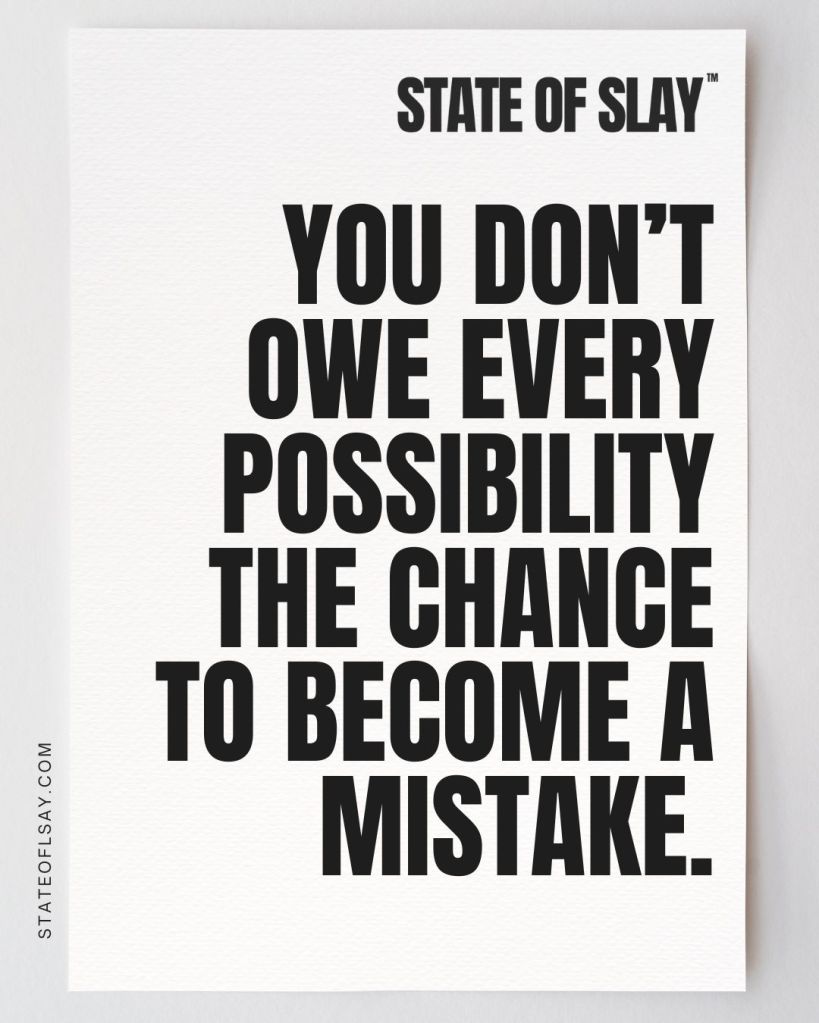
It’s built by learning which possibilities deserve your time, energy, trust, and attention.
You don’t have to date someone just because there might be something there.
You don’t have to accept an opportunity simply because it’s available.
You don’t have to revisit something you already know doesn’t work for you just to make absolutely certain.
And you don’t have to collect another scar to prove you learned from the last one.
Sometimes wisdom looks less dramatic than taking the leap.
Sometimes it looks like recognizing the edge and deciding you don’t need to jump from it.
This is your reminder:
You don’t have to experience every wrong choice firsthand to trust yourself enough to make a different one.
Conversation feels effortless. Attraction is immediate. You think about them when they’re not around. Hours disappear when you’re together. There is an energy between you that feels difficult to explain and even harder to ignore.
And because it feels so powerful, we often assume it must mean something.
This has to be special.
Maybe it is.
But special and sustainable are not the same thing.
You can have extraordinary chemistry with someone you cannot communicate with.
You can be intensely attracted to someone who cannot give you what you need.
You can feel more alive around someone whose values, priorities, or vision for the future are completely different from yours.
Chemistry can tell you that something is happening between two people.
It cannot tell you whether those two people can build a life together.
Prefer to listen? The Audio Blog version is available here.
CHEMISTRY FEELS LIKE EVIDENCE
One reason chemistry carries so much weight is because we can feel it.
It is immediate.
Compatibility isn’t always so dramatic.
Chemistry can happen across a dinner table.
Compatibility reveals itself over time.
It appears in how you communicate when you’re frustrated.
How you handle disagreement.
What you believe about money.
How you give and receive affection.
Whether you want children.
Where you want to live.
How much independence you need.
How you treat each other when life isn’t romantic, exciting, or easy.
Chemistry announces itself.
Compatibility tends to whisper.
And when one feeling is loud and the other information arrives quietly, it’s easy to let the loudest thing in the room make the decision.
INTENSITY DOESN’T ALWAYS MEAN DEPTH
We often use intensity as a measurement of connection.
The stronger the feeling, the more important the relationship must be.
But intensity and depth are not the same thing.
A relationship can be intense because it is uncertain.
Because you’re constantly wondering where you stand.
Because affection comes and goes.
Because you’re fighting and making up.
Because one minute you feel incredibly close and the next you feel miles apart.
Those emotional highs and lows can create a powerful experience.
And powerful experiences are memorable.
But emotional intensity doesn’t automatically tell us that a relationship is deep, healthy, or compatible.
Sometimes what feels like a great love story is actually a nervous system that never gets to sit down.
CHEMISTRY CAN EXIST INSIDE A BAD MATCH
This may be one of the hardest things to accept.
You don’t have to deny the chemistry to acknowledge the incompatibility.
The attraction may be real.
The conversations may be incredible.
The sex may be incredible.
The laughter may be real.
The affection may be real.
The connection may be real.
And the relationship may still not work.
We sometimes think something has to be fake before we’re allowed to leave it.
It doesn’t.
Two people can genuinely care about each other and still want completely different lives.
They can understand each other in beautiful ways and still communicate terribly during conflict.
They can have tremendous attraction and very different emotional needs.
They can love spending time together and disagree on the things that determine whether a shared future is possible.
Something doesn’t have to be bad to be wrong for you.
COMPATIBILITY LIVES IN THE ORDINARY
Chemistry loves the highlight reel.
Compatibility has to survive Tuesday.
The errands.
The bills.
The bad moods.
The canceled plans.
The stressful week.
The family obligations.
The dishes in the sink.
The moments when neither person is particularly charming.
It’s relatively easy to feel connected when you’re staring into someone’s eyes over dinner.
What happens when you’re trying to solve a problem together?
Can you disagree without punishing each other?
Can you express a need without it becoming an accusation?
Can you repair things after one of you gets it wrong?
Can you make decisions together?
Can you respect differences that aren’t going away?
Can you be bored together without assuming something is wrong?
Compatibility isn’t about being identical.
It’s about whether your differences can live in the same house without constantly setting off the smoke alarm.
SOMETIMES WE KEEP CHASING THE BEGINNING
The beginning of a relationship can be intoxicating.
Everything is discovery.
Every conversation reveals something new.
Every touch carries anticipation.
Every message creates a little spark.
Then eventually, the relationship becomes a relationship.
The mystery decreases.
Real life enters.
You begin seeing patterns instead of possibilities.
And sometimes that’s when we discover we were far more compatible with the fantasy than the reality.
So we try to get back to the beginning.
We chase the spark.
We remember how incredible it felt.
We use those early feelings as evidence that the relationship should work.
But the beginning showed you chemistry.
Time shows you compatibility.
Both matter.
They simply answer different questions.
WANTING SOMEONE DOESN’T TELL YOU WHETHER THEY ARE GOOD FOR YOU
Desire is powerful.
But desire isn’t always discerning.
We can want things that frustrate us.
Want things that destabilize us.
Want things that don’t fit the life we’re trying to create.
And we can absolutely want people who aren’t good partners for us.
That doesn’t make the desire foolish.
It makes it human.
But wanting someone and choosing someone are different acts.
Wanting happens inside us.
Choosing asks us to consider the whole picture.
Not just:
How strongly do I feel about this person?
But:
How do I feel when I am actually in this relationship?
There is an important difference between wanting someone badly and feeling good with them consistently.
COMPATIBILITY DOESN’T MEAN THERE WILL NEVER BE CONFLICT
Compatible people disagree.
They annoy each other.
They misunderstand each other.
They have different habits, preferences, personalities, and opinions.
Compatibility isn’t the absence of friction.
It’s partly about what happens when friction appears.
Can both people communicate?
Can both people listen?
Can both people take responsibility?
Can both people compromise without repeatedly betraying themselves?
Can a problem remain a problem instead of becoming a battle over someone’s worth?
A compatible relationship doesn’t require two people who naturally agree on everything.
It requires two people whose differences can be worked with rather than constantly survived.
DON’T CONFUSE HARD TO LEAVE WITH MEANT TO STAY
Sometimes the relationships that are hardest to leave are the ones we assume must matter most.
Why would I feel this strongly if this wasn’t supposed to work?
Why can’t I stop thinking about them?
Why do we keep finding our way back to each other?
Why is it so difficult to let go?
But difficulty leaving isn’t proof that staying is right.
Sometimes we’re attached to the person.
Sometimes we’re attached to the possibility.
Sometimes we’re attached to the intensity.
Sometimes we’re attached to who we were when the relationship felt good.
And sometimes we’re still trying to get a different ending from a story that has already shown us how it works.
You don’t have to make the relationship meaningless in order to recognize that it isn’t working.
ASK A DIFFERENT QUESTION
When chemistry is strong, we tend to ask:
Do I want this person?
Maybe there are better questions.
Do I like who I am in this relationship?
Can I communicate honestly here?
Do our values work together?
Can we give each other what we actually need?
Are we moving toward futures that can exist together?
Do I feel respected?
Can I trust what happens between us when things get difficult?
Am I constantly trying to turn potential into reality?
Chemistry asks whether there is a spark.
Compatibility asks whether there’s anything there that can keep burning without setting everything else on fire.
CHEMISTRY IS NOT THE SAME AS COMPATIBILITY
Chemistry matters.
Attraction matters.
Excitement matters.
That inexplicable something you feel with another person can be beautiful.
You don’t have to minimize it simply because it isn’t enough on its own.
But chemistry tells you there’s something between you.
Compatibility tells you whether you can build something on it.
Sometimes we’re so captivated by how a person makes us feel that we stop paying attention to how the relationship actually functions.
The two aren’t always the same.
A relationship can give you butterflies and still give you headaches.
It can have passion without peace.
Connection without consistency.
Desire without direction.
And recognizing that doesn’t erase what you felt.
It simply lets you see the whole relationship instead of allowing its most exciting part to speak for everything else.
You can acknowledge that the chemistry was extraordinary.
And still decide that extraordinary chemistry isn’t enough to build an ordinary life.
SLAY REFLECTION
S — Separate chemistry from compatibility Think about a relationship where the chemistry was strong. Beyond attraction and intensity, how well did the relationship actually function?
L — Look at the ordinary moments How do you feel in the everyday parts of the relationship? Pay attention to communication, trust, values, emotional needs, and how you handle problems together.
A — Ask a different question Instead of only asking, “How strongly do I feel about this person?” ask, “How do I feel when I am actually in this relationship?”
Y — Your feelings are part of the picture, not the whole picture Give yourself permission to value chemistry without allowing it to make every decision. Something can feel powerful and still not be right for the life you want.
CALL TO ACTION: JOIN THE CONVERSATION
I’d love to hear from you.
Have you ever had incredible chemistry with someone only to discover that the two of you weren’t actually compatible?
Was there a moment when you realized that wanting the relationship to work and being able to make it work were two different things?
Share your thoughts in the comments. Your experience may help someone else understand that acknowledging incompatibility doesn’t mean the connection wasn’t real.
And if you know someone who keeps returning to a relationship because the chemistry is impossible to ignore, send this to them.
Sometimes the hardest connections to leave aren’t the ones without something real between us. They’re the ones where something very real exists, but it still isn’t enough.
They assure us that what happened isn’t really who they are.
And sometimes we want so badly to believe what we’re hearing that we allow the words to carry more weight than everything we’ve actually experienced.
Words matter.
Intentions matter.
Apologies matter.
But none of them exist in a vacuum.
Eventually, they have to meet behavior.
Because anyone can tell you what they value.
The question is whether they live according to those values when it’s inconvenient.
Anyone can promise to be there.
The question is whether they consistently show up.
Anyone can say they respect your boundaries.
The question is what happens when your boundary prevents them from getting what they want.
Anyone can apologize.
The question is whether the behavior that required the apology keeps happening.
This doesn’t mean judging someone by one bad day or one poor decision.
We are all capable of getting it wrong.
We disappoint people.
We react badly.
We say things we wish we could take back.
We make choices that don’t represent who we want to be.
A single mistake can be just that.
A mistake.
But repetition gives us different information.
When the same behavior keeps appearing, the same boundary keeps being crossed, the same promise keeps being broken, or the same apology keeps following the same action, you’re no longer looking at an isolated moment.
You’re looking at a pattern.
And patterns deserve your attention.
Sometimes we ignore them because the explanation sounds reasonable.
They were stressed.
They were scared.
They’ve been through a lot.
They didn’t mean it that way.
They’re working on themselves.
Maybe all of that is true.
Understanding why someone behaves a certain way can give us compassion for them.
It doesn’t require us to pretend their behavior isn’t affecting us.
There is an important difference between understanding someone and trusting them.
Understanding can come from knowing their story.
Trust has to come from experiencing their consistency.
And that takes time.
It’s also worth noticing the good patterns.
The person who quietly keeps their word.
The friend who checks in without being asked.
The partner whose actions make you feel secure without constantly having to reassure you that you should.
The person who respects your no even when they wanted a yes.
The one whose behavior consistently matches what they say matters to them.
Those patterns are information too.
We sometimes spend so much energy analyzing what people mean that we overlook what they repeatedly show us.
You don’t have to become suspicious of everyone.
You don’t have to assume every promise is empty or every mistake is evidence of someone’s character.
You simply have to let time provide information that words alone cannot.
Listen to what people tell you.
Then watch what they do.
When those two things consistently agree, trust has somewhere to grow.
And when they consistently don’t, you don’t have to keep choosing the version of someone described by their words over the version you keep experiencing.
This is your reminder:
Believe change when you can see it in the pattern, not just hear it in the promise.
There is a particular kind of loneliness that can happen when everyone needs you.
You are the person they call when something goes wrong.
The person who listens.
The person who fixes things.
The person who remembers birthdays, checks in, solves problems, gives advice, makes arrangements, smooths things over, picks up the pieces, and somehow finds room for one more person’s crisis.
You are dependable.
Useful.
Needed.
And being needed can feel a lot like being loved.
Until one day you need something too.
Maybe you stop reaching out first.
Maybe you don’t have the energy to solve the problem.
Maybe you say no.
Maybe you’re the one having the terrible week.
Maybe you simply stop doing all the things you’ve always done.
And suddenly, some relationships become very quiet.
That’s when an uncomfortable question can surface:
Do they love me, or do they love what I do for them?
Prefer to listen? The Audio Blog version is available here.
WE LEARN TO CONFUSE USEFULNESS WITH VALUE
For some of us, being useful became part of our identity long before we realized it was happening.
Maybe praise came when you were helpful.
Maybe keeping everyone happy kept the peace.
Maybe you learned to read the room, anticipate what people needed, and take care of things before anyone had to ask.
Maybe being dependable made you feel important.
Or safe.
Or wanted.
Over time, a quiet belief can form:
I matter because I am useful.
So we become very good at being useful.
We are the reliable friend.
The responsible sibling.
The supportive partner.
The person at work who always handles it.
And every time someone needs us, we get another little piece of evidence that we matter.
But there is a problem with building your value around usefulness.
Eventually, you may start wondering what happens to your value when you have nothing to give.
BEING NEEDED CAN FEEL VERY GOOD
There is nothing inherently wrong with being needed.
Helping people can be deeply meaningful.
Showing up for the people we love is part of loving them.
It feels good to know someone trusts us enough to call.
It feels good to know our presence makes a difference.
It feels good to be someone others can count on.
The problem isn’t being needed.
The problem begins when being needed becomes the way we know we are loved.
Because then usefulness can become something we quietly chase.
We may volunteer before anyone asks.
Take responsibility that doesn’t belong to us.
Solve problems people are capable of solving themselves.
Make ourselves constantly available.
Not necessarily because anyone demanded it.
Sometimes because being indispensable feels safer than simply being loved.
If they need me, they won’t leave me.
If I’m important to their life, I’ll have a place in it.
If I keep giving them reasons to need me, maybe I’ll never have to find out whether they would choose me without them.
LOVE IS INTERESTED IN WHO YOU ARE
Someone can appreciate everything you do without really knowing you.
That’s a difficult distinction.
They may know you’re reliable.
They may know you’ll answer.
They may know you’ll help.
They may know you’ll listen.
They may know exactly what you can provide.
But do they know you?
Do they ask what you’re thinking when you’re not solving their problem?
Do they notice when you’re quieter than usual?
Do they care about what excites you, worries you, challenges you, or makes you laugh?
Do they make space for your needs when those needs are inconvenient?
Can you show up tired, confused, imperfect, uncertain, or empty-handed and still feel welcome?
Being needed often focuses on what you provide.
Love remains interested in the person doing the providing.
THE FIXER RARELY GETS ASKED IF THEY NEED FIXING
Once people become accustomed to you being strong, they can stop looking for signs that you’re struggling.
Not always because they don’t care.
Sometimes because you’ve trained everyone, including yourself, to believe you’ve got it.
You handle things.
You figure it out.
You don’t want to burden anyone.
You tell people you’re fine before they finish asking.
Then resentment can begin creeping in.
Why doesn’t anyone ever ask about me?
Sometimes the answer is painful.
But sometimes the answer is simply that we’ve become so practiced at performing self-sufficiency that nobody realizes there is another role available to us.
We want people to know we need support without ever letting ourselves need support.
That doesn’t mean every one-sided relationship is our responsibility.
It does mean we have to give healthy relationships the opportunity to meet the person underneath the capability.
STOP BEING USEFUL AND WATCH WHAT CHANGES
You can learn a lot about a relationship when you stop doing all the work.
Don’t play games.
Don’t create tests nobody knows they’re taking.
Just stop overfunctioning.
Let someone else initiate the conversation.
Let someone else make the plan.
Let someone else remember.
Let someone else solve their own problem.
Let a request go unanswered until you actually have the capacity to answer it.
Say no when the answer is no.
Then pay attention.
Some relationships won’t change at all.
Those people will still call just to hear your voice.
They’ll still want your company when you have nothing to offer except yourself.
They’ll notice when you’re not okay.
They’ll adjust when you’re overwhelmed.
They’ll show up.
Other relationships may begin to fade.
And while that can hurt, it may also reveal something you needed to see.
Sometimes we don’t realize we’ve built relationships around what we do for people until we stop doing it.
BEING INDISPENSABLE IS NOT THE SAME AS BEING IRREPLACEABLE
There is another trap hidden inside being needed.
We can begin trying to become indispensable.
If we’re the only one who can fix it, manage it, understand them, calm them down, rescue the situation, or keep everything together, then surely our place is secure.
But indispensability isn’t intimacy.
Someone depending on you doesn’t automatically mean they are connected to you.
In fact, constantly making yourself necessary can prevent you from discovering something far more meaningful:
Whether someone simply wants you there.
Not because you solved anything.
Not because you provided something.
Not because the whole machine falls apart without you.
Just because life feels better with you in it.
There is an enormous difference between someone saying:
I don’t know what I’d do without you.
And knowing:
I want you here.
LOVE HAS ROOM FOR YOUR NO
One of the clearest differences between being valued for what you provide and being valued for who you are often appears when you say no.
No, I can’t do that.
No, I don’t have the energy.
No, I’m not available.
No, I can’t take this on.
No, I need something from you this time.
People who have grown comfortable with unlimited access to your time and energy may not enjoy discovering that access has limits.
Their disappointment doesn’t automatically mean they don’t love you.
Healthy relationships can survive disappointment.
But pay attention to what happens next.
Are your limits respected?
Does affection disappear?
Does guilt suddenly enter the conversation?
Are you treated differently when you’re no longer providing what someone wants?
Love doesn’t require unlimited usefulness.
You should be allowed to have limits without fearing that every no will cost you the relationship.
YOU ARE ALLOWED TO RECEIVE
For people who are accustomed to giving, receiving can feel surprisingly uncomfortable.
Someone offers help and we immediately say, I’m fine.
Someone gives us something and we feel obligated to repay them.
Someone takes care of us and we start looking for a way to make ourselves useful again.
Receiving can make us feel exposed because it asks us to participate in a relationship without earning our place in that particular moment.
We aren’t fixing.
We aren’t giving.
We aren’t proving.
We’re simply allowing someone to care for us.
That can be harder than it sounds.
But healthy love needs movement in both directions.
Not perfect equality.
Not keeping score.
Just room for both people to matter.
WHAT WOULD REMAIN IF YOU STOPPED BEING USEFUL?
It’s an uncomfortable question.
But maybe it’s worth asking.
If you stopped fixing everyone’s problems, who would still call?
If you weren’t always available, who would respect your time?
If you couldn’t give advice, make the connection, lend the money, organize the plan, calm the crisis, or carry the emotional weight, who would still want to sit beside you?
If you went through a season when you had very little to give, who would make room for you anyway?
And perhaps most importantly:
Would you still know that you matter?
Because this isn’t only about examining other people’s motives.
It’s about examining the agreement you may have unknowingly made with yourself.
I have to be useful to deserve my place.
You don’t.
You can contribute without making contribution the price of admission.
You can be generous without turning generosity into proof of your worth.
You can be dependable without becoming responsible for everyone.
You can help people without needing them to need you.
BEING NEEDED IS NOT THE SAME AS BEING LOVED
Being needed can make you important to someone’s life.
Being loved makes you important even when you aren’t doing anything for them.
There will always be people we help.
People who depend on us.
People for whom we gladly carry a little extra weight from time to time.
That’s part of connection.
But love should also give us somewhere to put our own weight down.
You deserve relationships in which you don’t have to constantly perform your usefulness.
Where silence doesn’t make you invisible.
Where saying no doesn’t make you disposable.
Where needing support doesn’t make you difficult.
Where you are known beyond what you provide.
And where you can arrive with nothing in your hands and still know there is a place for you.
Because perhaps the better question isn’t:
Who needs me?
Maybe it’s:
Who knows me, chooses me, and loves me even when I have nothing to give?
SLAY REFLECTION
S — Separate being needed from being loved Think about the relationships where you feel most needed. If you removed everything you regularly do for those people, what would the relationship look like?
L — Look at your role Are you usually the fixer, caretaker, listener, organizer, or dependable one? What happens inside you when you can’t fill that role?
A — Allow yourself to receive Where could you let someone else show up for you instead of automatically insisting that you’re fine?
Y — Your value isn’t a service you provide Choose one small place this week where you can stop proving your usefulness and simply allow yourself to be present.
CALL TO ACTION: JOIN THE CONVERSATION
I’d love to hear from you.
Have you ever realized that a relationship was built more around what you provided than who you were?
Or have you struggled with feeling valuable when you’re not helping, fixing, giving, or taking care of someone else?
Share your thoughts in the comments. Your experience may help someone else recognize that being important to people shouldn’t require constantly proving how useful you can be.
And if you know someone who is always taking care of everyone else, send this to them.
They may need the reminder that they deserve relationships where they can put down what they’re carrying and still have a place at the table.
When we feel rejected, it can seem like proof that we weren’t wanted.
When we feel guilty, it can seem like proof that we did something wrong.
When we feel afraid, it can seem like proof that something bad is about to happen.
When we feel inadequate, it can seem like proof that we aren’t enough.
The emotion arrives, and almost instantly, our mind begins building a story around it.
I feel it, therefore it must be true.
But feelings and facts are not always the same thing.
Your feelings are real because you are experiencing them.
They deserve your attention. They can tell you something important about your fears, needs, history, expectations, wounds, hopes, and boundaries.
But a feeling isn’t necessarily an accurate description of what is happening.
Sometimes it is.
Sometimes it isn’t.
Learning the difference can change the way we understand ourselves.
Prefer to listen? The Audio Blog version is available here.
YOUR FEELINGS ARE REAL
There is an important distinction between saying a feeling may not be true and saying a feeling isn’t real.
If you’re hurt, you’re hurt.
If you’re afraid, you’re afraid.
If you’re angry, you’re angry.
You don’t need to argue yourself out of an emotion simply because someone else thinks you shouldn’t be having it.
Feelings are experiences, and experiences are real.
But the meaning we assign to those experiences is something different.
You can feel excluded without someone intentionally excluding you.
You can feel unloved while being deeply loved.
You can feel like a failure after making a perfectly ordinary mistake.
You can feel guilty for disappointing someone even though you made the healthiest decision available to you.
The feeling deserves compassion.
The conclusion deserves examination.
Those are two very different things.
FEELINGS ARE INFORMATION, NOT ALWAYS EVIDENCE
Think of a feeling as information arriving at your door.
It has something to tell you.
But that doesn’t mean you have to hand it the keys to the house.
Anxiety may tell you that something feels uncertain.
It doesn’t necessarily tell you that something terrible is going to happen.
Jealousy may tell you that you’re feeling insecure or afraid of losing something important.
It doesn’t necessarily tell you that someone has betrayed you.
Guilt may tell you that you’ve acted against your values.
But it can also appear because you’ve been conditioned to feel responsible for keeping everyone else happy.
Loneliness may tell you that you need connection.
It doesn’t tell you that nobody cares about you.
Feelings contain information.
The mistake we sometimes make is treating that information as a verdict.
OUR HISTORY CAN SPEAK IN THE PRESENT TENSE
Sometimes what we feel in the present was shaped long before the present moment arrived.
Maybe you’ve experienced abandonment.
Then someone you care about becomes quiet, distracted, or unavailable.
Suddenly, you feel that familiar drop in your stomach.
They’re leaving.
Nothing has actually happened yet.
But your body recognizes something.
Not necessarily the situation.
The pattern.
If you’ve spent years being criticized, a small piece of feedback may feel like a complete rejection of who you are.
If you’ve lived around unpredictable behavior, calm can sometimes feel suspicious.
If love once had to be earned, someone else’s disappointment may feel like a threat to the relationship.
Our history doesn’t disappear simply because the calendar moves forward.
Sometimes yesterday puts on today’s clothes.
And unless we stop to look closely, we may not recognize it.
YOUR MIND DOESN’T LIKE AN EMPTY SPACE
Human beings are meaning-makers.
When we don’t know why something happened, our minds tend to fill in the blank.
Someone doesn’t text back.
They’re upset with me.
A friend seems distant.
I did something wrong.
You don’t get the opportunity you wanted.
I’m not good enough.
Someone’s tone changes.
They’re angry.
You walk into a room and suddenly feel self-conscious.
Everyone is judging me.
Notice how quickly we can travel from observation to interpretation.
Something happened.
We felt something.
Then we created an explanation.
Sometimes that explanation is correct.
But sometimes we’ve turned a question mark into a period before we have enough information to finish the sentence.
GUILT DOESN’T ALWAYS MEAN YOU DID SOMETHING WRONG
This one can be especially difficult.
Many of us were taught, directly or indirectly, that being good meant being accommodating.
Don’t disappoint people.
Don’t upset anyone.
Don’t be difficult.
Don’t say no.
Don’t make someone uncomfortable.
So when we finally set a boundary, leave an unhealthy situation, decline a request, or choose ourselves, guilt can show up immediately.
And because guilt usually accompanies wrongdoing, we assume:
If I feel guilty, I must have done something wrong.
But sometimes guilt is simply what change feels like when you’re accustomed to abandoning yourself.
You can feel guilty and still have made the right decision.
You can disappoint someone without mistreating them.
You can choose not to carry something that was never yours to carry.
The presence of guilt doesn’t automatically mean the absence of integrity.
FEAR CAN CONFUSE NEW WITH DANGEROUS
Fear is designed to protect us.
That’s part of what makes it so persuasive.
When fear speaks, we tend to listen.
But fear doesn’t only respond to danger.
It also responds to uncertainty.
Starting over can feel frightening.
Being vulnerable can feel frightening.
Leaving something familiar can feel frightening.
Trying something you’ve never done before can feel frightening.
Even being treated well can feel unsettling if you’re accustomed to relationships where you had to constantly earn affection, anticipate moods, or protect yourself.
Your nervous system doesn’t have a crystal ball.
It recognizes patterns.
Sometimes it raises the alarm because something is dangerous.
Sometimes it raises the alarm because something is different.
Wisdom is learning not to confuse the two.
NOT EVERY THOUGHT ATTACHED TO A FEELING DESERVES TO STAY
Feelings are fast.
They arrive before we’ve had time to investigate them.
And they often bring thoughts along for the ride.
I’m embarrassed, so everyone must think I’m ridiculous.
I’m lonely, so I must be unwanted.
I’m overwhelmed, so I must be incapable.
I’m jealous, so there must be something to worry about.
I’m scared, so I shouldn’t do it.
I’m hurt, so they must have intended to hurt me.
That last part is where we can get ourselves into trouble.
We don’t have to reject the feeling.
We can question the story attached to it.
What actually happened?
What do I know?
What am I assuming?
Is there another explanation?
Have I felt this way in situations like this before?
Am I responding only to what is happening now, or to what this reminds me of?
Those questions don’t silence emotion.
They give it context.
YOU DON’T HAVE TO ACT ON EVERYTHING YOU FEEL
A feeling can be urgent without requiring immediate action.
That’s a powerful distinction.
You can be angry without sending the text.
You can feel rejected without withdrawing from the relationship.
You can feel anxious without cancelling the opportunity.
You can feel jealous without making an accusation.
You can feel insecure without asking someone else to prove your worth.
You can feel afraid without automatically turning around.
Sometimes the healthiest thing we can do with an emotion is simply allow it to exist for a moment.
Feel it.
Name it.
Listen to it.
Then decide what, if anything, it actually requires from you.
There is space between feeling and action.
A lot of our growth happens there.
TWO THINGS CAN BE TRUE AT ONCE
You can know someone loves you and still feel insecure.
You can know you made the right decision and still feel sad about it.
You can be proud of yourself and still feel afraid.
You can know you’re capable and still have moments when you doubt yourself.
You can know a relationship needed to end and still miss the person.
You can know you’re worthy and still have days when you don’t feel particularly worthy.
One truth doesn’t erase the other.
We get into trouble when we believe uncomfortable feelings invalidate everything else we know.
They don’t.
A difficult feeling doesn’t necessarily mean you’re moving in the wrong direction.
Sometimes it simply means you’re human while moving through something difficult.
A FEELING CAN BE REAL WITHOUT BEING TRUE
Emotional maturity isn’t learning how to stop feeling.
It’s learning how to feel without automatically believing every conclusion your emotions offer you.
Your feelings deserve to be heard.
They don’t always deserve to be obeyed.
Sometimes they are telling you exactly what you need to know.
Sometimes they’re showing you where something still hurts.
Sometimes they’re responding to an old experience.
Sometimes they’re reacting to uncertainty.
Sometimes they’re asking you to slow down long enough to separate what happened from what you fear it means.
You don’t have to invalidate yourself to question your interpretation.
You can say:
This feeling is real.
I am allowed to feel it.
And I am going to find out whether the story I’m telling myself about it is true.
That isn’t denying your emotions.
It’s learning to listen to them without handing them the microphone, the gavel, and the final word.
SLAY REFLECTION
S — Separate the feeling from the story Think about something you’re feeling strongly right now. What is the emotion, and what story have you attached to it?
L — Look at what you actually know What facts support the story you’re telling yourself? What parts are assumptions, fears, or interpretations?
A — Ask what the feeling may be showing you Does this emotion belong entirely to the present situation, or does something about it feel familiar from your past?
Y — You choose what happens next Before reacting, give yourself space to decide whether this feeling requires action, reflection, a conversation, a boundary, or simply time to pass.
CALL TO ACTION: JOIN THE CONVERSATION
I’d love to hear from you.
Have you ever had a feeling that seemed completely true in the moment, only to discover later that the story you attached to it wasn’t accurate?
Or have you ever felt guilty, afraid, rejected, or inadequate even when the facts were telling you something very different?
Share your thoughts in the comments. Your experience may help someone else realize that questioning the story behind a feeling doesn’t mean dismissing the feeling itself.
And if you know someone who tends to believe everything their emotions tell them, send this to them.
Sometimes the feeling is real, but the story still needs a second look.
We can be remarkably patient with other people while giving ourselves almost none of the same grace.
We understand when someone else is struggling.
We remind them that change takes time.
We tell them one mistake doesn’t define them.
We encourage them to keep going when they stumble.
But when it’s us?
Suddenly the rules change.
We criticize the body we’re trying to care for.
We shame ourselves for choices we made when we didn’t know better.
We replay mistakes as evidence of everything that’s wrong with us.
We compare ourselves to who we think we should already be.
And somewhere along the way, we convince ourselves that being harder on ourselves will somehow make us better.
If I hate this part of myself enough, maybe I’ll finally change it.
If I criticize myself enough, maybe I’ll become more disciplined.
If I keep reminding myself of everything I’ve done wrong, maybe I won’t do it again.
But shame is a terrible architect.
It may motivate you for a moment, but it’s difficult to build a healthy relationship with yourself on a foundation of constant rejection.
Growth requires accountability.
It requires honesty.
Sometimes it requires admitting that you’ve hurt people, made poor choices, ignored what you knew, or stayed somewhere long after you should have left.
Self-love doesn’t mean pretending those things didn’t happen.
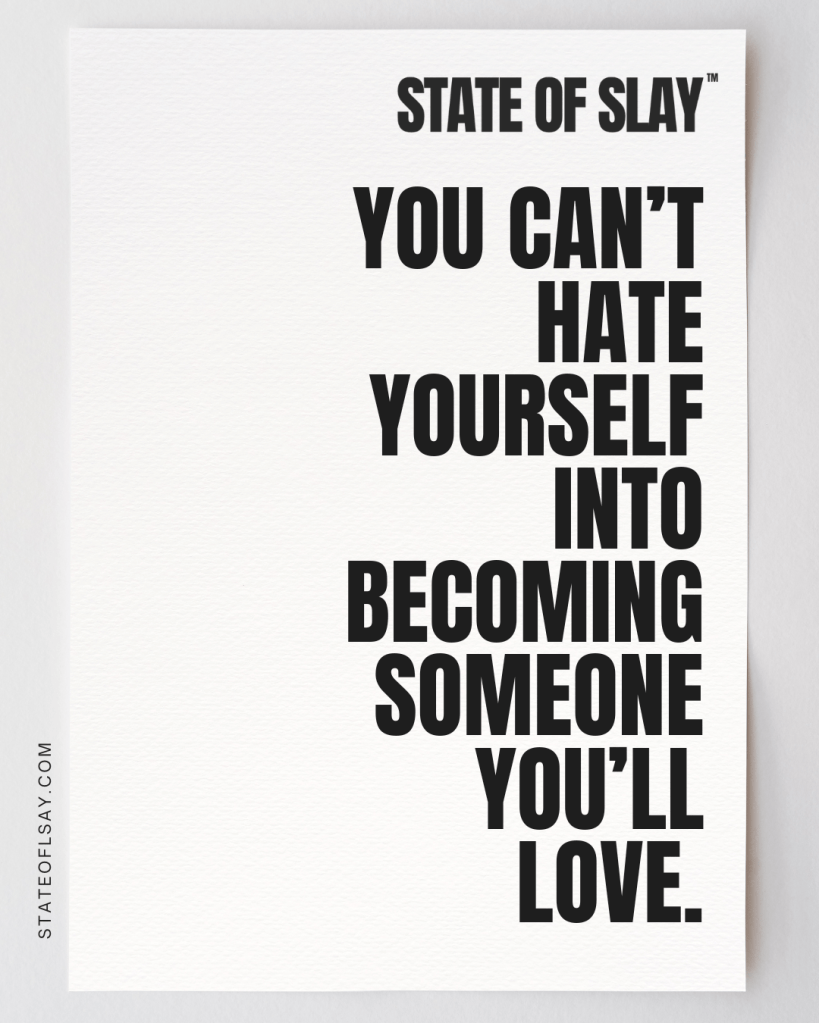
It means refusing to use them as weapons against yourself forever.
There is a difference between saying, I need to change this, and saying, There is something wrong with me.
One creates possibility.
The other turns growth into punishment.
You are allowed to want more for yourself without despising who you are today.
You can work on your habits without hating the person who developed them.
You can regret a decision without turning that regret into an identity.
You can recognize where you’ve fallen short while still believing you are worthy of patience, care, and another chance.
Because the person you’re trying so hard to become is still going to be you.
And if every step toward that person is fueled by rejection, there will always be another flaw to find, another standard to miss, another reason to postpone loving yourself.
Maybe the goal isn’t to finally become good enough to deserve your own love.
Maybe part of becoming who you want to be is learning to stop withholding it.
This is your reminder:
You don’t have to love everything about yourself to stop treating yourself like someone you’re trying to defeat.
It can remind us to notice what is good instead of constantly focusing on what is missing.
It can bring perspective.
It can help us recognize how much we have, how far we’ve come, and how many people and experiences have contributed to our lives.
But somewhere along the way, many of us learned to turn gratitude into a contract.
If we’re grateful for something, we think we’re supposed to keep wanting it.
If something has been good to us, we’re supposed to remain loyal to it.
If someone gave us an opportunity, we’re supposed to stay.
If a relationship once made us happy, questioning it can feel like a betrayal of everything it gave us.
And if our life looks good from the outside, wanting something different can feel almost embarrassingly ungrateful.
So we start arguing with our own desires.
What more could I possibly want?
Maybe that’s the wrong question.
Because gratitude tells you how you feel about what you’ve received.
It doesn’t necessarily tell you what you want next.
Prefer to listen? The Audio Blog version is available here.
GRATITUDE IS NOT A CONTRACT
Being grateful for something does not obligate you to keep choosing it forever.
You can be grateful for a job that gave you stability when you desperately needed it and eventually realize you want to do something else.
You can appreciate a friendship that carried you through a difficult period and recognize that the relationship has changed.
You can love the home where you built years of memories and still decide it’s time to move.
You can appreciate what someone has done for you without owing them permanent access to your life.
Gratitude acknowledges what something has meant to you.
It doesn’t sign away your right to change.
Sometimes we confuse appreciation with obligation because leaving feels as though we’re declaring that what came before wasn’t good enough.
But that’s not what change means.
Something can have been wonderful.
And you can still be finished with it.
DIFFERENT DOESN’T ALWAYS MEAN BETTER
We often talk about change as though we’re trying to upgrade our lives.
A better job.
A better relationship.
A better home.
A better version of ourselves.
But what if you don’t want better?
What if you simply want different?
That’s an important distinction.
You don’t have to prove that your current life is terrible before you’re allowed to imagine another one.
You don’t have to turn your job into the villain of the story before you’re allowed to leave it.
You don’t have to compile a list of someone’s faults to justify changing the relationship.
You don’t have to discover something wrong with where you are before you can become curious about somewhere else.
Sometimes change isn’t an indictment.
It’s movement.
And sometimes the pressure to prove that the next thing will be better is exactly what keeps us from exploring what might simply be more appropriate for who we are now.
A GOOD THING CAN STILL HAVE AN ENDING
This can be one of the hardest truths to accept.
We’re comfortable leaving things that are obviously bad for us.
At least then we have a reason.
But what about something that was good?
Something that worked?
Something we loved?
We tend to believe good things should continue indefinitely.
So when we begin wanting something different, we search for a problem to explain it.
Maybe nothing went wrong.
Maybe nothing needs to.
Not every ending is evidence of failure.
Some experiences belong to a particular period of our lives.
They give us something.
We give something to them.
And eventually the relationship between who we are and what they provide changes.
We don’t have to rewrite the past to make leaving the present acceptable.
WANTING MORE DOESN’T MEAN YOU HAVE LESS
There is a strange guilt that can come with wanting.
Especially when you know you’re fortunate.
You look around and see things you once hoped for.
Things other people would love to have.
Things you’ve worked hard to create.
And then another desire appears.
Immediately, we can begin policing ourselves.
Shouldn’t this be enough?
Enough is a complicated word.
Because something can be enough and still not be everything you want.
You can have enough love and still want more connection.
You can have enough success and still want a different challenge.
You can have enough security and still crave adventure.
You can have enough stability and still feel curious about change.
Wanting something else doesn’t erase what is already there.
Desire isn’t always evidence of dissatisfaction.
Sometimes it’s information.
BE CAREFUL WHEN GRATITUDE BECOMES GUILT
Gratitude says:
I appreciate this.
Guilt says:
Because I appreciate this, I’m not allowed to leave.
Those are very different things.
Guilt can make us stay long after our desire has gone quiet.
We think about the person who gave us our first chance.
The partner who stood beside us during a difficult time.
The friend who was there when nobody else was.
The family member who sacrificed for us.
And those things matter.
But gratitude becomes unhealthy when it requires you to build the rest of your life around repayment.
You can appreciate what someone gave you without handing them ownership of what comes next.
You can honor someone’s place in your story without giving them control over the remaining chapters.
SOMETIMES THE LIFE YOU WANTED STOPS FITTING
There are things we work incredibly hard to get.
And then we get them.
That can make changing our minds particularly difficult.
Because now we’re not only leaving something behind.
We’re confronting the person we once were who wanted it so badly.
You may have spent years building a career you no longer want.
You may have fought hard for a relationship that no longer feels right.
You may have sacrificed to create a lifestyle that now feels restrictive.
And part of you may think:
After everything I did to get here, how can I possibly walk away?
But your past desire doesn’t get permanent authority over your future.
You made choices based on who you were, what you knew, and what you needed at the time.
You are allowed to receive what you once wanted and eventually discover something about yourself you couldn’t have known before you had it.
That’s not ingratitude.
That’s new information.
YOU DON’T HAVE TO MAKE THE PAST WRONG
Sometimes we make change unnecessarily painful because we think we need to justify it.
So we start editing the story.
We focus on everything that wasn’t perfect.
We magnify frustrations.
We search for reasons something wasn’t actually as good as we thought.
We make people wrong so leaving them feels easier.
But what if you didn’t have to do that?
What if you could say:
That mattered to me.
That was good for me.
I’m glad I experienced it.
And I don’t want it anymore.
There is something freeing about allowing the past to remain good.
You don’t have to destroy your memories to earn permission to create new ones.
GRATITUDE LOOKS BACK. CHOICE LOOKS FORWARD.
Maybe this is the distinction we forget.
Gratitude asks:
What has this given me?
Choice asks:
What do I want from here?
One question doesn’t answer the other.
You can look backward with enormous appreciation while looking forward with completely different desires.
In fact, sometimes gratitude makes change easier because you no longer need to leave angry.
You don’t have to slam the door.
You don’t have to convince yourself that everything was terrible.
You don’t have to carry resentment into whatever comes next.
You can acknowledge what was good.
Take what you learned.
Keep what mattered.
And still go.
YOU ARE ALLOWED TO WANT SOMETHING DIFFERENT
Maybe your life is good.
Maybe there isn’t a dramatic problem to solve.
Maybe nobody did anything wrong.
Maybe you’re not unhappy.
Maybe you simply feel something changing inside you.
We often wait for unhappiness to give us permission to change.
But curiosity can be a reason too.
Growth can be a reason.
A shifting priority can be a reason.
A desire you can’t quite explain can be worth listening to.
You don’t have to immediately act on every feeling or blow up a perfectly good life because you woke up restless on a Tuesday.
But you can listen.
You can get curious.
You can ask yourself what the desire is trying to tell you without immediately shaming yourself for having it.
Because gratitude and desire can occupy the same space.
You can love what was and wonder what’s next.
You can appreciate where you are and imagine somewhere else.
You can be thankful for everything that brought you here without deciding that here is where you must remain.
Sometimes the most respectful thing you can do with a good chapter is let it be good without forcing it to become the entire story.
SLAY REFLECTION
S — SEE WHAT YOU APPRECIATE What in your life are you genuinely grateful for right now?
L — LISTEN TO WHAT YOU WANT Is there something different you’ve been wanting but dismissing because you think you should be satisfied?
A — ASK WHAT’S KEEPING YOU THERE Are you choosing something because you still want it, or because leaving would make you feel guilty or ungrateful?
Y — YOUR NEXT STEP Give yourself permission to explore what you want without requiring yourself to make an immediate decision. Sometimes acknowledging the desire is the first step.
CALL TO ACTION: JOIN THE CONVERSATION
I’d love to hear from you.
Have you ever felt guilty for wanting something different because what you already had was good?
Did you stay because you thought being grateful meant you weren’t allowed to change your mind?
Share your thoughts in the comments. Your experience may help someone else realize they don’t have to make something bad before they’re allowed to choose something different.
And if you know someone who is struggling with wanting change in a life they are genuinely grateful for, send this to them.