
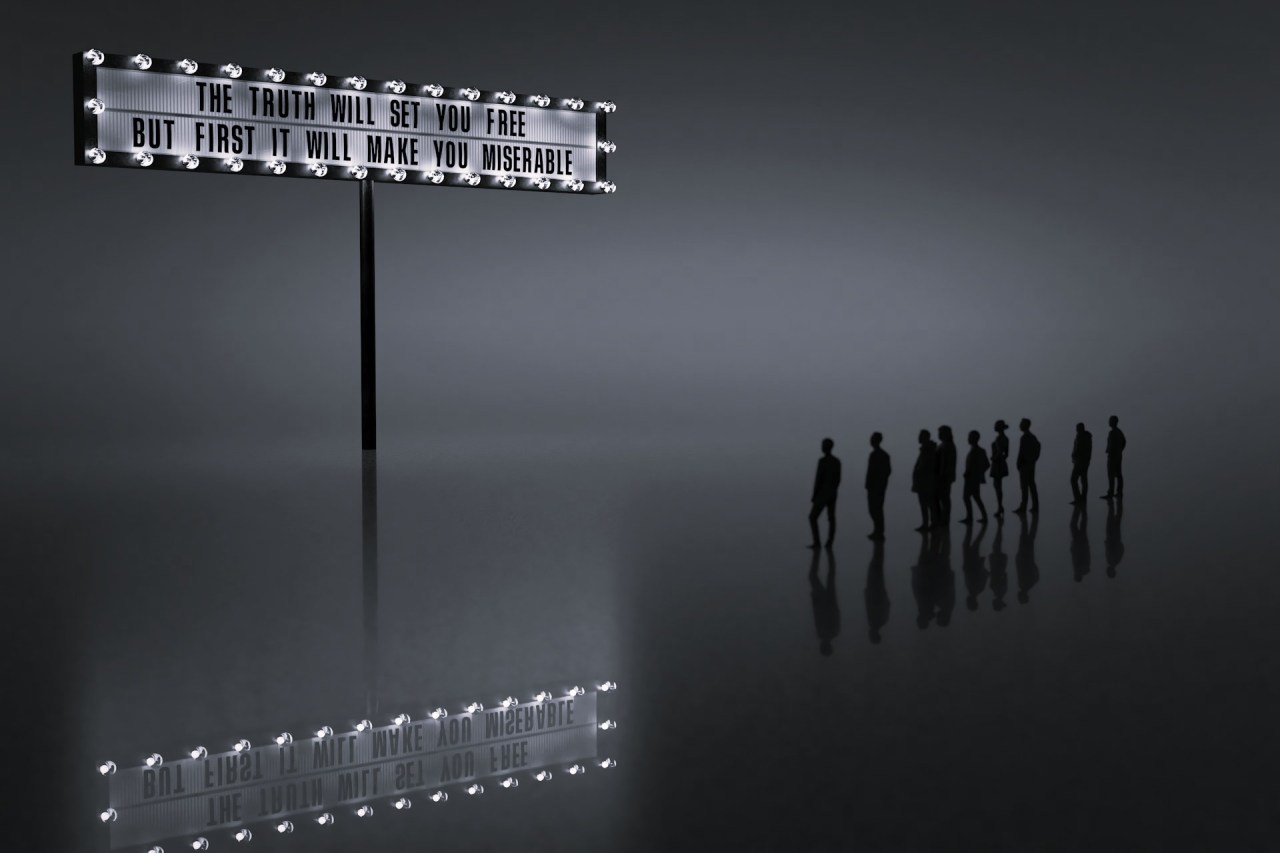
The Hardest Truth Is Usually the Right One

There is a reason we resist certain truths.

Not because they are false.

Because they are uncomfortable.

The truths that challenge us rarely arrive with a sense of relief.

They arrive with friction.

They ask us to let go of something.

A belief.

An expectation.

A relationship.

A version of ourselves.

And because of that, our first instinct is often not acceptance.

It is negotiation.

We argue with what we already know.

We search for different answers.

We look for evidence that supports the outcome we want instead of the reality we have.

But life has a way of bringing us back to the truth.

Again.

And again.

And again.

Until we are finally willing to face it.

The hardest truth is usually the right one.


Prefer to listen? The Audio Blog version is available here.


WE OFTEN KNOW LONG BEFORE WE ADMIT IT

One of the strangest things about being human is how often we already know.

We know when something feels off.

We know when a relationship has changed.

We know when we have outgrown a situation.

We know when a dream no longer fits.

We know when someone is showing us exactly who they are.

Yet we hesitate.

Not because we lack awareness.

Because awareness often demands action.

And action can be frightening.

So we stay.

We wait.

We hope.

We explain.

We rationalize.

All while quietly knowing.


WISHFUL THINKING CAN BE A POWERFUL DISTRACTION

Sometimes the greatest obstacle to clarity is not confusion.

It is hope placed in the wrong place.

Hope that someone will change.

Hope that circumstances will improve on their own.

Hope that if we wait long enough, reality will become something different.

Hope is beautiful when it inspires growth.

But hope can become dangerous when it prevents us from seeing what is already true.

There is a difference between believing in possibility and refusing to acknowledge reality.

The first creates progress.

The second creates suffering.


THE TRUTH USUALLY WHISPERS FIRST

Life rarely starts by shouting.

It starts with a whisper.

A feeling.

A hesitation.

A recurring thought.

A concern you cannot quite shake.

A quiet voice that says, “Pay attention.”

Most of us have experienced this.

That moment when something did not sit right.

That feeling in the pit of your stomach.

That persistent awareness that something was not adding up.

The problem is not that we fail to hear the whisper.

The problem is that we often spend too much time convincing ourselves to ignore it.


DENIAL FEELS SAFER THAN CHANGE

There is a reason people stay in situations they know are not working.

The familiar feels safer than the unknown.

Even when the familiar hurts.

Even when the familiar limits us.

Even when the familiar keeps us stuck.

Accepting a difficult truth often means stepping into uncertainty.

And uncertainty can be terrifying.

At least with denial, we know what tomorrow looks like.

But comfort and growth rarely occupy the same space.


I LEARNED THAT RESISTANCE IS A CLUE

For years, I thought resistance meant I was headed in the wrong direction.

Now I often see it differently.

Resistance is frequently a clue.

Not that something is wrong.

That something matters.

When we find ourselves defending a belief, excusing behavior, or repeatedly avoiding a reality, it is worth asking why.

What are we afraid will happen if we accept the truth?

What are we protecting?

What are we refusing to let go of?

Those questions often reveal more than the situation itself.


THE COST OF AVOIDING THE TRUTH IS HIGHER THAN THE TRUTH ITSELF

Most people focus on how painful the truth will be.

What they rarely consider is the cost of avoiding it.

Avoiding the truth steals time.

It drains energy.

It delays healing.

It keeps us attached to situations that no longer serve us.

The truth may hurt.

But avoidance creates its own kind of pain.

A slower pain.

A lingering pain.

A pain that grows every day we refuse to face what we already know.


CLARITY OFTEN FEELS LIKE LOSS BEFORE IT FEELS LIKE FREEDOM

This is where many people get stuck.

The moment they finally see clearly, they feel grief.

They lose the fantasy.

They lose the expectation.

They lose the future they imagined.

And that loss is real.

But what comes after is equally real.

Freedom.

Freedom from confusion.

Freedom from pretending.

Freedom from carrying the weight of uncertainty.

Clarity can feel painful in the beginning because it asks us to release what was never actually ours.


SELF-TRUST IS BUILT THROUGH HONESTY

Every time you acknowledge a difficult truth, you strengthen your relationship with yourself.

You prove that you are willing to listen.

You prove that you are willing to see clearly.

You prove that your intuition matters.

Self-trust is not built by always being right.

It is built by being honest.

Especially when honesty is uncomfortable.


THE RIGHT TRUTH WILL SET YOU FREE

Not immediately.

Not dramatically.

Not without emotion.

But eventually.

The right truth may break your heart.

It may challenge your plans.

It may force you to reconsider everything you thought you knew.

But it also creates space.

Space for growth.

Space for healing.

Space for something better aligned with who you are becoming.

That is why the hardest truth is often the right one.

Not because it is easy.

Because it leads somewhere worth going.


STOP NEGOTIATING WITH WHAT YOU ALREADY KNOW

If there is something you have been avoiding, consider this your invitation.

Not to judge yourself.

Not to force an answer.

But to listen.

To stop looking for a different truth.

To stop waiting for reality to become more convenient.

To stop negotiating with what you already know.

Because the truth you are resisting may be the very thing trying to set you free.

And the sooner you face it, the sooner your life can begin moving forward again.


SLAY REFLECTION

S — See the Truth
What reality have you been avoiding or negotiating with?

L — Look at the Resistance
What makes accepting that truth feel difficult?

A — Acknowledge the Cost
How has avoiding it affected your peace, energy, or growth?

Y — Your Next Step
What is one honest step you can take toward acceptance today?


CALL TO ACTION: JOIN THE CONVERSATION

I’d love to hear from you.

Have you ever discovered that the truth you resisted most was the one you needed most?

Share your story in the comments. Let’s cheer each other on.

And if you know someone who might need this reminder, send this to them.

Sometimes, all we need is a nudge.

Your Story Does Not Need Special Effects

Somewhere along the way, many of us began to believe that the truth was not enough.

Not enough attention.

Not enough admiration.

Not enough sympathy.

Not enough significance.

So we started adding special effects to our stories.

Sometimes it is a small exaggeration.

Sometimes it is a carefully edited version of events.

Sometimes it is a detail that gets stretched a little further each time it is told.

And sometimes it becomes something much bigger.

A false achievement.

An embellished hardship.

A narrative supported by evidence that is not entirely honest.

The strange thing is that most people do not do this to fool others.

They do it because somewhere deep down, they have started to believe that who they really are is not enough.

That their actual story needs help.

That the truth needs embellishment.

But the truth has a power that performance will never have.

And the moment you stop trusting your own story is the moment you begin losing touch with yourself.


Prefer to listen? The Audio Blog version is available here.


THE TRUTH DOES NOT NEED DECORATION

Authenticity has become a buzzword.

Everyone talks about it.

Everyone claims to value it.

But authenticity is often tested the moment the truth feels ordinary.

The moment the real story is less dramatic.

Less impressive.

Less likely to attract attention.

That is when integrity matters.

Because integrity is not about telling the truth when it benefits you.

It is about telling the truth when embellishment would make you look better.


WE LIVE IN A WORLD THAT REWARDS PERFORMANCE

Social media did not create this problem.

But it certainly amplified it.

Every day, we see curated versions of people’s lives.

Achievements.

Milestones.

Victories.

Moments designed to capture attention.

Over time, it becomes easy to believe that significance comes from standing out.

From having the most extraordinary story.

The most dramatic experience.

The most impressive accomplishment.

But significance and spectacle are not the same thing.

And one should never be confused with the other.


THE NEED TO EMBELLISH OFTEN COMES FROM INSECURITY

This is the part people rarely talk about.

Most exaggeration is not rooted in confidence.

It is rooted in doubt.

Doubt that the truth is enough.

Doubt that people will care.

Doubt that ordinary experiences have value.

So people begin adding layers.

Making things bigger.

More mysterious.

More impressive.

More tragic.

More remarkable.

Not because the truth lacks value.

Because they have forgotten its value.


THE COST OF A FALSE NARRATIVE

At first, embellishment may seem harmless.

A detail here.

An exaggeration there.

A slightly improved version of events.

But over time, something begins to happen.

The story becomes harder to maintain.

The gap between reality and presentation grows wider.

And eventually, the person telling the story has to keep serving the narrative instead of living the truth.

That is an exhausting way to live.

Because every false layer creates distance.

Distance from others.

Distance from reality.

And most importantly, distance from yourself.


THE MOST INTERESTING PEOPLE ARE OFTEN THE MOST HONEST

Think about the people you genuinely admire.

Not the ones who impress you.

The ones you trust.

The ones whose words carry weight.

The ones who feel real.

Chances are, what makes them compelling is not perfection.

It is honesty.

Their willingness to tell the truth.

Even when it makes them look vulnerable.

Even when it makes them look human.

Especially then.


YOUR STORY HAS VALUE WITHOUT EMBELLISHMENT

One of the greatest lies many people carry is the belief that their life is too ordinary.

Too simple.

Too unremarkable.

But every person carries experiences that shaped them.

Lessons that changed them.

Moments that challenged them.

Stories that matter.

You do not need extraordinary circumstances to have a meaningful life.

You only need the courage to own the life you have actually lived.


INTEGRITY IS AN INSIDE JOB

Integrity is not about public image.

It is not about reputation.

It is not about convincing other people that you are honest.

It is about knowing that the person you present to the world matches the person you are when no one is watching.

That alignment creates peace.

Because there is nothing to defend.

Nothing to maintain.

Nothing to remember.

Just the truth.


THE REAL STORY IS ENOUGH

The older I get, the more I appreciate honesty.

Not perfection.

Not performance.

Not spectacle.

Honesty.

The person who admits they do not know.

The person who shares what really happened.

The person who resists the temptation to make the story bigger than it was.

There is something deeply powerful about that.

Because the truth does not need special effects.

It does not need dramatic lighting.

It does not need a better ending.

It does not need embellishment.

It simply needs the courage to be told.


TRUST THE STORY THAT IS REAL

If you find yourself tempted to exaggerate, impress, or enhance the narrative, pause for a moment.

Ask yourself why.

Not with judgment.

With curiosity.

Because underneath that impulse may be a belief that deserves examination.

A belief that says your real story is not enough.

But it is.

Your life does not need embellishment to have meaning.

Your experiences do not need exaggeration to matter.

Your truth does not need special effects to be powerful.

The real story is enough.

And so are you.

SLAY on.


SLAY REFLECTION

S — See the Story
Have you ever felt pressure to make yourself seem more impressive, successful, or interesting than you really felt?

L — Look Beneath the Need
What belief might be driving that desire?

A — Acknowledge the Truth
What part of your real story have you overlooked or undervalued?

Y — Your Next Step
How can you practice greater authenticity in the way you share your experiences?


CALL TO ACTION: JOIN THE CONVERSATION

I’d love to hear from you.

Have you ever discovered that the most powerful version of a story was the honest one?

Share your story in the comments. Let’s cheer each other on.

And if you know someone who might need this reminder, send this to them.

Sometimes, all we need is a nudge.